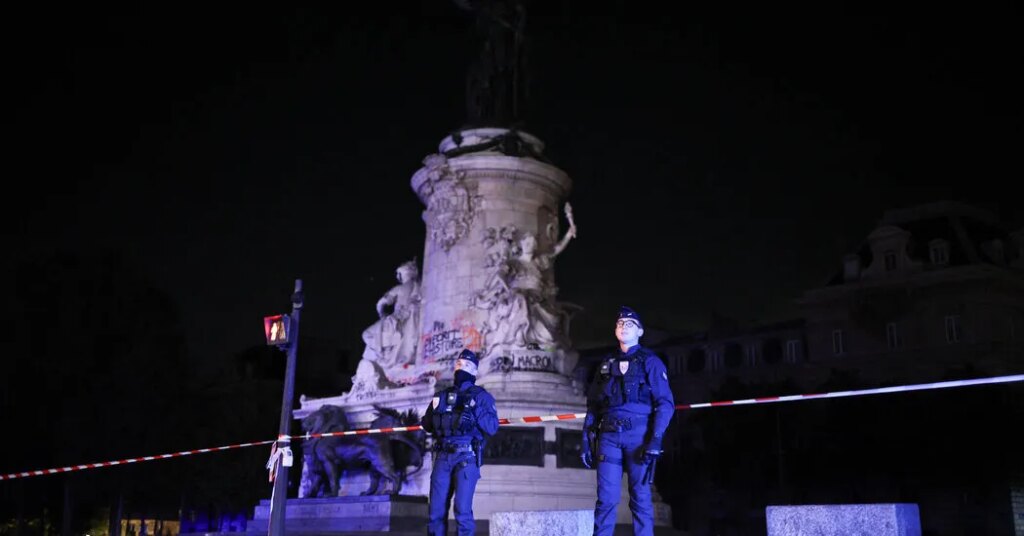
The French authorities banned gatherings in some cities on Thursday and over the coming days, in an attempt to avoid a repeat of the riots that rocked the country last weekend.
President Emmanuel Macron of France said on Thursday that the bans were necessary “so that calm prevails, so that we can protect businesses and so that we can also protect public buildings.”
“The general recommendation is that there should be no protests in the coming days,” Mr. Macron announced after emerging from a security council meeting with the French intelligence services. He said that some protests planned by unions would be permitted, though the authorities would propose alternative protest routes.
Last weekend, riots spun out of huge and largely peaceful demonstrations in cities across France. During the unrest, nearly 1,000 police officers were injured and more than 3,000 shops were looted or damaged, according to the authorities. With more than 2,500 people arrested across the country, French courts were expediting trials. Police investigators were still working to identify other suspects.
Still, the large CGT union and student groups were among those urging further demonstrations and another march on Saturday. Many are calling those protests a “second act” to the rallies last weekend, which numbered more than half a million participants. That has prompted the authorities to move to limit further fallout.
Even before Mr. Macron’s declaration, the authorities in places like Paris and Lille imposed temporary bans on gatherings for Thursday. Other cities, such as Grenoble and Le Mans, put multiday bans in place. Rouen, Toulon and Le Havre banned any protests in their city centers on Saturday.
Mr. Macron on Thursday repeated the government’s assertion that both opportunistic criminals and “ultraleft groups aiming to bring down the Republic” were behind the riots.
In Paris, the police prefecture banned public gatherings, protests and marches in some parts of the city for 12 hours on Thursday starting at 8 a.m. The areas designated as off-limits for demonstrations included around many important government buildings, train stations and tourist sites including the Louvre and the Champs-Élysées.
Members of a student university union called Interfac IDF, which had planned a march in Paris for Thursday, called the decision a “shame” and an act of clear “repression.” In a post on social media, the union vowed to challenge the ban in court.
In the Var department of southern France, which includes the city of Toulon, the authorities also implemented other restrictions. They banned people from wearing face coverings and protective clothing, and from buying or selling fireworks from Wednesday night until Monday.
The post In Wake of Riots, French Authorities Ban Some Protests appeared first on New York Times.