“No man is an island,” John Donne insisted. Whether you buy into the poet’s touchy-feely metaphysics or not, he makes one valid point: For better and often for worse, it’s near impossible to avoid the rest of humanity.
Or, for that matter, humanity’s influence on even our most private thinking — a dynamic plainly on the minds of many a D.C. creative this fall. In a quartet of biodramas playing out on stages across the city, actors and actor-creators are excavating the inner lives — and poking around the romantic and domestic affairs, too — of writers and painters and poets and singers. They’re assessing both their interiorities and their intimate relationships, looking for where individual creativity ends and shared perspective-shaping begins.
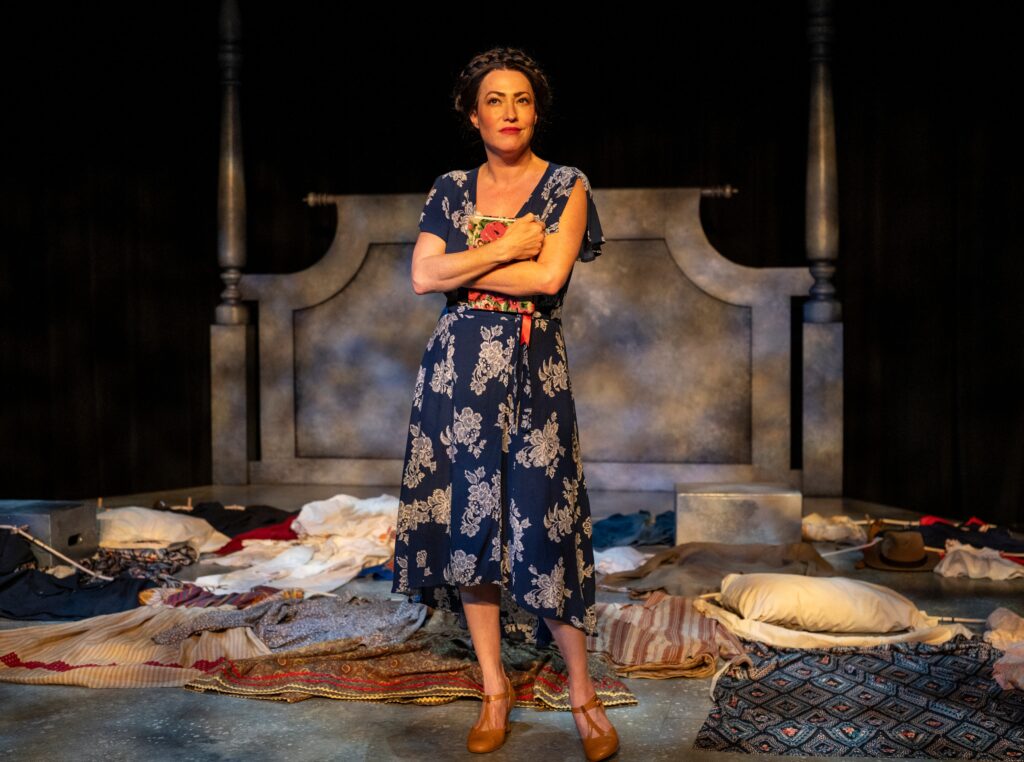
The boldest and richest examples is “Frida … A Self Portrait” at Shakespeare Theatre Company. There’s been no shortage of ink spilled on Mexican painter Frida Kahlo’s volatile entanglement with the muralist Diego Rivera — not least by the lady herself, who emblazoned her paramour’s face on her own forehead in one provocative self-portrait. What writer-actor Vanessa Severo brings to the inquiry is a deep fascination with injuries and what the unkind call imperfections, not to mention a quicksilver dynamism and the visual panache to do justice to a surrealist provocateur once described as “a ribbon around a bomb.”
“Am I everything you heard?” asks Severo’s angular, animated Frida. She’s being interviewed late in life, high on morphine and sprawled across a convalescent bed, by an architecture writer who’s apparently more interested in her family home than in her work, and she’s having none of it.
We’re not six pages into Severo’s script, in fact, before her heroine has veered off talk of La Casa Azul to chronicle first her childhood bout with polio and then the horrific bus accident that left her skeleton shattered and her torso impaled. In the same stretch, Severo herself interrupts Kahlo’s narrative to draw a parallel to her own experience as a 4-year-old with a surgeon intent on “correcting” a congenital condition. The solution? Removing several of her toes and grafting them onto her underdeveloped left hand.
This is all before anyone mentions Rivera. That partner’s own bruising stamp — the shameless philandering, the affairs Kahlo pursued in retribution — will impose itself soon enough, though, as Kahlo chronicles their split and remarriage and the multiple miscarriages she suffered. These moments — like other intense stretches in this story — are sketched out wordlessly.
It’s not quite dance, what Severo does as she moves among and into and out of the various coats and dresses and swaths of fabric suspended from a trio of stage-spanning clotheslines. But it communicates in the same heightened key. And it’s a fascinating meditation on the pressures one artist can exert on another: Rivera on Kahlo, Kahlo on Severo, Severo in turn on the “Frida” and the “Diego” of her imagination — what they mean to each other and what their work means to them and her and us.
Through Nov. 8 at Shakespeare Theatre Company’s Klein Theatre, 450 Seventh St. NW. About 1 hour 15 minutes. shakespearetheatre.org.
Here are reviews of three more productions now on D.C. stages:
‘The Flying Lovers of Vitebsk’
For the painter Marc Chagall and his writer wife, Bella, relationship stressors involved not domestic betrayals but the Russian Revolution and the rise of the Bolsheviks (with czarist-era pogroms and Hitler’s rise not far behind).
“The Flying Lovers of Vitebsk,” staged at Theater J by artistic director Hayley Finn, reflects and refracts those events and their implications for the couple using an onstage musical duo and a pair of aerialists. If Daniel Jamieson’s extra-dramatic conceit sounds like a bit much, it’s handsomely executed here.
Dani Stoller’s remarkable physical precision helps make her Bella Chagall a distinct and compelling personality of her own, not just a helpmeet and emotional supporter for her Great Artist. The clarity of her performance also, alas, can make Jamie Smithson’s relatively loose Marc Chagall seem a little unfocused, even clumsy.
That’s apt enough in its way for a man whose devotion to his wife apparently found its way into his art more easily than it did into their home life. (The play shows him ignoring the birth of a daughter during a multiday stretch immured in his studio.) But it shifts the emotional stakes in a way the creative team may not entirely have intended.
Still, “Flying Lovers” is brisk enough to go down easily. It’s also perceptive enough to highlight questions about how it feels when one talent eclipses another, even when the other is devoted to helping maintain the myth.
Through Nov. 1 at Theater J, 1529 16th St. NW. About 1 hour 30 minutes. edcjcc.org.
‘Hundred Days’
Keegan Theatre’s “Hundred Days” — another quick, music-drenched one-act — dramatizes a wild and whirlwind courtship between Shaun (Bradley Foster Smith) and Abigail (Kylie Clare Truby), who front a real-life folk-punk band called the Bengsons. The hook is that Abigail, who’s tormented by a never-quite-explained family catastrophe from her teens, also carries the burden of a childhood premonition that she would meet — and lose — the love of her life within the titular span of time.
How to overcome the trauma of those two memories and make a meet-cute relationship work for the long run? “Live in the moment” is basically his answer when she panics about the possibility: Jump in with both feet, never lose focus, and commit to making each passing second memorable.
Which: Sure, as far as it goes, though that’s got to be exhausting. Doesn’t matter, because “Hundred Days” is as much a concert as a prescription for mindful living, and the nine-piece ensemble Christina A. Coakley and Lucia LaNave have assembled makes an infectious and largely joyful noise (even when the songs are about doubt and fear). Smith and Truby make the Bengsons a warm and agreeable pair of oddballs, well worth accompanying for an evening.
Through Nov. 8 at Keegan Theatre, 1742 Church St. NW. About 1 hour 15 minutes. keegantheatre.com.
‘Woody Sez’
Freshly upholstered for election season, “Woody Sez: The Life & Music of Woody Guthrie” returns to D.C. as politically pointed and richly human as ever. Once again, co-creator David M. Lutken spins tales and songs of Dust Bowl deprivation and Depression-era indignity as the troubadour of the title.
Lutken won a Helen Hayes Award for his 2012 staging of this rousing, sobering evening, and the fresh castmates he’s brought along for this fleshed-out version at Dupont Underground frame a performance as vital and wise as before. Guthrie’s life story, for newcomers, may be an eye-opener; his musical catalogue remains a vital document of the American Dream — and its discontents.
Through Sunday at Dupont Underground, 19 Dupont Circle NW. About 2 hours. dupontunderground.org.
The post Step inside the minds of Frida Kahlo and Woody Guthrie at these D.C. stages appeared first on Washington Post.