What if you could make your favorite desserts more nutritious — without changing any of the ingredients?
Many of the most popular desserts, like cake, cookies, ice cream and pie, tend to be loaded with fat, sugar, white flour and other not-so healthy ingredients. Healthy ingredients like nuts and fresh fruit are often just a garnish or topping.
But what would happen if that ratio were flipped around? Would you still enjoy your dessert?
Researchers set out to find out by designing an experiment in which people were offered different desserts: a big slice of cake with a garnish of fruit, or a small slice of cake with a heaping portion of nuts, berries and other fruit.
To their surprise, the researchers found that people actually preferred the desserts that were mostly fresh fruit.
The findings, published in the Journal of Food Science, challenge assumptions people often have about desserts. While many of us assume that the best desserts are necessarily unhealthy — loaded with butter, sugar and preservatives — the reality is you can make dessert more enjoyable and nutritious by loading it with nuts and fruit.
“I’m a huge dessert lover,” said Amalie Kurzer, a graduate student in the food science and technology department at the University of California at Davis, who was the lead author of the study. “But you can make a delicious dessert that has a lot of fruit, and it will be better for you.”
Why ‘the dessert flip’ is good for you
Kurzer and her colleagues call this strategy “the dessert flip,” because it flips the proportion of ingredients in conventional desserts.
This strategy has been tried in other research, as well. Americans tend to eat a lot of meat and not very many vegetables. So, researchers have carried out studies that looked at the best ways to partially replace meat and chicken in some meals with vegetables and other plant-based ingredients — for example, by replacing some of the ground beef in hamburger patties and meat sauces with savory plants like mushrooms and lentils.
Most Americans don’t eat enough fruits and vegetables. Studies show that only about 12 percent of Americans eat at least 1½ to two cups of fruit daily, the amount recommended by the federal government’s dietary guidelines. Meanwhile, just 10 percent of Americans eat the recommended two to three cups of vegetables daily.
“We are seeing health consequences as a result,” Kurzer said. “Rates of colorectal cancer are higher and there are a lot of chronic diseases that have an inverse relationship with how many fruits and vegetables you eat.”
If we could get people to eat healthier and enjoy it, she added, “that would be the best of both worlds.”
So Kurzer and her colleagues set up an experiment in a dining hall at UC-Davis and recruited 118 people, mostly college and graduate students.
Over a period of several weeks, the participants simply had to show up to the dining hall and eat different meals — followed by dessert — that were prepared by chefs. Then the participants rated the food, and the researchers examined their plates to determine how much they ate and how much they discarded.
Why people prefer ‘flipped’ desserts
The researchers created three scenarios. In the first, participants were given a slice of vanilla cake with a small side of berries and nuts. This first option was 80 percent cake by weight and 20 percent fruit and nuts.
On other occasions, the participants were given what the researchers called a “stealth” option, which was a slice of cake that had peach puree inside of it. This dessert was 55 percent cake by weight and 45 percent fruit. Kurzer compared it to a parent mixing or “hiding” vegetables in their son or daughter’s pasta, meatballs, sauces and other foods.
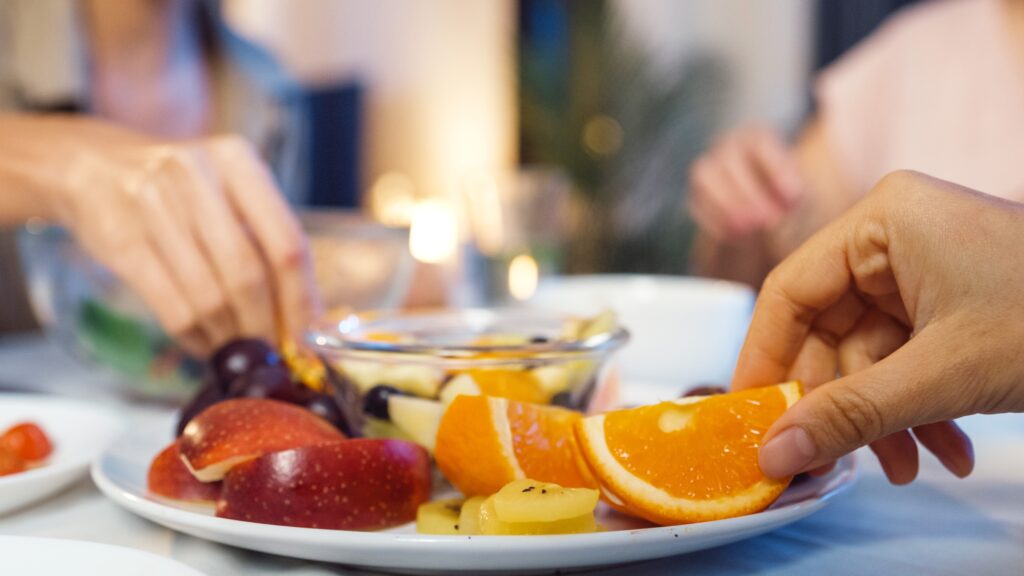
Lastly, on some occasions, the participants were given a “flipped” dessert that was 20 percent cake by weight and 80 percent fruit and nuts — a thin slice of vanilla cake with a heaping side of chopped strawberries, blueberries, raspberries, blackberries and sliced almonds.
Ultimately, the participants liked the conventional dessert as much as the “stealth” dessert with peach puree “hidden” inside.
But they liked the “flipped” dessert — the one that was mostly fruit and nuts — much more, rating it higher than the other options.
Kurzer said it appeared that people preferred the “flipped” dessert because it was more interesting, with a variety of flavors, colors and textures, as well as some crunchiness from the nuts.
She said that when people were served a big slice of cake, they often wouldn’t eat it all.
“I got to see what people threw away,” she said. “People would just get tired of their cake. They would eat a little and then be like, ‘Yeah, I’m done.’ As humans, we crave variety in our diets. So, a big piece of cake gets boring fast, especially if it’s a cake that you know is not necessarily good for you.”
How to ‘flip’ your favorite desserts
If you’re making dessert at home, you can make it healthier by looking for ways to add fruit.
Instead of having a large slice of cake or pie, consider having a smaller serving along a big side of fruit, Kurzer said. Instead of having a large bowl of ice cream, consider having a smaller portion of ice cream and topping it with nuts and fruit.
Interestingly, as part of the study, the researchers looked into which fruits are best suited for dessert. They found that people preferred eating mangoes and berries for dessert over other fruits.
Kurzer said it isn’t realistic to tell people not to eat dessert, so this strategy can help you focus more on moderation.
You’re still having dessert, she added, “You’re just having the new and improved version of it.”
Do you have a question about healthy eating? Email [email protected] and we may answer your question in a future column.
The post The science of ‘dessert flipping’ — and how it can help you eat healthier appeared first on Washington Post.