Kazuo Ishiguro’s novel “Klara and the Sun” (2021) is told from the perspective of a store-bought android who doesn’t always comprehend the intricacies of human feelings. By contrast, the movie version, directed by Taika Waititi, from a script by him and Dahvi Waller, is determined to let no emotional button go unpushed. The lacquer of whimsy isn’t as heinously misapplied as it was in “Jojo Rabbit” (2019), but there is a sense that the filmmaker has adopted his protagonist’s winsome outlook as his own — and, in doing so, rendered the material incoherent.
In Waititi’s telling, which makes significant alterations from Ishiguro’s, Klara (Jenna Ortega, exuding effort) is a bit of misfit toy. Her eccentric habit of standing on one leg at rest, flamingo-style, mystifies her fellow robots at the Friend Store. In truth, she is no weirder than the store’s manager, played by Natasha Lyonne, who, despite a hideous fun-house coif, brings a hint of recognizable world-weariness to the part. The early scenes show promise, as Klara and her robot colleagues model in the store window to Lesley Gore’s “Sunshine, Lollipops and Rainbows.” Klara struggles to understand the people milling around outside and hopes to be found by her forever owner.
She eventually goes home with the teenage Josie (Mia Tharia) but faces the unrelenting disapproval of Josie’s mother (Amy Adams), Chrissy, an interior decorator — or rather, specialist in “spatial guidance.” At one point, Chrissy even tries to drown Klara, who does not breathe, in a scene that yields a rare funny moment in this saccharine, yet oddly humorless, film.
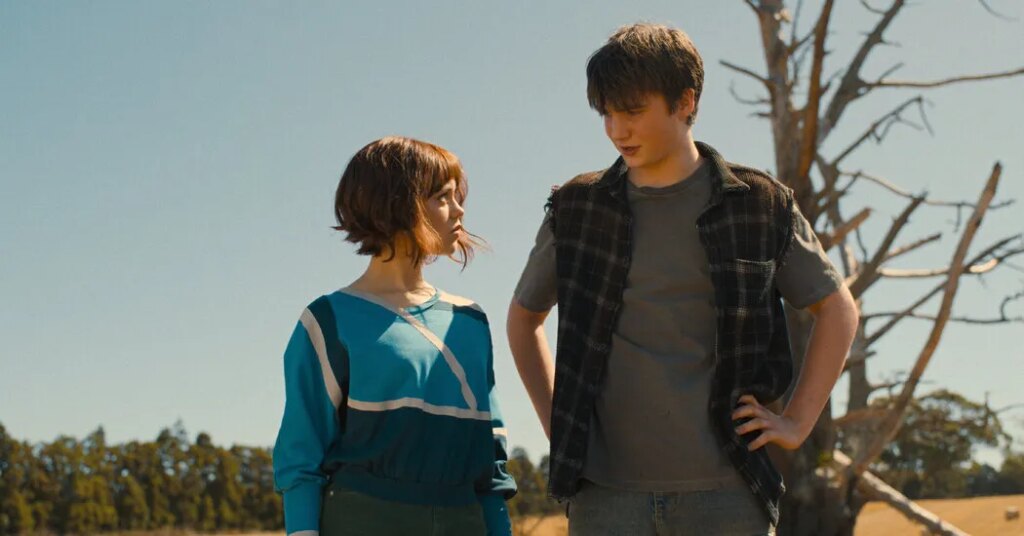
The movie is set well in the future — the internet was taken away, Lyonne’s character explains, after World War III — in an unplaceable locale. (The film was shot in Waititi’s native New Zealand.) Josie, who is chronically ill, lives in a secluded, wheat-filled farm region, where she hangs out with a love interest (Aran Murphy). At ground level, the city scenes evoke Tokyo, but the skyline has a touch of Chicago. The palette is splashy and loud; the asymmetries in the costume and hair designs owe a debt to Tim Burton. In the most demented interlude, we meet Josie’s peers, who seem to have wandered out of an ’80s downtown art scene.
Like them, Josie has been “lifted,” or genetically modified to make her a genius, although her heightened intelligence hasn’t turned her into a cruel, arrogant monster, as it has them. The story flips genre conventions by making Josie better-read than her robot friend, who begins the movie in a state of utter naïveté and in some ways never escapes from it.
There are genuinely disturbing themes in “Klara and the Sun,” which turns on the question of whether humans tend to overrate their own specialness, as a robot scarecrow (Jesse Griffin), who is not in the book, suggests. But Waititi really is an everybody-is-special type of director, inclined toward mawkishness when a philosophical reserve is called for. Even Steven Spielberg, often caricatured as an arm-twisting sentimentalist, went darker when working with similar material in “A.I.” (2001). In this context, sunshine, rainbows and lollipops are no fun.
Klara and the Sun Rated PG-13 for violence against robots. Running time: 1 hour 56 minutes. In theaters.
The post ‘Klara and the Sun’ Review: She’s Not Like the Other Girls appeared first on New York Times.