The mausoleum where Abraham Lincoln wept over the body of his boy is not well tended these days. There are lichen growing on the cornice above its entrance, and the paving stones outside are chipped and broken. The Carroll crypt, where 11-year-old Willie Lincoln was interred after his death from typhoid in 1862, is perched on a steep slope above Rock Creek Parkway, at the utmost far end of Oak Hill Cemetery, down a flight of broken stairs. Some dilapidated chain-link fencing marks the edge of the Georgetown graveyard, where Lincoln is said to have taken his child’s body from its coffin to hold it one last time.
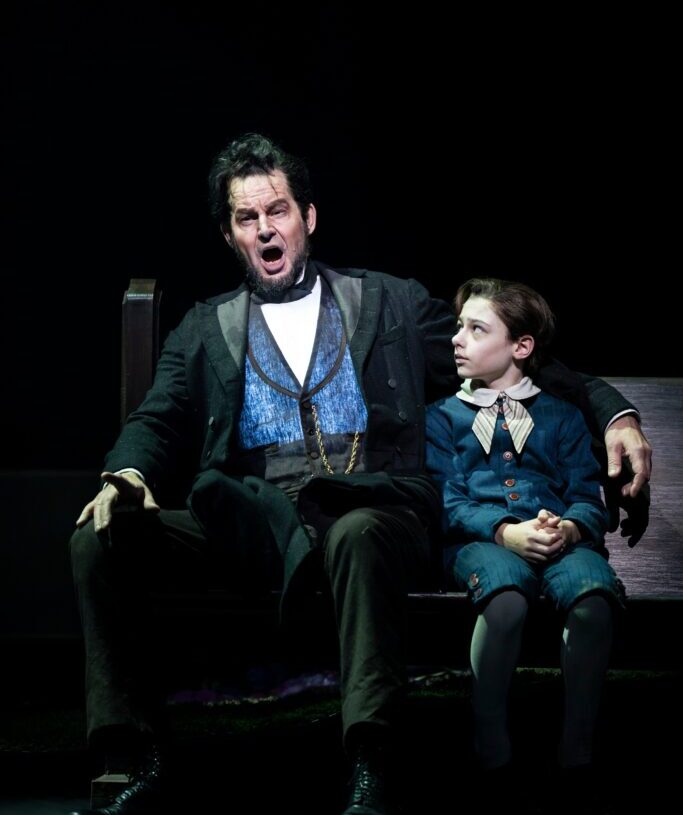
The story of Lincoln’s sorrow at the Carroll-family tomb inspired George Saunders’s 2017 Booker Prize-winning experimental novel “Lincoln in the Bardo,” and now an opera of the same name by composer Missy Mazzoli premiered at the Metropolitan Opera in New York on Monday. Saunders is one of our most poetic writers, and Mazzoli one of the most articulate and imaginative of a new generation of composers (and the first woman to have a world premiere at the Met). The premiere of an opera about social division, and the surreal fluctuations between hope and despair, trauma and redemption that have haunted the American project since it began some 250 years ago, make this one of the most anticipated events in the cultural calendar in years.
On a warm and sunny Labor Day, when Washington was quiet, Saunders and Mazzoli came to Oak Hill to talk about the project. For Saunders, it was an offhand observation from his wife’s cousin, during a drive through the city in the 1990s, that offered the first germ of the project. She mentioned to Saunders that Oak Hill was where Willie Lincoln had been interred while his father served out his first and tragically interrupted second term as president. Saunders didn’t know the story: “I mean, who’s Willie Lincoln?”
But he researched it, and the idea took root, especially an anecdote that is almost Homeric in its condensation of the narrative sweep, the tension between private sorrow and public duty: That on a cold night not long after the boy’s death, with the Civil War raging, Lincoln left the White House on horseback and rode the two miles to Oak Hill to hold his son one last time. It suggested to Saunders a pietà, the classic Christian image of Mary holding the body of Jesus after his crucifixion, and it became the defining image of a novel that he struggled to write for years. It was a return visit to Oak Hill about a decade later that finally decided the author, who had a distinguished career as a writer of short stories, not just to undertake his first full-length novel, but to center it on one of the most storied and mythologized figures in American history.
“I was just standing there, and I thought, this actually happened,” he says. “Lincoln stood right here — and so I thought, you know, if you can’t write that book, you don’t deserve the title [of author].”
In 2018, when the Met approached Mazzoli about writing an opera, she says, Saunders’s novel was the first story that came to mind. The scene that struck her as essentially operatic, the moment that cried out for the layered, dramatically polyphonic possibilities of the art form, wasn’t the image of Lincoln at the tomb. Rather, it was one of the book’s most surreal passages that enticed her — a comic, deranged, otherworldly storm of emotion.
The bardo of the title refers to a Tibetan Buddhist idea of a transitional space between death and rebirth. Saunders imagines it as a terrestrial purgatory where the dead who departed life in the grips of something unresolved, some obsession, wander in limbo. There are drunkards and suicides, abusers and melancholics, all of them not quite able to understand that they are dead, that there is no more accounting to be done, no more entries in the ledger sheet of life. At night, they chatter and gossip, befriend and berate one another, unable to move on and petrified of the transitional moment they call matterlightblooming. Willie Lincoln finds himself stranded in this netherworld because, it seems, of the intense grief of his parents.
At one point in the book’s nocturnal carnival of regrets and recriminations, a storm of spectral energy sweeps through the cemetery, and those stuck in the bardo see multiple versions of people important to them, urging them to move on.
“I just pictured this cascade of people who were entering, and leaving, and singing, and then singing together and then singing by themselves,” Mazzoli says. Her score divides the chorus at several points into smaller ensembles, a quintet of Mary Todd Lincolns who tend to Willie, a half-dozen angels and an ensemble of six Gilberts, the young man who broke the heart of one of the central characters, Roger Bevins iii.
Saunders says he modeled the novel in part on a nonfiction story he researched in California. “I lived in a homeless camp in Fresno for a week,” he says. “Everybody wanted to tell their story. They were all tormented one way or another, and they would also tell you the same story over and over again.” Like the people in Fresno, the homeless shades in the Bardo engage in the same repetition and forgetfulness, indulge the same need to be heard, to understand one’s life by crafting it into a narrative.
Even as Saunders was writing the novel, he imagined it as an opera, but he has taken a hands-off approach to the musical project. Instead Mazzoli adapted the book with her longtime librettist, Royce Vavrek. And the score builds on Mazzoli’s earlier work, her mastery of the orchestra and large-format music drama. Like her 2018 opera “Proving Up,” premiered by the Washington National Opera, the drama takes place in 19th-century America, and it shares with that piece — a haunted tale of homesteading and the occult — an interest in the gothic and supernatural. Mazzoli transplanted the same sense of American phantasmagoria to the present day in another opera a few years later, “The Listeners,” in which deracinated suburbanites in the American Southwest are tortured by “the hum,” a sonic phenomenon felt by some as a painful ringing in the ears, by others as a spiritual emanation.
Unlike 19th-century composers, who used opera to focus emotion into moments of superheated intensity, Mazzoli’s work centers on what the 20th-century literary critic Mikhail Bakhtin called heteroglossia, the multivoiced simultaneity of different modes of speech and dialects. Like the people in Saunders’s homeless camp, the characters in Mazzoli’s operas need to be heard, their voices overlap, they speak not just with but at and over one another. America is the country that can never stop talking, and Americans are defined by a desire to be heard and an inability to listen.
“I think opera’s superpower is in these layers of psychological complexity and layers of material,” she says.
Ambiguity prevails in the music, as well. Frequent harmonic shifts, unexpected turns, vocal lines that begin melodically and then fracture into shards, keep the listener in a state of emotional suspension. In “Lincoln and the Bardo,” she often uses open fifths — an interval missing the central note that defines a chord as either major or minor, happy or sad — to create a sense of emotional uncertainty. And then there are sounds that defy the ear’s powers of discernment, including knitting needles on the metal bars of vibraphone.
“I really love music to play with people’s expectations,” Mazzoli says. “To draw people in with something that is very familiar, whether that’s a very tonal melody, or to make them feel like we’re firmly rooted in a specific key, but then to turn it all on its head by introducing a wrong bass note or a melody that’s in a different key.”
Thus opera, which for centuries followed the clear vectors of tragedy to an inevitable conclusion, becomes a sonic picture of life as it is more commonly felt and experienced: full of change, growth and decay; sudden reversals of fortune; a torrent of unprocessed stuff that is understood only in reflection and memory. Like John Corigliano’s “The Ghosts of Versailles” — another major Met premiere, in 1991, which Mazzoli cites as an inspiration — the central characters are dead, their lives understood in retrospect. The inevitability of classical drama has yielded to something more static but coruscating, and often wildly crude and funny.
A conventional narrative about Lincoln and the death of his son Willie would proceed chronologically, from the first signs of illness in early 1862 to the night of Feb. 5 when he ran a dangerously high fever while Lincoln hosted a party downstairs at the White House, to his death on Feb. 20 and interment at Oak Hill four days later. Perhaps we would hear the pitiful words of his father: “We loved him so much. It is hard, hard to have him die.”
But we don’t hear from Lincoln directly in Saunders’s novel. Rather, Lincoln is inhabited by other ghosts, who report back with varying reliability on his inner thoughts and monologue. The candor of memoir, and its supposed direct access to inner truth, is replaced by the far more problematic material of history. And Lincoln, who experienced Willie’s death with the same sense of bewilderment and confusion with which we experience death in our own lives, becomes an enigma to decipher, interpret and re-create.
In Mazzoli’s opera, Lincoln, performed by a baritone, speaks, or, rather, sings, but the sense of indirectness is given musical form. The final lines of the opera reproduce the haunting final words of the novel, as Lincoln rides back to the White House with the ghost of a 30-year-old formerly enslaved Black man inside him: They ride, as Saunders writes, “forward into the night, past the sleeping houses of our countrymen.”
The cohabitation of spirit and historical figure, the haunting of a man who only slowly found his way to emancipating African Americans held in bondage are represented by two musical lines that are sung together but not in unison. The effect isn’t quite dissonant, but it leaves the impression of an uneasy future.
“That’s the point of the whole novel, and the opera to me was leading to that beautiful shared history,” says Mazzoli, sitting on a bench outside the small gothic chapel where Lincoln attended the final service for Willie. “It’s very moving because that was on this street.”
On the far side of the tall and forbidding iron fence that bounds the cemetery — and that in the novel keeps the ghosts bounded in limbo — barely a car is moving on R Street. Willie’s body, like that of Lincoln, left Washington after his father’s assassination. The Carroll crypt wants sweeping out and some mortar on the old joints. After Saunders’s novel was published, the crypt became a pilgrimage site for fans of the book and tourists. But it’s quiet again now.
Lincoln remains perhaps the only fully shared secular saint of American civic life. Even Donald Trump occasionally gives him precedence in importance and suffering. At the end of Saunders’s novel, Lincoln lets go of the boy, Willie departs the bardo, and the 16th president drags himself back emotionally to the land of the living. “Given that his position in the world situated him to be either of great help or great harm, it would not do to stay low, if he could help it.”
The story becomes, thus, operatic in the 19th-century sense, with its primary struggle between personal emotion and public duty. It is an extraordinarily powerful moment, suggesting the kernel of Lincoln’s decency, his selflessness. Mazzoli is convinced that Lincoln has been transformed, but her music keeps the question open.
The post How ‘Lincoln in the Bardo’ found the words for a president’s operatic grief appeared first on Washington Post.