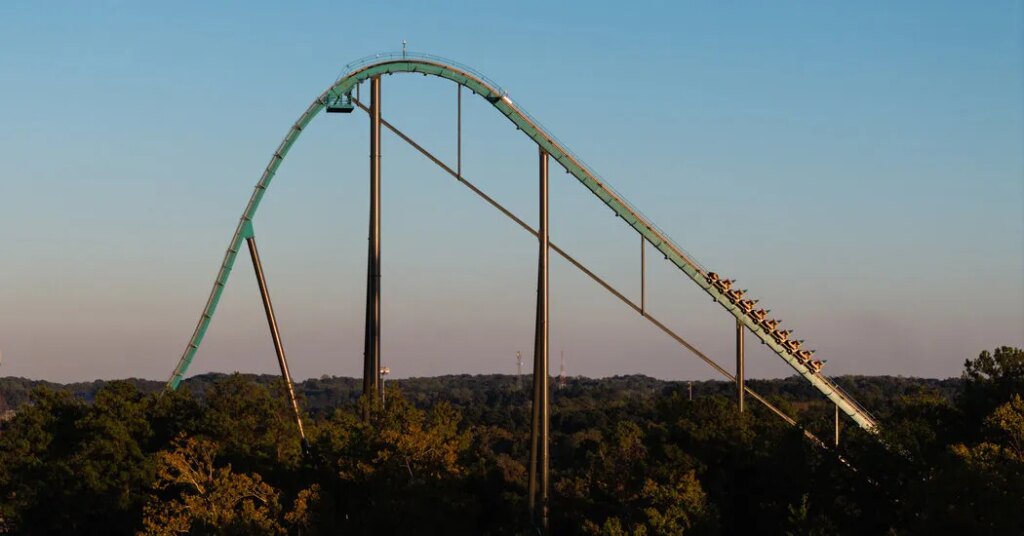
Compared with baseball and apple pie, the roller coaster is the renegade symbol of the carefree American summer.
It is a twisted beacon over the kaleidoscopic amusement-park landscape. It dares us to be daring. Steep drops, high speeds and improbably tight curves force screams from contorted faces and cause butterflies for those crowding to be next.
For the American leisure class, there is no entertainment quite like it. The roller coaster can be a rite of passage for kids and an obsession for adults.
Their continued popularity depends on a mind trick, a bit of dynamic tension — enticing us to strap into something that feels dangerous, maybe unwise, but is actually safe.
“The goal is to flirt with danger without actually experiencing it,” said Brian Avery, a University of Florida lecturer who specializes in amusement-park safety. “But occasionally, people are exposed to it, and they’re either dying or are being significantly injured as a result of it.”
This month, a new round of reckoning has arrived.
On Oct. 12, a man was thrown from his seat, mid-ride, and died on the Goliath coaster at Six Flags Over Georgia. That prompted Six Flags, the chain of amusement parks, to shut down at least nine other coasters across the country for closer inspection.
Only weeks earlier, in late September, Six Flags Magic Mountain in Valencia, Calif., permanently closed one of its popular coasters, X2, after years of complaints about its safety. It faced a lawsuit from three riders regarding catastrophic brain injuries, and recently settled a wrongful-death suit involving a 22-year-old man who died a day after riding the coaster in 2022.
Concern over roller-coaster safety is not a new issue. It rises and falls with every technological twist of gut-bending, mind-blowing adaptations. Each generation of coaster becomes higher, faster, steeper, bendier and gnarlier. And maybe more worrisome.
Have roller coasters, finally, gone too far? Have we reached the point where they can’t get more thrilling, or death-defying, because of limits in technology, safety or human physiology?
Probably not, experts said. Tomorrow’s coasters will certainly have the capability of flinging around people in more extreme ways.
But should they?
“I don’t know that we’ve explored the limits of, Is that good for a person?” Mr. Avery said.
The only sure thing is that more coasters are on the way.
“In our industry, the coaster is still king,” said Dennis Speigel, a global theme-park consultant and past president of the International Association of Amusement Parks and Attractions.
“When you want attendance to pop at your park or in your company, you don’t put in a carousel, you don’t put in a scrambler, you put in a roller coaster, and you name it ‘The Demon’ or ‘The Bat’ or ‘The Beast’ or whatever,” he said. “And people come out in droves to ride it.”
‘Gravity Rides’ Take Off
The history of fatal coaster rides includes mechanical failures, people falling out, heart attacks and other medical ailments.
The deadliest incident in the United States occurred in 1930, on a coaster in Omaha called “The Big Dipper.” A loose bolt caused a crash that killed four people and injured 17.
In 1972, in England, a chain pulling a coaster uphill snapped, sending cars backward and killing five people.
The idea of attaching small, wheeled cars to rails for thrills, not just transport, goes back about 200 years. But it was in the United States in the late 1800s that so-called gravity rides truly took shape.
Slews of patents were filed — to pull cars uphill, to link multiple cars together, to bring cars to a stop. By 1888, an inventor named LaMarcus Adna Thompson had built dozens of coasters in the United States and Europe, including the Switchback Railway in Coney Island in New York.
By 1895, the Flip Flap at Sea Lion Park in Coney Island took riders for a loop, literally, after its safety was tested by sand bags and monkeys. Its tight circle-shaped loop — not the larger teardrop of modern times — created G-forces beyond the 4 or 5 Gs that some coasters exert today. It left untold riders limping away with whiplash and spine injuries before it closed in 1902.
But Coney Island’s long history of coasters was just getting rolling, and not always safely. In 1910, three people died on the Rough Riders coaster when it took a curve too fast, flipped over and ejected 17 riders.
The ride lost its license, just temporarily. Five summers later, five people flew out. “Passengers were shot out of their seats and hurled against the double railing of one-inch iron piping which bordered the track for about 40 feet above the entrance,” The New York Times reported. “The railing broke under the impact, and the passengers were flung headlong down to the crowded pavement.” A passing priest delivered last rites.
The two survivors were a mother and son; she had somehow clung to a railing with one arm, dangling above the crowd, while holding her 4-year-old child, the Times account said.
Soon came the invention of securing wheels under the rails, instead of between them like a train car. That led to steeper, more contorted coasters.
By the 1920s, the country had 1,500 roller coasters, none more famous than the Cyclone in Coney Island. The clattering loop, with an 85-foot plunge and speeds of up to 60 miles per hour, is still there, a historical landmark.
Coaster popularity faded with the Depression and World War II. But Disneyland opened in 1955, and its Matterhorn helped spark a new era: relatively smooth rides on tubular steel.
In 1975, the Corkscrew at Knott’s Berry Farm in California turned riders upside down and held them in place with over-the-shoulder harnesses. A year later, the Revolution at Magic Mountain featured a vertical loop, which was quickly imitated.
Before long, there were propulsion systems that shot cars as if from a cannon. There were coasters where riders’ feet dangled free, and others that stood riders up or laid them flat to give the sensation of flying. There were coasters that went backward. There were coasters with up to 10 loops.
The first 100 m.p.h. coaster — the 415-foot-tall “Superman: Escape From Krypton” ride at Magic Mountain — opened in 1997.
Then came X, renamed X2 after a redesign in 2008.
“X is just the latest ploy in a constant game of technological one-upmanship played by amusement parks every summer to attract the masochistic masses,” Forbes wrote in 2001 before the ride opened.
Aside from the loops and drops, the article said, “the cars spin 360 degrees, sending passengers head over heels like Mary Lou Retton on a tumbling routine strapped to the Cyclone.”
The revolution continues. Last December, Falcons Flight opened in Saudi Arabia. It set records for the fastest (155 m.p.h.), tallest (535 feet) and longest coaster (nearly 14,000 feet, or about 2.6 miles).
“If you can think it, it gets created,” said Mr. Avery, the University of Florida lecturer. “And as long as an engineer establishes tolerances that the average person can continue to be safe while experiencing it, I don’t know where it ends.”
‘I’ll Still Go’
Last Friday at Magic Mountain — “The Thrill Capital of the World,” where the daily pass at the window costs $110 for adults — there were the familiar sights and sounds of the roller coasters, the clacking and whooshing of cars, riders screaming and laughing.
Goliath, one of the coasters that Six Flags had closed after the Georgia incident — the two rides share a name but have different designs and manufacturers — was open again.
The gate to X2 was locked and the sign was gone. Under construction elsewhere in the park, though, was Thrill Glider, a “suspended glider train” with five inversions. It is expected to open next year.
Darien Lewis and his fiancée, Melissa Bethel, both 36, are season-pass holders. He loves the coasters. She goes along but is scared of heights.
They knew about X2’s closing — “The scariest ride I’ve ever been on,” he said — but had not heard that someone fell out and died on a coaster in Georgia.
“Oh my god,” Ms. Bethel said.
“That’s the only thing I fear,” Mr. Lewis said.
“That is terrifying,” she said, adding, “He’ll still go.”
“I’ll still go,” he said. “I’ll just be thinking of that now.”
“But rides are never going to be perfect,” she said. “You just never know. Anything could happen.”
The International Association of Amusement Parks and Attractions reports that about one injury occurs for every million coaster rides in North America. A 2004 study found that an average of four people had died on coasters each year over the previous decade.
Mr. Speigel, the consultant, noted that the recent death in Georgia was the coaster’s first known fatal incident since a man died of a heart attack on the ride shortly after it opened in 2006.
“If they’re not safe, the manufacturers are out of business,” Mr. Speigel said.
But Mr. Avery, whose father was safety director at Busch Gardens in Florida, advocates changes. Among them: better and more transparent reporting of injuries and safety problems; federal oversight instead of a hodgepodge of state and local jurisdictions and self-regulation among the biggest parks; and better guidance for people trying to decide if the ride is really a good idea.
In interviews last week with coaster riders at the Cedar Point theme park in Ohio and at Magic Mountain in California, most were aware of the recent fatality but undeterred about climbing aboard.
“Hearing about that death doesn’t make me scared to die when I get on a roller coaster,” said Jenna Kulhawuk, 32, a videographer visiting Cedar Point. “I’ve never been like that — afraid of things that won’t happen.”
Among the riders of Goliath at Magic Mountain on Friday was Alexa Montoya, 20, visiting with several friends. She knew about the incident in Georgia, and before she left home her mother had told her to take extra care to strap in.
Ms. Montoya and her friends were all laughs and smiles as they got off the ride.
“I definitely got an adrenaline high,” Ms. Montoya said.
“Dude, I, like, almost passed out,” her friend said.
“Yeah, not gonna lie,” Ms. Montoya said. “I did almost pass out, but I was remembering, like, ‘Breathe, breathe.’”
They were tickled by the thrill more than they were worried about the danger.
“It seems simple in nature,” Mr. Avery said. “You walk up the platform, you get on the train, and you’re dispatched. And you’re delivered back to that platform in the same shape in which you left. That’s the goal.”
Esmé E. Deprez contributed reporting from Valencia, Calif., and Dan McGraw from Sandusky, Ohio.
The post Higher, Faster, Gnarlier: Have Roller Coasters Become Too Extreme? appeared first on New York Times.