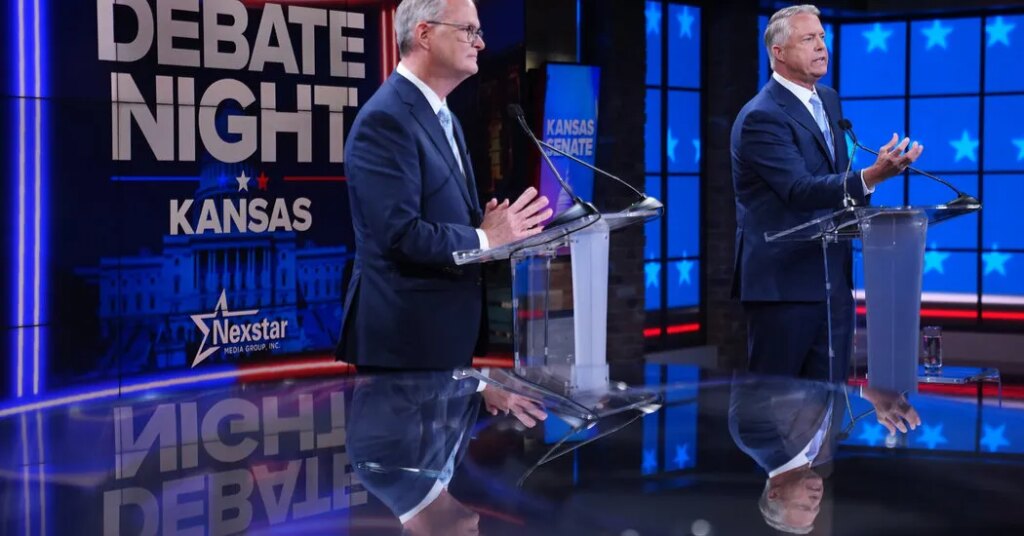
Once upon a time, the Kansas Senate race was expected to be a sleepy affair, one where Senator Roger Marshall, a first-term Republican, would cruise to re-election.
Then came Adam Hamilton.
In a matter of months, Mr. Hamilton, the Democratic nominee, has turned the deep red state into one of the most unexpected battlegrounds of the midterms, putting Mr. Marshall on the defensive in a contentious campaign that has pumped the airwaves full of attack ads.
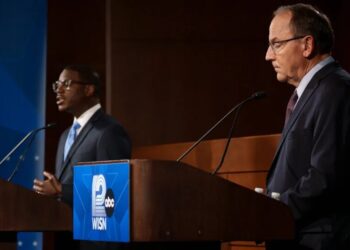
So the most surprising thing about Wednesday night’s Senate debate might just have been how civil it was.
The moderator, John Holt of Fox4 in Kansas City, skillfully dispensed with the main attacks of the campaign in its opening minutes and pushed the two men instead to tangle over substance. They stuck to his rules and — no doubt unintentionally — even presented a unified sartorial front, wearing matching dark suits and silvery ties.
And both candidates tried to use their time onstage to transform the race into a referendum on unpopular national figures: President Trump and Senator Chuck Schumer, the Democratic leader.
Here are five takeaways from the night.
Hamilton was the more comfortable speaker …
No one has more practice at extemporaneous talking than a megachurch pastor.
Mr. Hamilton, who founded the 24,000-member Church of the Resurrection, the nation’s largest United Methodist congregation, is comfortable delivering sermons and speaking on long podcasts. That showed, as he deftly navigated a lightning-speed debate that veered from foreign policy to farming to artificial intelligence, creating a stark contrast with Mr. Marshall, who spoke haltingly and sometimes tripped over his words.
Mr. Hamilton blamed Mr. Marshall for what he framed as the excesses of the Trump administration — including record diesel prices and immigration raids in farm country — while seeking to present himself as an independent-minded Democrat who has steered clear of his own party’s more extreme positions.
He spoke sparingly about his faith, but used his status as a political newcomer to separate himself from the national party, as when Mr. Marshall sought to connect him to former President Barack Obama’s immigration policies.
“You were pointing at me as though I developed these policies,” Mr. Hamilton said. “I just want to remind you, I’ve been a pastor for the last 38 years. I have not been a senator. I didn’t develop policies with President Obama or anyone else.”
… but he didn’t always have the answers.
Mr. Holt, the moderator, lobbed detailed questions at the candidates and pressed repeatedly when they tried to sidestep them. At times, Mr. Hamilton answered with candor: He just wasn’t sure.
At one point, Mr. Holt asked both candidates where, exactly, they would draw the line on subsidies for farmers — a delicate question in a year when farmers are facing strong economic headwinds, some of which have been exacerbated by the Trump administration.
Mr. Marshall defended the subsidies.
Mr. Hamilton, who has said on the campaign trail that he doesn’t want to come up with “bogus” answers, said: “I don’t really have an answer to that. I can only say this: that we do need to be able to help our farmers. Our farmers need support.”
He said he would raise the cap on Social Security, but he wasn’t sure to what level. And he said he wasn’t sure what federal regulations he would support on artificial intelligence, in part because, he said, no one in Congress fully understands its dangers.
Mr. Marshall moved to highlight Mr. Hamilton’s inexperience, including once after an exchange over Israel — a country Mr. Hamilton said he had visited 12 times.
For “a novice even to start making national security policy without all the details, I think it’s really hard to do that,” Mr. Marshall said.
Marshall embraced the Trump agenda.
Republican candidates running in more traditional battleground states have attempted to distance themselves from President Trump and his unpopular policies, including the Iran war and tariffs. But not Mr. Marshall.
The senator offered a vocal defense of the president, saying he had fulfilled some of his central promises to voters. Mr. Trump, said Mr. Marshall, had strengthened the nation’s military, secured the borders and passed a sweeping tax cut.
His comments were part of an effort to remind Republican voters, including those frustrated by high gas prices and inflation, what they liked about the president. “If you want the Trump agenda to continue,” he said. “you need to come out, because we delivered on those things.”
Two years ago, Mr. Trump won Kansas by 16 points. To win this year, Mr. Marshall must persuade those voters to stick with Republicans, rather than stay home or cross party lines and vote for Mr. Hamilton.
“We need the Trump voters to come out,” he said.
There was no love for Chuck Schumer.
With Mr. Trump facing record low approval ratings, Mr. Marshall attempted to energize Kansas Republicans by reminding them of a figure they like even less: Senator Chuck Schumer of New York, the Democratic leader in the Senate.
Again and again, Mr. Marshall warned that electing Mr. Hamilton would award control of the Senate to Democrats and Mr. Schumer. “This guy’s funded by Chuck Schumer,” he said. “He’ll be beholden to Chuck Schumer forever, and that’s why we have to keep me in that Senate seat.”
The repeated invocation of Mr. Schumer’s name was part of an effort by Mr. Marshall to nationalize the race, turning it into a referendum — not on Mr. Trump but on which party controls the Senate. While Mr. Trump is unpopular, Democrats also have plenty of detractors in this red state.
Mr. Hamilton has said he would not support Mr. Schumer as the head of the party in the Senate, arguing that Democrats need fresh leadership. In the debate, he tried to distance himself from national Democrats, calling former President Joseph R. Biden Jr.’s immigration policy a “disaster” and saying he does not agree with the “socialist party.”
“If I’m elected, as a moderate or independent-minded Democrat, I’m going to work across the aisle,” he said.
The candidates were pressed on (mostly) serious issues.
As the Kansas Senate race has grown more competitive, it has also become far more contentious.
The debate opened with both candidates being pressed on issues on which they have faced personal criticism. Mr. Marshall defended his aggressive debt collection practices as an obstetrician-gynecologist. Mr. Hamilton attempted to distance himself from an incident of child sex abuse at a church retreat two decades ago.
But they were also pressed on a range of substantive policy questions, including weapons support for Israel, immigration reform and health insurance. Mr. Hamilton hammered Mr. Marshall for backing unpopular policies of the Trump administration, including the war in Iran and tariffs.
For his part, Mr. Marshall attempted to link his opponent to unpopular positions held by some in his party, including support for trans girls playing women’s sports. (Mr. Hamilton said he would not want his 12-year-old granddaughter competing against biological men or boys, saying, “it’s not a fair fight.”)
But not every question was quite as serious.
In a Kansas twist, the moderator asked each candidate to select his favorite stretch of highway in the state.
Mr. Marshall chose Interstate 77 between Manhattan and Cassoday. Mr. Hamilton chose Interstate 35 through the Flint Hills. “One of the most beautiful places on God’s green earth,” he said.
The post Farmers, Health Care and Highways: 5 Takeaways from the Kansas Senate Debate appeared first on New York Times.