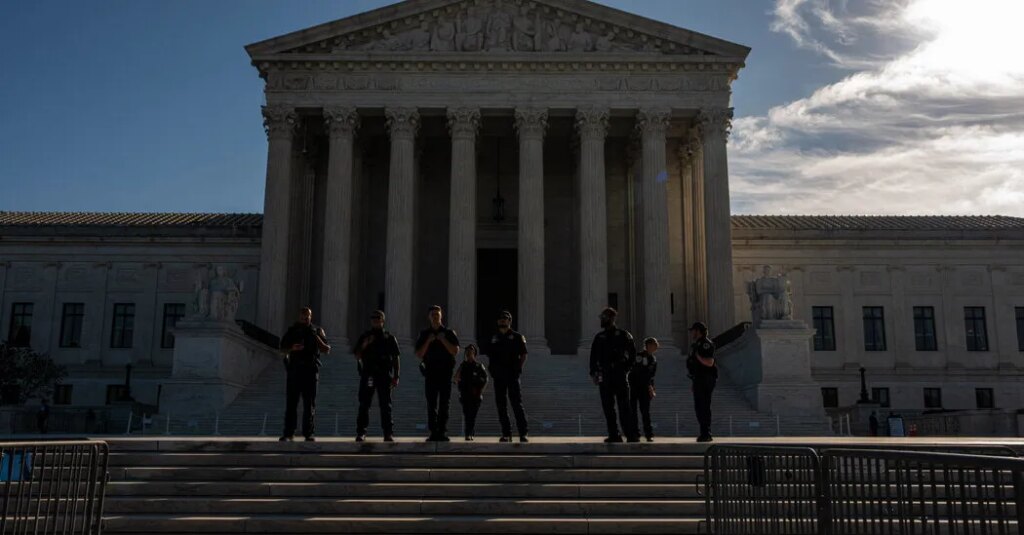
The Supreme Court on Wednesday prevented the Trump administration from immediately denying certain gender-transition medical treatments for transgender inmates at federal prisons.
The court’s unsigned, unexplained order was a rare example of the conservative-dominated bench siding, at least temporarily, with the rights of transgender individuals. Two conservative justices, Samuel A. Alito Jr. and Clarence Thomas, said they would have granted the administration’s emergency request to stop the treatments.
Under President Trump, the Bureau of Prisons adopted new policies that would prohibit inmates from receiving the care. Three transgender people in federal custody initially challenged the new rules. All three had previously been diagnosed with gender dysphoria by prison medical officials and had been prescribed treatments.
The ruling means that, for now, as many as 1,000 federal prisoners who have been diagnosed with gender dysphoria will continue to receive gender transition treatments that the Trump administration has attempted to restrict.
The lawsuit argued that the administration’s change in policy violated Eighth Amendment protections against cruel and unusual punishment. The policy has been blocked since June 2025, and the court’s ruling means that block remains in place while litigation about the issue proceeds.
Li Nowlin-Sohl, a lawyer with the American Civil Liberties Union’s LGBTQ & HIV Project, called Wednesday’s order a “critical ruling.”
“The attempted denial of medically necessary health care, including gender-affirming health care, to people in prison is a violation of their fundamental constitutional rights,” she said in a statement.
Audrey Cook, the Justice Department’s press secretary, said that while the court’s order is disappointing, it is not the final word on the administration’s policy.
“We look forward to pursuing our appeal in the D.C. Circuit to reinstate BOP’s policy that affirms biological reality,” she said in a statement.
In January 2025, President Trump issued an executive order barring prison officials from spending federal funds on “any medical procedure, treatment, or drug” to address gender dysphoria — a medical condition defined as the significant distress linked to a mismatch between a person’s birth sex and gender identity.
Earlier this year, prison officials issued a policy to implement Mr. Trump’s executive order. The policy permitted other forms of care for people with gender dysphoria, including psychotherapy and medications such as antidepressants.
The prison policy is one of a series of actions by the administration targeting transgender people. The president also directed government agencies to withdraw federal funding from schools that allow transgender athletes to participate in girls’ and women’s sports, and the administration has sought to bar transgender people from the military.
The ban has also been challenged in court, and the administration has asked the Supreme Court to allow the U.S. military to fully enforce it. The case is pending.
At the Supreme Court, the justices in June upheld state laws barring transgender female athletes from playing on girls’ and women’s teams. Last year, the justices also upheld a state law prohibiting some medical treatments for transgender youths, rejecting arguments that the law violated the Constitution.
In a narrower case from Idaho in 2020, the court similarly turned down a request from state prison officials to block court-ordered sex reassignment surgery for a transgender prisoner. Justices Alito and Thomas also said in that case that they would have granted the prison officials’ request.
In Wednesday’s case involving federal prisoners, Judge Royce C. Lamberth of the District Court in Washington, has issued a series of rulings ordering prison officials to continue providing medical care to the inmates. Those treatments have included hormone therapy, surgery and social accommodations such as makeup and wigs.
In June, Judge Lamberth found that “no adverse impacts on public safety or the operation of the criminal justice system” would result from maintaining the status quo while litigation continued.
“Denying individuals with gender dysphoria the ability to socially transition or obtain hormone therapy will predictably lead to mental health risks,” he wrote. “These risks include exacerbated depression, anxiety, suicidal ideation and self-harm.”
D. John Sauer, the solicitor general, asked the justices to intervene on an emergency basis, arguing that the rulings blocking policy were thwarting a step that prison administrators had “determined is necessary to maintain institutional security.”
In defending its new policy, the Bureau of Prisons said that the benefits to inmates of providing such care “no longer outweighed BOP’s other security and prison-administration concerns.”
If allowed to proceed, the government’s plan would mean that inmates who had been receiving treatment would be required to taper off their use of the medication, in a “rapid discontinuation of the hormone intervention.” Social accommodations such as makeup would be confiscated.
Lawyers for the transgender prisoners told the justices in court filings that gender-transition treatment is the only approach known to effectively treat gender dysphoria and that prison officials have provided hormone therapy to transgender inmates dating back to at least 1992.
Prison officials are seeking to “cut off treatment that its health care providers had recommended for decades,” according to lawyers from the American Civil Liberties Union. In addition, the lawyers said, prison officials have “not pointed to a single security incident relating to its provision of this treatment over the past 30 years.”
The post Supreme Court Blocks Trump From Denying Gender-Transition Care to Federal Prisoners appeared first on New York Times.