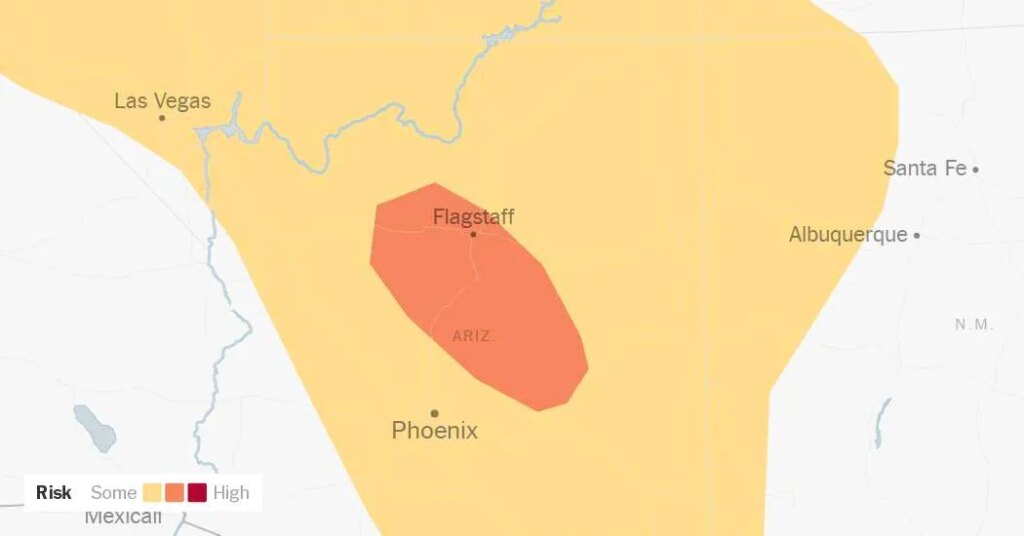
Parts of Arizona were under the state’s first tornado watch in 15 years on Wednesday as intense storms tore through.
Nearly the entire state faced some risk of severe weather on Wednesday and Thursday as the storms also threatened to produce hail the size of limes, damaging winds and significant rain.
The watch means that the atmospheric ingredients are in place for a tornado to possibly form somewhere in a broad area. It was in place for the northern part of the state, including Flagstaff, until 6 p.m. local time. The last time any part of Arizona was under a tornado watch was October 2010.
Several brief tornado warnings, a more-urgent notice that means meteorologists think tornadoes have been spotted on radar or on the ground, came and went on Wednesday morning with no major damage reported.
This is “very unusual” weather for this part of the country, Mark O’Malley, a meteorologist at the National Weather Service office in Phoenix, said on Wednesday morning. It isn’t that thunderstorms are unheard-of in Arizona, but they are usually not as intense as what was predicted for Wednesday.
Arizona gets about five tornadoes a year, most of them occurring between July and October, according to records from the National Oceanic and Atmospheric Administration.
Though nearly all of the state’s tornadoes have been in the weakest categories of the Enhanced Fujita scale, which runs from zero to five, four of them were rated EF-3.
The most recent of those was near Flagstaff on Oct. 6, 2010, amid the worst tornado outbreak in Arizona history. There were 11 tornadoes that day, the highest count ever in a single event west of the Continental Divide.
Mr. O’Malley said the storm system that caused the 2010 outbreak was much stronger than the one moving into the region on Wednesday.
There was at least some risk of intense storms in Tucson and Phoenix in Arizona, stretching north into Las Vegas. Central Arizona, including Flagstaff, faced a slightly higher risk.
How to prepare
The post Arizona Faces Its First Tornado Watch in 15 Years as Rare Storms Blow Through appeared first on New York Times.