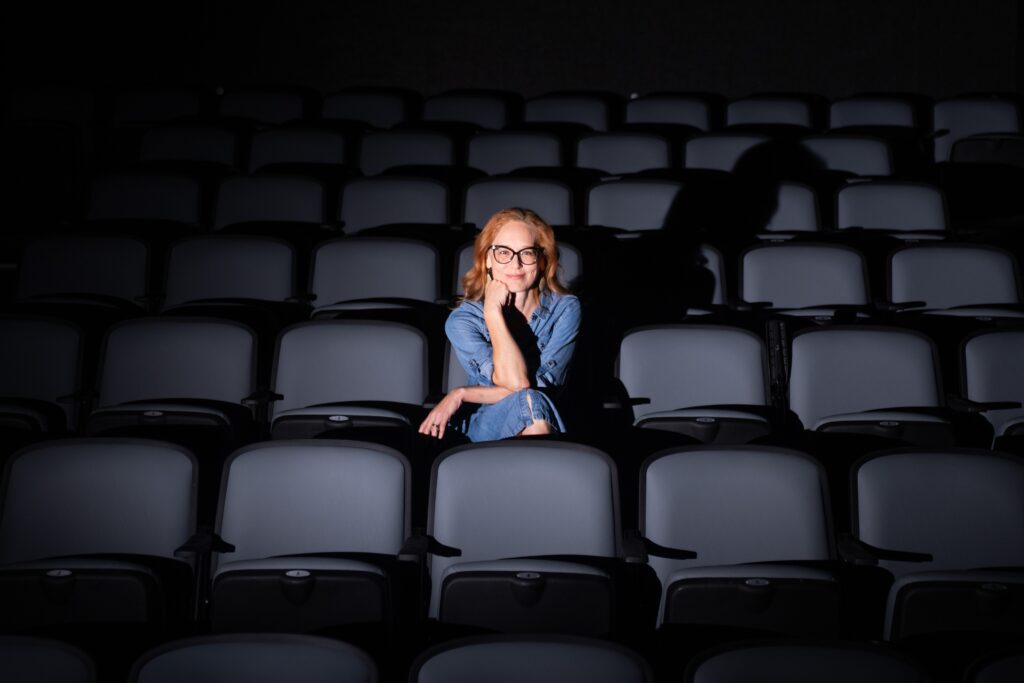
In 2024, D.C. theater veteran Shanara Gabrielle was eight days into her job as artistic director of Theater Alliance — her first full-time role running an arts organization — when she showed up to work and was met with an eviction notice. The Anacostia Playhouse, the nonprofit theater company’s home for more than 10 years, had been accused of not paying its rent for months. Suddenly, Theater Alliance didn’t have a stage.
“Ultimately, that became a blessing in disguise,” Gabrielle says. “It proved the necessity of Theater Alliance in the theater community because we could have just gone away. We weren’t that big of an organization. But we’ve always had a physical home. We had a physical home on H Street. We had a physical home in Anacostia. It’s always been a gathering space.”
After two years of planning and pop-up performances, Theater Alliance’s new home, the Revada Arts Center, opens this weekend in Southwest Washington — across the river (and two Metro stops) from its old one. The building, which opens with a free community festival Friday through Tuesday, is piloting a cooperative nonprofit partnership model.
Revada will also house the innovative and immersive opera company In Series, which has never had a proper home, and 4Eye Film Center, a new 58-seat art house cinema. All three organizations have a financial stake and long-term agreements (though Theater Alliance holds the lease and much of the risk) and will share the space, collaborating on programming, community events and infrastructure.
“The very founding of Theater Alliance — the name — was about allying ourselves with other arts organizations,” Gabrielle says. “Twenty-five years ago, that was the original idea that, over time, has now come to full realization.”
Theater Alliance actually popped up in the new space at 340 Maple Dr. SW for a year, using D.C.’s Pop-Up Permitting (PUP) program when it was just a shell of concrete and pipes with no running water. Theatergoers had to use the restrooms at the preschool next door. Gabrielle says the residency gave her time to work with the developer (which also built the Wharf nearby) on a lease and “to start this very intentional process of: What does the structure of the place look like?”
When you walk into the 9,000-square-foot facility, you enter into a cafe and co-working space — Gabrielle calls it the “radical hospitality hub” — that doubles as a micro-amphitheater that seats 35. Straight down the hall is Theater 1, a 140-seat black box theater with flexible seating and staging that will serve as the primary performance space for Theater Alliance and In Series. To the left is Theater 2, a cinema with collapsible stadium seating, a wide 14-by-7-foot silver screen and 7.1 Dolby surround sound. “The whole idea is to be very flexible,” says Emily Lenzner, the founder and director of 4Eye.
Tucked in every corner are thoughtful uses of space: a rehearsal room that can be a reception room; a black box theater that may eventually screen films; a cinema that is also a proscenium performance space for small concerts, play readings and one-person shows. “You walk into [Theater 2] and are like, ‘Oh, this is clearly a movie theater,’” Gabrielle says. “But it’s also built acoustically to be able to do opera.”
The scene shop, where the team builds props and sets, is just off Theater 1. “I think it’s easy to underestimate how meaningful it is to have your scene shop on-site, to be able to build and take it straight into the rehearsal rooms,” says In Series artistic director Timothy Nelson.
Theater Alliance, known for staging socially conscious plays, and In Series, which breaks down the rigid traditions of opera, will trade off shows in the black box (alternating who gets it for holidays, for example). While one organization is staging a show, the other will be preparing its next production in the rehearsal room. “Our dream version is that there’s a movie happening while there’s a play happening and while an opera is being rehearsed,” Gabrielle says.
Part of the idea behind putting these three disciplines under one roof is to bring those differing audiences together. “I think there’s really power in the fact that our audiences are so different, and that this gets them coming into conversation with people they wouldn’t otherwise be,” Nelson says. “It’s not always planned interaction. It’s sort of inadvertent.”
By giving each partner a say and stake in the building — not just Theater Alliance renting out the space to tenants — Revada pushes back against the idea of megamergers as a means to survive. And while Revada will eventually have three other partners with long-term residency and the spaces will be available to rent, that’s part of a community mindset as much as an economic one.
“That idea of mergers being the solution is starting to infiltrate the philanthropic community, so there’s a lot of pressure from foundations to encourage small organizations to merge,” Nelson says. “And I think what we hope is to provide a different model and educate the philanthropic community that that’s not the answer.”
“We’re coming together out of an abundance mindset,” Gabrielle says. “This is a useful, positive thing for all of us. Not just: I need you to survive, and you need me to survive.”
Lenzner, who used to run communications at the Motion Picture Association and previously tried to revive the Uptown Theater movie palace in Cleveland Park, knew that opening a single-screen theater would be a challenge financially and operationally. “By having this partnership, by sharing resources, it’s much more palatable and doable,” she says.
Opening weekend will work a bit like a neighborhood festival and celebration for each organization. Friday is an invite-only ribbon-cutting ceremony and party hosted by Theater Alliance that will include a preview of its new season. The festivities will include “tidbit tasters” of each show, Gabrielle says, including Sam Shepard’s “Fool for Love” with an all-Black cast.
Saturday will function like an open house with family activities, such as a “Frozen” sing-a-long at 4Eye, improvised opera from In Series, acting classes and a make-your-own movie poster activity. On Sunday, people can explore the different spaces and check out the cafe, which serves coffee, alcohol, popcorn and light bites; on Monday, you can use the space for co-working.
On Tuesday, 4Eye (named for the center’s proximity to Fourth and I streets SW) and In Series will collaborate by screening Richard Linklater’s 2025 film “Blue Moon,” about lyricist Lorenz Hart. After the movie, In Series will do a cabaret of songs by Hart and his longtime collaborator Richard Rodgers.
The three organizations hope that kind of synergy happens on the regular.
“Celine Song [director of 2023’s “Past Lives”] is one of my favorite playwrights and wrote a play called ‘Endlings’ that I love that I don’t know that we’ll ever be able to produce at Theater Alliance because of the size and scope,” Gabrielle says. “But we could do a reading of it and show one of her movies and invite Celine Song to come be in residence and work on a new play. That was one of the first artistic ideas that came out of this.”
After the grand opening, 4Eye will host regular film screenings — often repertory, some first-run, some with director Q&As or expert discussions after — and Theater Alliance will take up residence in the black box. In Series won’t start hosting regular productions in the space until January, but Nelson is looking forward to finally having a permanent home.
“We’ve always been itinerant,” Nelson says. “One of the reasons it was really important that the black box seemed flexible is because our audiences expect it to feel different every time. We’d come to a point where we really need the consistency of a home to be able to advance quality and institutional sustainability. For me, it’s more about being able to do better work — not more work, but better work — because we’re in the same place and we’re not having to reinvent the wheel every time.”
Because Revada has a cafe and co-working space, you don’t need to buy a ticket to engage with the center. For now, the goal is for the cafe to be open Thursday through Saturday and when there are performances and movie screenings.
“I don’t want to jinx it,” Lenzner says, “but I think we’re going to have a lot of people wanting to come and be part of this.”
“One of the core principles is that the arts are a central part of civic society,” Gabrielle adds, “and gathering together in space is the thing that all of us are doing.”
The post A new D.C. arts hub is envisioned as a haven for theater, opera and cinema appeared first on Washington Post.