The United States view of Taiwan is often through the lens of a possible conflict with China or its dominance in advanced chip manufacturing. But behind the silicon shield is a vibrant democracy of 23 million people that was the first in Asia to legalize same-sex marriage and had a voter turnout of over 70 percent in its 2024 presidential election.
It has also been running one of the world’s longest experiments in political affirmative action.
For decades, Taiwan has used quotas and reserved seats to bring women into electoral politics. Today its political representation by women is among the highest in the world, and, as new research suggests, few of them were ultimately elected based on quotas.
Women hold 42 percent of Taiwan’s legislative seats, the highest share in Asia and comparable to Nordic countries. It elected its first female president in 2016 and re-elected her four years later. It has also elected two female vice presidents since 2000.
“People often argue that elections should simply be about choosing the best and most capable,” said Chang-Ling Huang, a professor at National Taiwan University who has studied gender politics for more than 20 years. Taiwan’s experience shows that “gender quotas are precisely what allow a society to truly elect the best and the most capable.”
“Otherwise,” Ms. Huang added, “patriarchal systems simply exclude qualified women from the race.”
Since the 1990s, a trend of gender quotas in elections has spread around the globe, with more than 130 countries, including more than two dozen in Europe, introducing constitutional, electoral or political party quotas for women in elections, according to data from the International Institute for Democracy and Electoral Assistance, an intergovernmental organization.
But Taiwan’s approach began much earlier. In 1946, the Republic of China passed a Constitution that reserved seats for women in elections, a result of a women’s movement that dated back to the 1920s and the influence of socialism in the country, said Ms. Huang, the political scientist. When the Nationalist government was defeated in the civil war and moved to Taiwan in 1949, the quotas, set at 5 to 10 percent, were followed in local elections even though the Constitution was largely suspended during the next decades of authoritarian rule.
As Taiwan began to democratize in 1987, some feminist organizations worried that quotas could send a message that women were incapable of winning elections on their own merits. But they ultimately decided to lean into quotas. They fought for and succeeded in getting four rounds of major quota reforms over the next few decades.
A law that took effect in 2002 guarantees women a seat in local council districts electing four or more members. If, say, four men received the highest numbers of votes for a four-person council, the fourth seat would go to the female candidate with the most votes, regardless of party affiliations. So the law created an incentive for all political parties to recruit and nominate female candidates. In 2030, the quota will go up to one in three, and will be gender neutral. It means that in every three seats there must be at least one woman and one man.
After studying data sets from six election cycles from 2002 to 2022, Ms. Huang found that female candidates became very competitive over time. The number of electoral districts that needed to activate a reserved seat dropped from 31 in 2002 to just four in 2022.
Now women rarely need reserved seats to get elected, but the existence of those seats remains crucial to securing party nominations. “They serve as a safeguard, even when they go unused,” Ms. Huang said.
What if Taiwan had never adopted gender quotas? A redo of history isn’t possible, of course, but Japan provides a fairly good comparison. Women in both Japan and the Republic of China won their suffrage right after the World War II. And Taiwan’s election system resembles Japan’s. But Japan never reserved seats for women, and today women hold only 15 percent of seats in Parliament. (Women make up 28 percent of the U.S. Congress, which puts the country 84th in a global ranking of the percentage of women in national legislatures.)
Women make up about a quarter of China’s Parliament, a percentage that has barely moved since 1970s. In Xi Jinping’s third term as China’s leader, there’s not a single woman in the Communist Party’s Politburo, breaking a tradition of more than two decades. In the party’s 77 years ruling the country, no woman has ever been appointed to the Standing Committee, the pinnacle of C.C.P. power. The government under Mr. Xi has systematically tightened restrictions on feminist advocacy and movements like #MeToo.
The biggest impact of the quota system in Taiwan is that it made women in political office ordinary rather than extraordinary, Ms. Huang said.
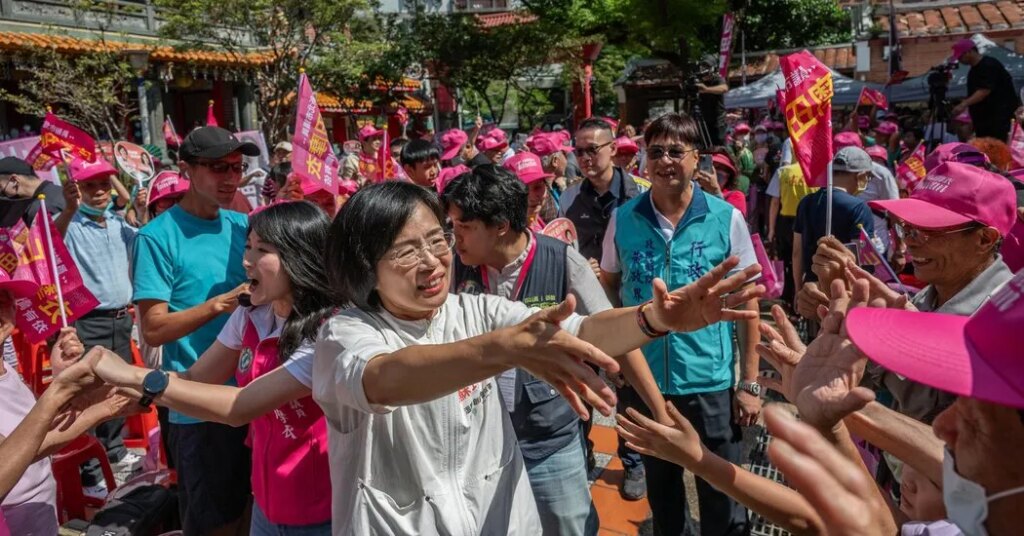
With Taiwan gearing up for local elections in late November, giant campaign posters of female candidates seem to be everywhere on the island, especially in big cities.
Su Chiao-hui is running as the mayoral candidate of the ruling Democratic Progressive Party in New Taipei City, a metropolitan ring of more than four million residents that surrounds the capital city, Taipei, and is a stronghold of the opposition Nationalist Party (K.M.T.).
It’s a high-stakes election, and Ms. Su, 50, a three-term legislator representing a district in the city, is running against Lee Shu-chuan, a 68-year-old political veteran whose English name is Hammer.
Ms. Su’s party emphasizes Taiwan’s distinct identity while Mr. Lee’s party has historically tied its identity in the Republic of China that was founded in mainland in 1912. But in this local race, campaigns are intensely personal and practical. Candidates meet voters face to face and make their case on housing, child care, transportation and other everyday issues.
Ms. Su’s campaign embraces a feminine, maternal image — she hosts a children’s storytelling podcast — suggesting that she is comfortable with that side of herself and believes voters are, too.
Her campaign office has a vibe of a children’s activity room, with pastel blocks, oversize pink lettering and cheerful cartoon figures of “Otter Mom,” her podcast. She hopes the persona projects an approachable, family-friendly image targeted at younger voters and parents who value education.
The rising women’s representation in electoral politics has not erased gender stereotypes and misogyny in Taiwan.
Yu-Yu Liu, an activist turned township head in central rural Taiwan, said that when she first ran for the office four years ago, many voters told her that, at 35, she was too young. Then almost in the same breath they would comment that she needed to hurry up to get married. She sometimes felt subtly isolated at traditional political networking gatherings where older men drank and smoked.
Even Tsai Ing-wen, Taiwan’s first female president, endured many misogynistic attacks. An opponent called her an ill-fated woman. She was questioned over her qualifications to understand parental issues because she’s a single, childless woman (who raised two cats and five dogs during her presidency). After her party suffered a huge defeat in the 2018 local elections, some people questioned whether she would be a one-term president.
“I told myself,” she said in a recent meeting at her office, “as the first female president, I can’t fail.” She was re-elected two years later.
The post For an Experiment in Political Affirmative Action, Look to Taiwan appeared first on New York Times.