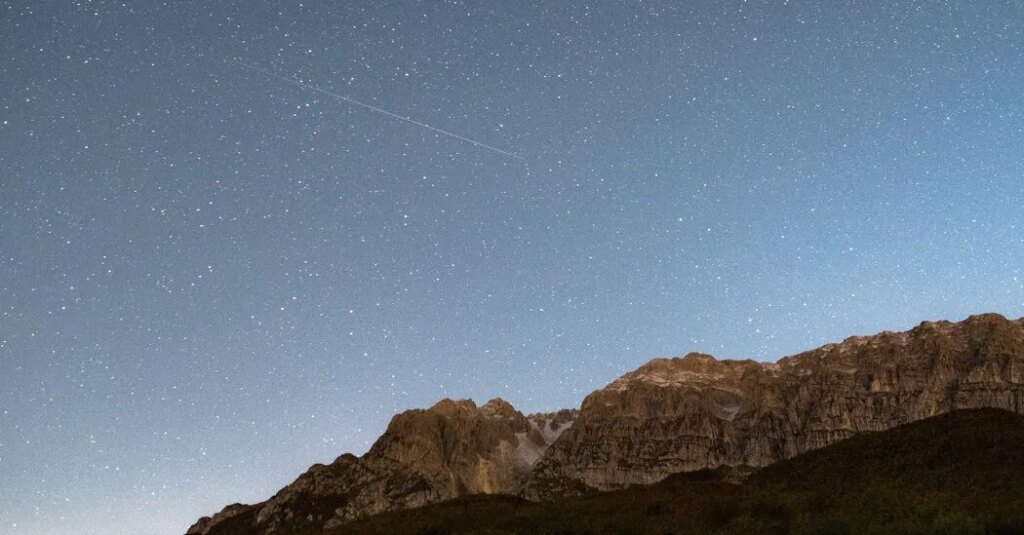
Our universe might be chock-full of cosmic wonder, but you can observe only a fraction of astronomical phenomena with your naked eye. Meteor showers, natural fireworks that streak brightly across the sky, are one of them.
The latest shower to grace the firmament is the Orionids, a fall favorite known for bright speedy streaks that can sometimes linger for minutes. Like the Eta Aquarids of the spring, the Orionids arise when Earth passes through the debris from Halley’s comet.
The Orionids have been active since Oct. 2 and are expected to continue through Nov. 7. The shower reaches its peak activity Oct. 21 to 22, or Wednesday night into Thursday morning.
Stargazers in both hemispheres will get a chance to catch the Orionids. But they will have to contend with the brightness of the moon, which will be 77 percent full on the night of the shower’s peak. For a hint at when to watch, use this tool, which relies on data from the Global Meteor Network to show real-time fireball activity levels.
Where do the Orionids come from?
In general, meteor showers occur when Earth passes through the rubble trailing a comet or an asteroid orbiting the sun. This debris, which includes particles as small as grains of sand, leaves behind glowing streams of light as it burns up in our atmosphere.
The Orionids are caused by Halley’s comet, which takes about 76 years to orbit around the sun and was last seen by stargazers in 1986. As it nears the sun, Halley’s comet melts, releasing material that eventually spreads along the path of its orbit. Earth passes through this debris twice a year, in the spring and in the fall.
Many meteor showers occur annually and last for days or weeks. But they reach peak activity within a small window of time, when Earth crosses the densest part of the cosmic debris. The peak is the best time to look for a meteor shower.
How can I watch the Orionids?
Meteors belonging to a specific shower appear to come from the same point in the sky. The Orionids radiate from a spot just north of the star Betelgeuse, in the constellation Orion. This constellation is visible in the southeast from the Northern Hemisphere, and in the northeast from the Southern Hemisphere.
NASA recommends searching for the Orionids in the hours before dawn, after the moon sets.
According to Michelle Nichols, the senior director of public programs at the Adler Planetarium in Chicago, you should avoid using telescopes or binoculars while watching a meteor shower. Meteors can shoot across large swaths of the sky, and observing equipment can limit your field of view.
“You just need your eyes and, ideally, a dark sky,” she said.
Expect about 10 to 20 streaks per hour during the peak night of the Orionids, though that number may lower depending on where you observe.
“Almost everybody is under a light-polluted sky,” Ms. Nichols said. “You may think you’re under a dark sky, but in reality, even in a small town, you can have bright lights nearby.”
Planetariums, local astronomy clubs or maps like this one can help you figure out where to go to escape excessive light. The best conditions for catching a meteor shower are a clear sky with no moon or cloud cover, sometime between midnight and sunrise. (Moonlight, like light pollution, washes out fainter sources of light in the sky.) Make sure to give your eyes at least 30 minutes to adjust to seeing in the dark.
Ms. Nichols also recommends wearing layers. “You’re going to be sitting there for quite a while, watching,” she said.
Bring a cup of cocoa or tea for more warmth. Then lie back, scan the sky and enjoy the show.
The post How to Catch the Orionids, a Meteor Shower From Halley’s Comet appeared first on New York Times.