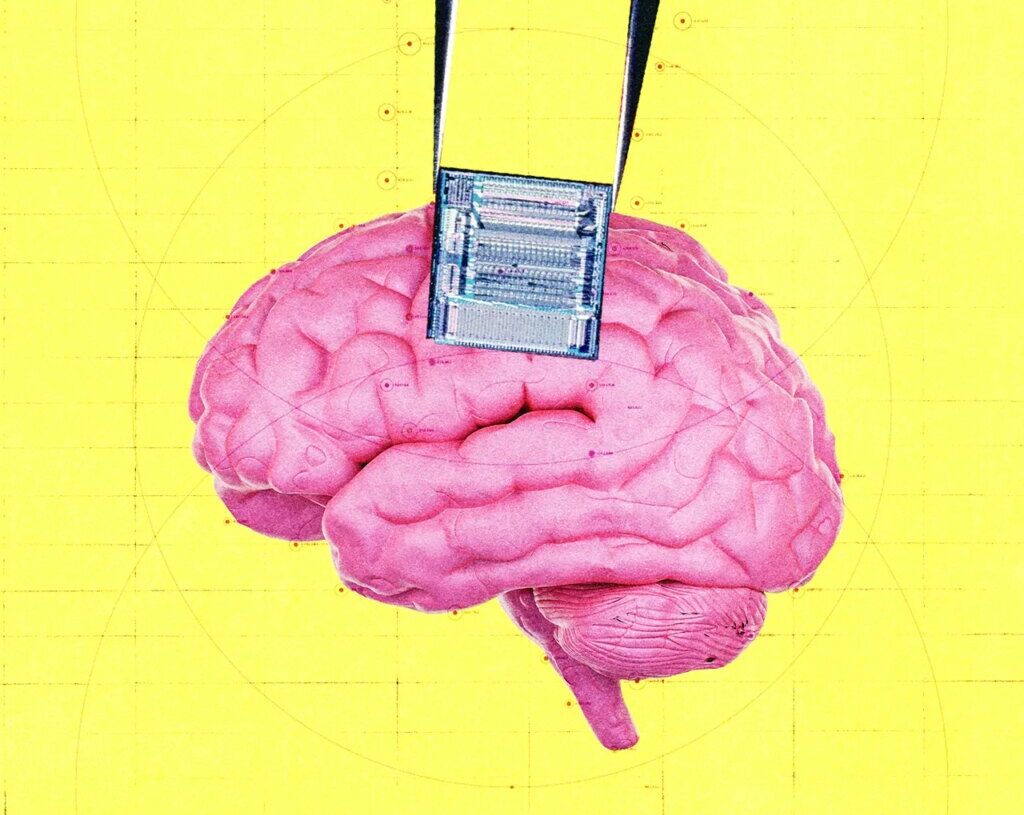
OpenAI’s venture capital arm as well as Peter Thiel’s Founders Fund are investing in Coherence Neuro, a startup developing a brain implant to detect and treat cancer.
The investments are part of a $45 million seed funding round for Coherence and reflect Big Tech’s burgeoning interest in brain data. Coherence’s CEO and cofounder Ben Woodington says there is “growing synergy” between the big AI labs and companies building devices to decode the brain, known as brain-computer interfaces.
“The idea of capturing data to train better models and use it to optimize treatments is going to be super important,” he says. “The AI companies seem to be aligned with this thesis as well—that this novel data source is going to be valuable.”
Woodington says AI is a “perfect use case” for brain-computer interfaces because developers of these devices generate massive datasets that are too large for humans to analyze themselves. AI models can help read raw neural data and link it to actions, such as moving a computer cursor or producing synthesized speech.
In January, OpenAI announced that it was directly investing in a new brain-computer interface company, Merge Labs, cofounded by its billionaire CEO Sam Altman. Merge Labs came out of stealth with $252 million in initial funding to pursue ultrasound technology that can decode information from the brain. At the time, OpenAI said it was funding Merge Labs because of a belief that brain-computer interfaces “will create a natural, human-centered way for anyone to seamlessly interact with AI.” (The name Merge Labs comes from the idea popular in Silicon Valley that humans will eventually merge with machine intelligence.)
Thiel’s VC firm has also backed Elon Musk’s Neuralink as well as CTRL-labs, the creator of a wristband that translates neural signals from arm and hand movements that was acquired by Facebook in 2019.
Rather than focusing on restoring function for paralyzed individuals, San Francisco–based Coherence is developing AI models to decode subtle electrical signals associated with brain tumors. The company says it already knows how to detect these signals in animals to determine whether cancer is growing, shrinking, or recurring. The team is working to translate these findings for human research and, eventually, clinical trials.
This summer, Coherence briefly tested the recording ability of its implant in the brains of three people who were already undergoing brain tumor removal surgery at the Royal Melbourne Hospital in Australia. The implant was in place for roughly 30 minutes before being removed, providing an initial safety check. Next, Coherence is testing both the recording and stimulation capabilities of the device in an additional seven patients.
The implant is also designed to emit mild electrical stimulation to halt the growth of tumors. The idea is that over time, the device would learn to detect signals associated with cancer and provide real-time treatment. Coherence plans to use the new funding to launch a clinical trial to implant the device long-term in patients with glioblastoma, an aggressive type of brain cancer. The company also aims to develop implants to treat cancers in other parts of the body.
“Coherence’s approach to developing a cancer therapy capable of improving from data is incredibly innovative,” Ian Hathaway, partner at the OpenAI Startup Fund, says in a statement. “We are proud to be backing them on this exciting mission.”
Woodington says that OpenAI will not have access to its data. “There’s nothing in the contracts or arrangements that would mean that we would share, or they would have access to, any brain data or other health data that we’re generating,” he says.
That is seemingly different from OpenAI’s relationship with Merge Labs. In its January announcement, OpenAI said it would “collaborate with Merge Labs on scientific foundation models and other frontier tools to accelerate progress.”
The post OpenAI Invests in Startup That Uses Brain Implants to Detect Cancer appeared first on Wired.