In today’s edition … The Maine Senate race is not about Troy Jackson … I ask you about religious candidates … but first …
Election ‘goodies’ are getting more bespoke
Welcome to Donald Trump’s world of bespoke election handouts.
The Republican president notably used a prime-time speech at the party’s midterm convention in Dallas last month to promise a $5,000 “dividend” if Republicans keep control of Congress after the midterms. Democrats quickly criticized the plan. And Republicans, long the party worried about the national debt, struggled with how to get behind a plan that would cost well over $1 trillion. Even some Trump supporters were skeptical.
Trump, however, is undeterred. Not only has he continued to promise handouts, but he’s increasingly making them bespoke — and threatening to withhold help if Republicans lose.
Trump told an audience in North Carolina last night that, if Republicans win the House and Senate, he would direct the Department of Justice to settle “all remaining legitimate claims” from contaminated water at nearby Camp Lejeune “as soon as possible.”
“If we don’t win,” Trump said, “there’s no money. If we do win, you are getting it, and it is going to be finally over with.”
Veterans and their families have been fighting for years to be compensated for the exposure they had to contaminated water at the base in the 1980s that led to different cancers, including leukemia and non-Hodgkin’s lymphoma, and other health issues. I wrote last year about Camp Lejeune families’ heart-wrenching struggles.
The threat raises the question: If Trump could direct his Department of Justice to address these families’ claims and believes it is the right policy, why doesn’t he do it without staking the matter on the election?
However, this wasn’t a unique moment for the president.
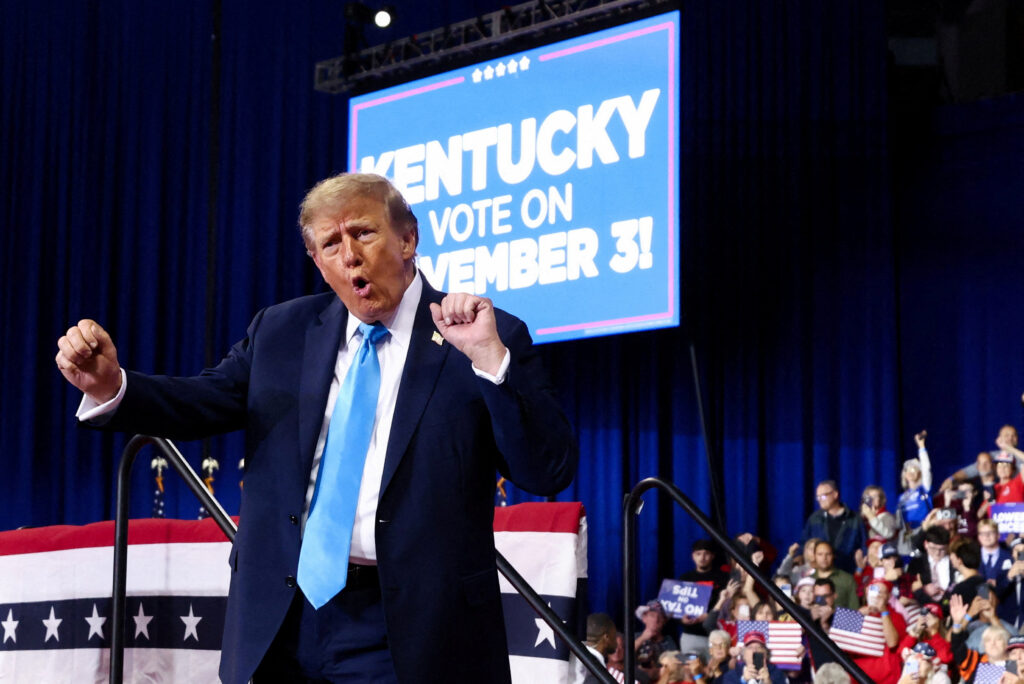
“If the Republicans win, the Department of War will be investing $100 million in the pharmaceutical company Antheia to revitalize a gigantic drug manufacturing facility in Winchester, Kentucky,” Trump said at a rally in Kentucky last week. “That’s a big one,” he quipped.
Trump offered a similar sweetener earlier this week in Kansas, telling the audience he will remove bans on summertime sales of fuel blended with ethanol — made from Kansas’s crops — only if GOP Sen. Roger Marshall wins reelection next month.
“With Roger Marshall in the Senate, we will make year-round E15 permanent. But if Adam Hamilton is in, I’m not going to do it. That’s it. I’m only doing it for him,” Trump said, noting the issue is “a big deal for Kansas” because the state is one of the top ethanol-producing states in the nation.
He also announced the so-called Harvest Fuel Relief Program, which would offer farmers $8 billion to “offset diesel costs during this harvest season,” and credited Marshall with the plan.
Trump called these plans “goodies” during his Kansas rally and let slip that he sees them as electoral levers he can pull to improve his political fortunes.
“I always heard that when you’re president, you have a little bit of an advantage,” Trump said. “And I sort of see why now, actually. I sort of see why.”
Democrats aren’t calling these goodies. They’re calling them bribes.
“Trump’s pledge to only take action if his political party prevails in the midterms — like his nationwide vote-buying scheme — shows that Trump and Republicans would rather attempt to bribe voters than make Kentuckians’ lives better,” said Nat Turner, spokesperson for the Kentucky Democratic Party.
“This is historic abuse of power,” Democratic podcaster Dan Pfeiffer wrote on X about Trump’s ethanol plan.
What stands out to me is just how politically desperate the repeated, localized promises make the president appear.
Trump has always pushed the envelope as far as possible, and this is no exception. But he seems to hope the promises are enough to at least dampen the reckoning that polls and reporting suggest is headed his party’s way next month.
The latest Washington Post poll found Trump at a record-low approval, with just 33 percent of U.S. adults approving of his job as president, compared with 66 percent who disapprove. The depth of that disapproval was striking: Just over half of Americans said they “strongly” disapprove of the job the president is doing, and 58 percent of registered voters said they would like a Democratic-led Congress that would check Trump, compared with 39 percent who wanted a Republican Congress that would support his agenda.
Trump’s promises are all economic, a tacit acknowledgment that the president must turn his economic numbers around if Republicans are going to buck historical norms and overperform in November. The same Washington Post poll found Trump’s economic approval rating at 28 percent, down from 33 percent in July, 41 percent in February and 49 percent at this point in the 2018 midterm election campaign.
With less than two weeks before the midterms, the president clearly thinks he needs a Hail Mary — and he is now willing to promise government action only if Republicans do well next month.
Want this in your inbox?
Start your day with The Washington Post’s flagship political newsletter. Sign up here.
From across the newsroom
- Ohio governor’s race in uproar over ad featuring Democrat’s estranged mother, from Karen Tumulty.
- Their police jobs ended. They kept using Flock’s vast surveillance network, from Douglas MacMillan, Drew Harwell and Aaron Schaffer.
- When protesters tried to levitate the Pentagon — and produced an anti-war icon, from Matthew Hay Brown.
- Riots leave France divided as Macron enters his final stretch, from Ellen Francis.
- U.S. restores intelligence sharing with Ukraine, Zelensky says, from Francesca Ebel.
What I’m watching
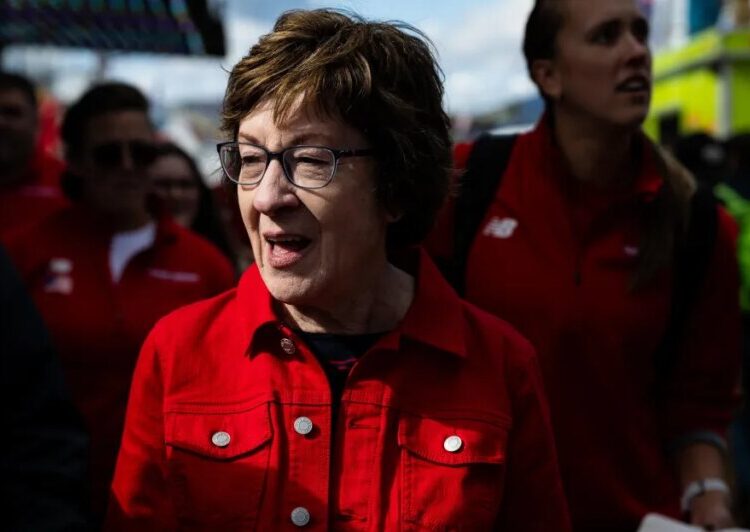
Elections are often a binary choice, and Maine’s critical Senate race between Republican incumbent Susan Collins and Democratic challenger Troy Jackson is no different.
But what if I told you the binary in Maine isn’t Collins vs. Jackson, but whether you like Collins or not?
That is the upshot of the piece I published this morning about Jackson and the Maine Senate race: Jackson, who Democrats chose to replace their original nominee Graham Platner after his campaign imploded, isn’t exactly a movement leader. Jackson admitted as much to me. But Democrats say that doesn’t matter, because Mainers’ rage at Trump — and at Collins for her role in advancing his policy goals — is so strong that voters will deny her a sixth term.
“This race isn’t really about me, it never was,” Jackson, 58, told me during an interview in Biddeford, Maine, the Saco River running behind us. “People should be angry that our government is broke.”
I want to be clear: Jackson has plenty of proponents. He has built up a lot of goodwill with Democratic voters for stepping into the race at the last moment, and he has a career of standing up for working-class and union workers, something on full display when he rallied with the AFL-CIO in York County, Maine.
But there is also an acceptance that Jackson is not the charismatic leader of a movement, and that that may be okay at this moment of deep anger at Trump and Republicans.
“I wish they were voting for Troy, for Troy,” Mattie Daughtry, Jackson’s successor as president of the Maine state Senate, told me before rallying a group of door knockers for Jackson in Brunswick, Maine. “But I think even if Troy were here, he would agree that the state has had enough of Susan Collins.”
Voters, including those supporting Jackson, were even more blunt.
“He’s not inspirational,” Chris Gulick, a 73-year-old in Kennebunk, Maine, told me mere seconds after casting his ballot for Jackson. “We have got to get rid of the Republicans,” he said, holding back tears as he explained his vote. “They are killing the country.”
You can read my full piece from Maine here.
In your local paper
Utah News Dispatch: Trump has a $1 billion proposal to save the dying Great Salt Lake. Utah’s Republican incumbent Sen. John Curtis says he is working in Congress to drum up support.
Virginia Mercury: Child care is a massive issue in state politics — one that is probably undercovered. Virginia officials recently found that closing the state’s child care affordability gap would cost $4.5 billion a year over the next decade.
Santa Fe New Mexican: Jeffrey Epstein owned a ranch in southern Santa Fe County, and local officials are trying to better understand what happened there. Now, state Attorney General Raúl Torrez “has renewed his call for Congress to pass a bill that would add teeth to a federal law on Epstein files.”
From you
You sent in a few responses to my question about your most audacious midterm prediction. But I wanted to highlight two here — both from Maine.
“I hope it’s not too audacious, but I think Matt Dunlap is going to win the race for the second congressional district in Maine,” wrote Angelica Booker, about the Democratic candidate for the open swing seat. “It’s the second most rural district in the country, and has leaned more and more Republican over the last decade, but Matt is such a genuinely great guy and devoted Mainer, that I really think he can win this.”
Mike Hein, a reader in Fairfield, Maine, took a different view.
“Maine, weirdly being the center of the political universe this cycle, will buck the national midterms trend of going against the current President’s party,” Hein wrote, predicting that Collins will win reelection and Dunlap will lose to former governor Paul LePage next month. “The final Senate result of 50.5% to 49.5% will fall into recount territory and only Troy Jackson’s camp knows whether he’ll request one and thus subject us to that weeks-long electoral torture mechanism.”
Send a reply
Religion has played a significant role in these midterms, from questions about the reaction some Jewish voters in Michigan have had about Abdul El-Sayed’s Senate campaign to Trump saying a Kansas pastor running as a Democrat “mocks Jesus” to all the focus on James Talarico’s self-proclaimed “cringey” commentary on God in Texas. (Shout out to American University student Neil Lazarus, who asked me about this topic when I spoke to his class last night!)
So I wanted to ask you: What role does a candidate’s faith play in your decision to support them? How do you factor a candidate’s religion or role in their faith into your voting decision? Let me and your fellow Early Brief readers know at [email protected].
Thanks for reading. You can follow me on X at @merica.
The post Trump’s questionable election ‘goodies’ are getting more bespoke appeared first on Washington Post.