SAN FRANCISCO — In her decades leading House Democrats, Rep. Nancy Pelosi (California) was known for the ironfisted rule that kept her caucus in line and propelled major legislation through Congress.
As she prepares to retire after nearly 40 years representing San Francisco, the first woman speaker of the House is putting that influence to perhaps a final test: whether she can anoint her successor.
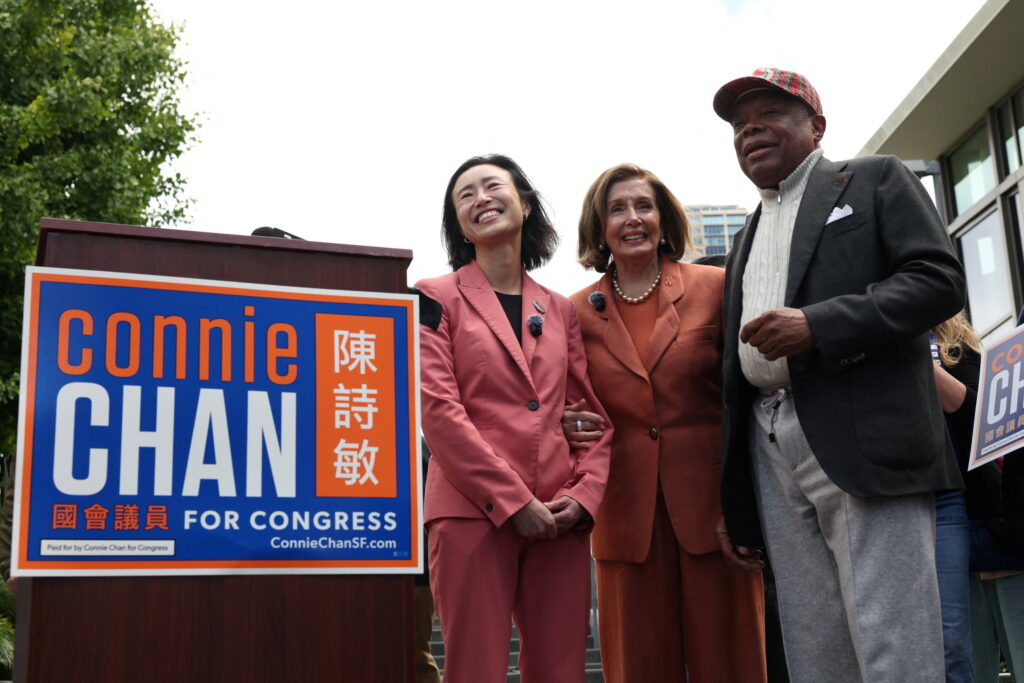
Pelosi’s endorsement of underdog Connie Chan — a member of the city’s board of supervisors who had strong support from organized labor but scant financial resources — instantly shifted the race ahead of the June primary. Pelosi’s seal of approval has helped elevate Chan into a highly competitive runoff with fellow Democrat Scott Wiener, whose accomplished but divisive tenure in the state Senate made him a front-runner to replace Pelosi.
“Having her support means everything,” said Supervisor Shamann Walton, a supporter of Chan’s. “We want somebody who knows how to fight like Nancy.”
The campaign marks yet another chapter in the perpetual battle between San Francisco’s progressive and moderate Democratic wings, this time over issues such as housing development and the war in Gaza. (It’s all relative, of course, as either of these candidates would be among the most liberal in Congress on most matters.)
But Pelosi looms. She tapped donors, rounded up additional endorsements and even lent staff to Chan in a show of force. Meanwhile, her barely concealed disdain for the ambitious Wiener — who angered Pelosi by making moves for the seat before she was ready to give it up — has fueled complaints from Wiener allies that Pelosi is driven primarily by a personal vendetta.
A win for Chan would cement Pelosi’s imprint on the city whose image she came to define on the national stage. That’s no guarantee, though.
“She has such a powerful legacy. I’m sorry for her that this last maneuver is going to be a stain,” said Susie Tompkins Buell, co-founder of the Esprit clothing brand and a prominent local Democratic donor backing Wiener. Tompkins Buell expressed disappointment that Pelosi has put so much effort into blocking what would have been a “shoo-in” for Wiener, which she said diverted resources better spent elsewhere helping Democrats win back the House: “It just seems very small to me.”
The drama has threatened at times to overshadow the candidates themselves and the stakes of the race. Both would make history for San Francisco — Wiener the first openly gay House member from the city or Chan, who was born in Hong Kong and immigrated at age 13, a breakthrough for its large Chinese community. The two have clashed over whether she is an obstructionist to much-needed housing development and his hesitancy to label Israel’s actions in Gaza a genocide, which he eventually did in January after much criticism.
Chan, 48, presents herself as a voice for the middle class who will fight for affordability in Washington, in contrast to Wiener, whose campaign has drawn millions of dollars in funding and outside spending from developers and tech interests.
“We know that we’re a Democratic city. We’re going to send a Democrat to Congress. So what kind of Democrats are we sending?” Chan said in an interview, following a Gaza solidarity rally at an Irish cultural center where she called for an arms embargo on Israel. “Scott Wiener is not good enough a choice for the working people.”
Wiener, 56, a veteran local and state representative, touts his extensive legislative record, including early regulations for artificial intelligence models. His contentious proposals to boost housing production have made him a national avatar for the Yes In My Backyard movement. Wiener argues that he is the only candidate who has proved he could be effective right away in Congress.
“I don’t have to work through another person to be introduced to voters or to be vouched for,” Wiener said over coffee near his home in the Castro District. “I have a direct relationship with San Franciscans.”
While Pelosi endorsed Wiener in a handful of his previous campaigns, the tension between them has built for several years. Wiener launched an exploratory committee for Congress in 2023, before Pelosi publicly indicated that she planned to step down. It was an attempt to position himself for the once-in-a-generation opportunity when the seat finally opened.
Speculation has swirled that Pelosi was trying to clear the way for her daughter, Christine, to follow her to Congress, which both have denied. Christine Pelosi is now running for Wiener’s state Senate seat instead.
Then last October, weeks before Nancy Pelosi announced her retirement, Wiener formally entered the race. He said he couldn’t wait any longer as Saikat Chakrabarti, an independently wealthy tech executive and progressive political operative who had already been running for months to challenge Pelosi from the left, made inroads in the city.
The lack of deference to Pelosi’s timeline infuriated her. She waited until November to make her plans known, two days after California voters passed a critical ballot measure gerrymandering the state’s congressional lines to benefit Democrats.
“She wouldn’t even mention his name,” said Kim Tavaglione, executive director of the San Francisco Labor Council, a longtime Pelosi ally. “You could tell she was a little irritated by it, because she didn’t want that to be the headline.”
The labor movement in California also has a complicated relationship with Wiener, whose legislative efforts to streamline the building process came into direct conflict with job protections and pay standards for construction workers. Tavaglione said union officials often felt dismissed and mistreated by Wiener, whom she said “has a paternalistic way of governing.”
Union leaders pushed Pelosi to get behind their preferred candidate, Chan, the progressive chair of the board of supervisors’ budget committee. Chan has been a controversial figure in her own right for fiercely opposing policies to build denser housing across San Francisco.
Pelosi eventually endorsed Chan in May, shortly before the primary election, citing her “voice that will be heard for the people, not the powerful” and her “lived experience” as an immigrant. It provided a crucial jolt of momentum for Chan, who trailed in early polls but surged past Chakrabarti to finish second with about 30 percent of the vote, behind Wiener with about 41 percent. Under California’s open primary system, the top two vote-getters advance to a November runoff, regardless of party.
Pelosi declined to be interviewed for this story. But before a fundraising stop Tuesday in the Phoenix suburbs, she told a Washington Post reporter that she was “just looking for the best” candidate to endorse and that she “didn’t even think about” Wiener.
“People say, ‘Oh, it must have been something he did.’ No! Stop thinking about him! It’s about her!” Pelosi said. “I don’t think they’ll vote that differently in Congress, but … the women thing was very important, and that she happens to be fabulously capable.”
Since the endorsement, Pelosi has become a highly valuable, and sometimes ruthless, surrogate for the Chan campaign. She hosted fundraisers and phone-banked for Chan. In August, after the Wiener campaign created an AI-powered chatbot mocking what it said was Chan’s penchant for saying no, Pelosi gathered a group of Democratic women lawmakers to publish a letter condemning Wiener for reinforcing sexist tropes and racist stereotypes. Wiener apologized and took down the chatbot.
Andrea Dew Steele, the founder of an organization that develops female candidates and a self-professed “disciple” of Pelosi, joined a rally to defend Wiener from those accusations. She said in an interview that she was perplexed by Pelosi’s opposition to Wiener, whom she described as “a pragmatic progressive” who is “absolutely in Nancy Pelosi’s model.”
“I don’t understand it, to be honest. Because I know she loves her adopted city of San Francisco,” Dew Steele said. “He is literally one of the smartest, most hardworking politicians I’ve ever encountered.”
Wiener speaks carefully about Pelosi’s involvement in the race. “She has every right to have a strong opinion about who succeeds her,” he said, though it’s clear some of her moves have wounded him, including the “over-the-top, unfair” letter about the chatbot.
“The last few years have been hard and that’s the reality,” Wiener said. “The speaker emerita and I, whatever our current disagreements, both care deeply about San Francisco and the country, and I know we’ll all move forward after the election.”
All sides are now downplaying the significance of the Chan endorsement. Chan’s supporters accuse Wiener of unnecessary histrionics over Pelosi’s involvement in the campaign. Walton said “Scott winning the race doesn’t tarnish her at all, because no way in hell could Scott beat Nancy.” Wiener called the endorsement “a footnote” for Pelosi and said that, even if he wins, “her legacy is going to be just fine.”
Chan, for her part, is trying to define herself for voters beyond her most famous supporter.
“I absolutely appreciate and have worked hard to earn that endorsement, just as I have worked hard to earn a lot of endorsements along the way,” she said. Asked about criticisms that her campaign has been pulled along by Pelosi, Chan made a mocking crying face: “Wah wah!”
While Pelosi’s stamp of approval sent a clear signal through San Francisco political circles, it’s less clear that it matters to voters still trying to decide between Chan and Wiener.
Craig Powers, a 57-year-old banker, said he would “probably be swayed by Nancy’s endorsement,” which he said would cause him to look more closely at a candidate. “I have always tended to agree with her politically,” he said as he strolled through the Noe Valley neighborhood.
But many San Franciscans, while expressing admiration for Pelosi’s career, say they have been waiting for new leaders and fresh ideas.
“Her time has passed,” Jennifer McGaugh, a 58-year-old nurse, said as she relaxed in Mission Dolores Park on a recent afternoon. McGaugh, who sported a Democratic Socialists of America baseball cap, said she would always appreciate Pelosi’s early support for HIV and AIDS patients, but their politics have diverged in recent years. Pelosi’s endorsement, she said, “doesn’t have the power it used to.”
Nathan O’Hara, a 27-year-old software developer who voted for Chakrabarti in the primary, said he was having trouble differentiating between Wiener and Chan, both progressives whom he figures would govern nearly identically in Congress.
“This is an election where I’m trying to understand better what my representative in Washington can actually do,” O’Hara said. “I don’t know the degree that I care about Nancy Pelosi’s opinion at all.”
The post Nancy Pelosi goes all in on helping elect an underdog as her successor appeared first on Washington Post.