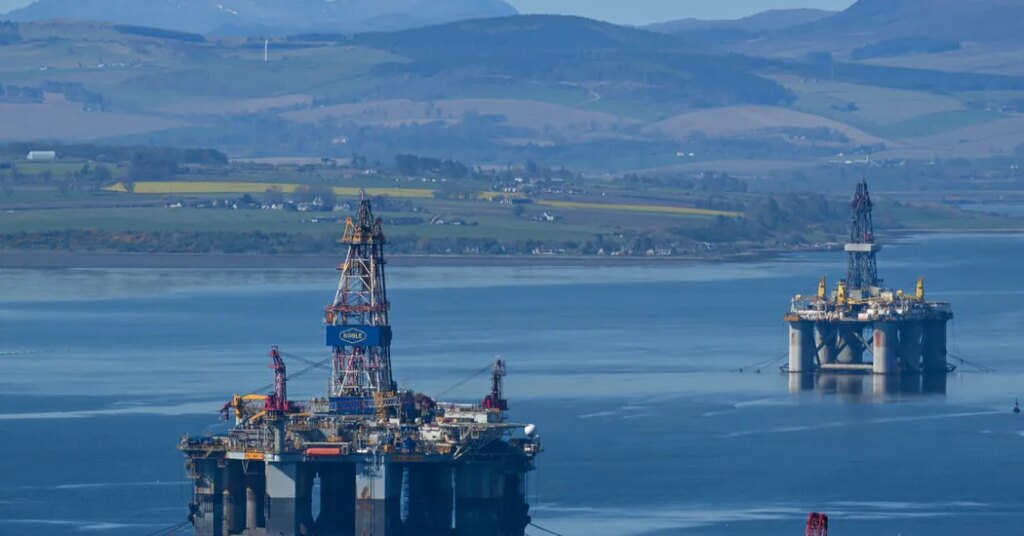
The British government greenlit a major offshore natural gas project in the North Sea on Wednesday, defying its own climate change pledge to halt new fossil fuel extraction.
The approval for the Jackdaw field, off the coast of Scotland, is a major victory for Britain’s oil and gas industry, unions and cities in Britain’s energy heartland, which consider the project an economic lifeline. It is also a win for President Trump, who has pressured a succession of British leaders to “open up” the North Sea to new oil and gas drilling.
Amid a sharp rise in energy prices caused by the war in Iran, British leaders cast the decision as a crucial step toward reducing the country’s reliance on imported fuels. Jackdaw’s gas would be used in Britain and fed into the gas network.
Environmental activists called the approval of Jackdaw a betrayal of the country’s efforts to transition to renewable energy. They also noted that the decision comes just weeks ahead of a United Nations climate summit in Turkey, where Andy Burnham, the prime minister, has said he will lead the British delegation and “meet the climate challenge.”
“Jackdaw won’t make a lot of difference to our energy bills, but it will fuel the climate chaos already unfurling in front of us,” said Danny Gross, a campaigner for Friends of the Earth, an environmental group.
Mr. Burnham’s government has left an even more contentious decision — whether to allow a separate offshore oil development in the North Sea known as Rosebank — for a later date.
Jackdaw will be the first new oil and gas extraction in Britain’s North Sea since the Labour government imposed a moratorium on new drilling.
Adura, a joint venture between Shell, the British oil giant, and the Norwegian energy company Equinor, intends to develop the project. It has said work on the field could begin immediately after approval.
Britain imports most of its oil and gas, and the war in Iran has pushed up the costs by disrupting global energy markets. Supporters of new North Sea drilling argue that expanding domestic extraction is essential to safeguarding Britain’s energy security and shielding households from price volatility.
Adura estimated that Jackdaw’s gas could meet 6 percent of Britain’s gas needs and heat 1.4 million homes, reducing the country’s reliance on imported liquefied natural gas. The field is believed to hold about 200 million barrels of oil equivalent.
Supporters of new drilling argue that even as Britain transitions to clean energy, the nation will remain dependent on natural gas for decades. After all, 85 percent of Britain’s homes and businesses still use boilers for hot water and central heating, and 30 million vehicles still run on petroleum. New domestic sources will help ease Britain’s reliance on imports.
While a portion of those imports comes via pipeline from Norway — a neighbor with strict environmental regulations — the rest must be shipped across oceans as liquefied natural gas, or L.N.G. Supplying Britain from far-flung producers like Qatar, Peru, and Trinidad and Tobago carries a significantly higher carbon footprint because of the energy required to cool and transport the gas.
“Jackdaw is 99.9 percent complete and with approval now secured, gas from this field will be flowing into homes up and down the country within weeks,” Russell Borthwick, chief executive of the Aberdeen & Grampian Chamber of Commerce said in a statement.
He called the approval “a direct, tangible boost to the U.K.’s energy security at a time when it matters most.”
Environmental groups have estimated Jackdaw’s gas will serve closer to 2 percent of the country’s needs and noted that Britain would still require imports. They also maintained that new oil and gas extraction diverts money and momentum from renewable power.
“Jackdaw has been oversold,” said Tessa Khan, the executive director of Uplift, a British environmental group.
“Clean energy is how we lower bills and reindustrialize regions, not by caving to an oil industry making obscene profits while pushing up bills, laying off workers and driving the heat waves we saw this summer,” Ms. Khan said.
There is also the question of whether the approval of Jackdaw violates domestic and international commitments.
Rosebank was first approved in 2022 and Jackdaw a year later, when the Conservative Party was in power. But environmental groups sued, and those approvals were later overturned.
In 2024, nearly 200 nations agreed at a United Nations climate summit to transition away from fossil fuels. A few months later, the Labour government under Keir Starmer, who preceded Mr. Burnham, pledged a moratorium on new drilling licenses.
Mr. Burnham inherited that pledge when he became prime minister in July. But since both fields were licensed under a previous government, supporters argued, allowing exploration to move forward again does not violate the moratorium.
For the fog-shrouded stretch of the Scottish coastline around Aberdeen, the epicenter of Britain’s oil industry, the approval offers a rare new economic opportunity. The region has endured a quarter-century of declining North Sea production, with the local business chamber reporting losses of more than 1,000 oil and gas jobs each month.
The anxiety over the basin’s decline was underscored in August when BP announced plans to sell its North Sea business after six decades of operations there.
Oil and gas industry officials said the approval of Jackdaw was unlikely to change BP’s decision. It also won’t change the fundamental geology of the North Sea basin, where about 93 percent of oil and gas has already been extracted.
But, they argued, the project would provide enough investment to keep jobs steady as Britain sought to bolster renewable energy industries like offshore wind.
For Mr. Burnham, the decision is one of the first tests of how he will balance demands from progressive lawmakers in his party with the economic realities that face his government.
Many Labour members of Parliament are counting on Mr. Burnham to be a more robust advocate of their pro-environment agenda than Mr. Starmer was. During two decades in public life, Mr. Burnham has frequently endorsed net-zero policies and vowed to be part of the fight against climate change.
But the wars in Ukraine and Iran have driven up the price of energy and left many in the country angry about the rising cost of living.
Those goals — maintaining his party’s commitment to the environment and promising to lower energy costs — could prove difficult to achieve at the same time. Since Mr. Burnham took office, his aides have suggested he will take a “pragmatic” approach to energy, by accepting the need for dependence on fossil fuels in the short run but pushing the country toward a sustainable transition over time.
In his first call as prime minister with President Trump, Mr. Burnham also promised that he would be pragmatic about the North Sea energy fields. “There is a resource there,” the prime minister told reporters. “When people are struggling, we can’t ignore that.”
In some ways, Mr. Burnham’s decision to approve new drilling is a strange alignment with Mr. Trump, who has berated British prime ministers for embracing net-zero policies and failing to drill more in the North Sea.
Despite Mr. Trump’s vocal support for British offshore extraction, American oil giants have almost entirely abandoned the North Sea, driven out by declining yields in mature fields and higher operating costs.
ConocoPhillips sold off its British fields in 2019, followed by Exxon Mobil, which parted with decades of North Sea holdings to refocus capital on U.S. shale and South American deepwater projects. Chevron, the last major American holdout, also sold its remaining British North Sea assets.
Michael D. Shear contributed reporting from London.
The post Britain Approves New Gas Drilling in the North Sea appeared first on New York Times.