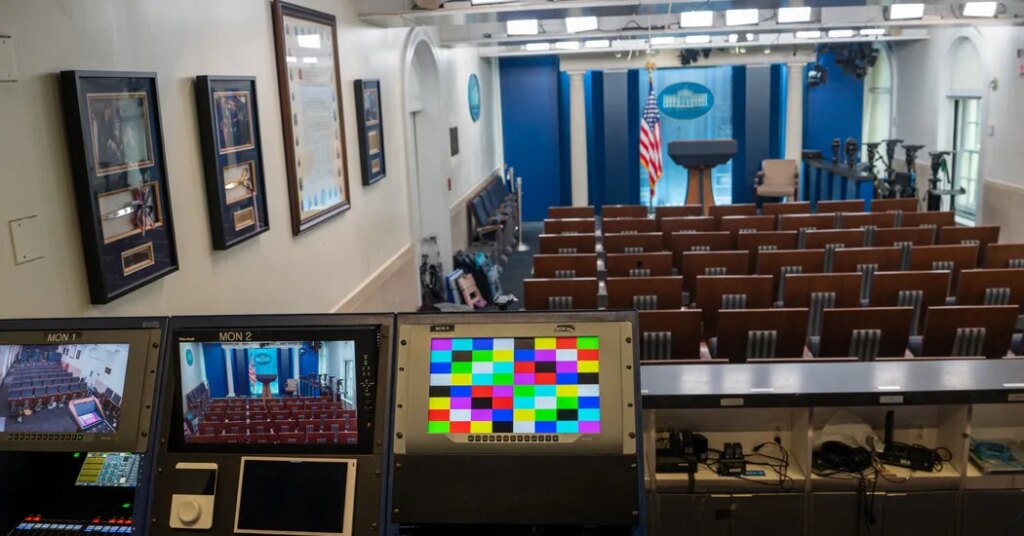
In late August, during one of Karoline Leavitt’s final meetings with President Trump in the Oval Office, he pitched her on an idea in front of several senior aides. He told her to move reporters out of the James S. Brady Press Briefing Room, which would effectively remove news organizations from the White House. It would be, he told her, her “last legacy.”
But the proposal never moved forward while she was there. The president had put the request to her several times over months, according to three people with knowledge of the discussions who were not authorized to speak publicly. Ms. Leavitt officially stepped down as White House press secretary on Aug. 27.
Mr. Trump has told aides he would prefer to bring back the indoor pool President Franklin D. Roosevelt added in 1933 as therapy for his polio-afflicted legs; President Richard Nixon later covered it over to make room for the news media. Journalists who are credentialed to cover the White House work out of a small office space connected to the press briefing room.
While moving the media out of the White House may be a relatively small debate considering Mr. Trump’s attacks on journalists more broadly, it would be highly symbolic. The proximity of the media to the seat of U.S. executive power has long been an acknowledgment of the importance of a free press in a constitutional democracy.
It would also be a decision that would be difficult to undo by future presidents.
Mr. Trump has brought up the press-eviction idea before, dating to his first term, and he has never quite dropped it. A growing number of people around him favor the idea. Several close to him believe that moving the news media, most likely to the Eisenhower Executive Office Building across the street, may be the latest escalation in a remarkable series of moves against the news media that have already gone further than most of them expected.
As recently as Sept. 27, Mr. Trump shared a pair of images on Truth Social showing the briefing room as it is now, captioned “Fake News,” alongside another that shows the space reimagined as a gilded swimming pool, captioned “FDR Pool.”
The Wall Street Journal reported last month that Mr. Trump had repeatedly discussed moving the press corps out of the White House, and that his advisers had so far either offered pushback or waited for him to move on.
What has changed since Mr. Trump’s first term or even earlier this term is the staff around him. The president’s core team has shrunk from the already-tight unit that he brought into the White House last year. During earlier discussions, most of Mr. Trump’s senior aides agreed it served him better to keep the media nearby. But Mr. Trump has grown more enraged about his press coverage, and other advisers of growing influence have encouraged him to take drastic measures to punish journalists.
“America is rightly distrustful of the fake news media because they fabricate stories based off lies and sources who are not even privy to any type of information,” said Steven Cheung, the White House communications director. “All options remain on the table, and we will make an announcement when appropriate.”
A Buffer Against the Press
During the 2016 Trump transition, Stephen K. Bannon, then the incoming chief strategist, suggested moving the press corps out of the West Wing, to a townhouse near Lafayette Square. Senior officials rejected the idea out of hand. Mr. Bannon proposed the Eisenhower building as a fallback option.
In January 2017, the incoming chief of staff, Reince Priebus, publicly confirmed that the team was weighing a move of press briefings to that location, framing it as a way to accommodate more reporters. But he and others dropped the idea, ultimately viewing it as too disruptive and impractical.
“From the moment I arrived in the White House I believed it was a national security threat to have the press literally surround the Oval Office — and devised a plan to either move them off campus next to the Blair House or at least to E.O.B.,” Mr. Bannon recalled in a statement to The New York Times this month. “But definitely physically remove them from the West Wing. That plan landed with a thud among all the other senior advisers to the president.”
The idea came up again during the summer of 2017, when the West Wing was undergoing renovations. A former administration official recalled that it was less a formal plan than an impulse tied to the renovations: With the space torn up anyway, why let the reporters back in? The official said that Sean Spicer, the departing press secretary, and Sarah Huckabee Sanders, his successor, questioned the logistical complexities. It soon died again.
The idea came up yet again during the presidential transition in late 2024. Most of Mr. Trump’s advisers thought it was better to leave the news media inside the White House. They knew Mr. Trump liked to call the cameras into the Oval Office at a moment’s notice. And several of his more seasoned advisers suspected that if they followed his direction to evict the press — and his coverage got worse — Mr. Trump would blame them for the inevitable results of his own idea.
But even without physically moving the news media to a building outside the White House main gates, the administration has for months been building up a buffer against the press. Last fall, Mr. Trump’s team barred reporters from entering “Upper Press,” the area near the press secretary’s office, without an appointment.
It has been more than 30 years since another president seriously considered removing the news media from the White House. President Bill Clinton’s first communications director, George Stephanopoulos, recounted in his memoir that in 1993 the first lady, Hillary Clinton, wanted to convert the press quarters back into a swimming pool. When word of her plan leaked, the blowback quickly ended it.
But Mr. Trump currently faces no comparable pressure to accommodate a news media that is despised by so many of his supporters. He has received relatively little backlash so far — even from Democrats — against his anti-media moves.
Attacks on the News Media
Mr. Trump entered his second term emboldened by his victory, and he quickly went on offense against media companies that had covered him critically. He filed lawsuits against ABC, CBS and The Des Moines Register. His aides made clear that the president intended these suits to have a chilling effect on negative coverage.
One of the instigators of the swimming pool discussion has been Bill Pulte, the director of the Federal Housing Finance Agency, according to two people familiar with the discussions. Mr. Pulte has no formal role in White House operations. But he created a foam board rendering of the briefing room restored as an in-ground pool, the people said.
Mr. Pulte often spends his weekends with Mr. Trump at his golf clubs. The president has only a tiny staff around him on the weekends, which means Mr. Pulte often enjoys freewheeling access to Mr. Trump, which he uses to pitch the president on his latest ideas. Senior White House officials say that Mr. Pulte brings along foam boards that highlight potential targets for revenge prosecutions.
Mr. Pulte did not respond to multiple messages seeking comment.
Another top adviser feeding into Mr. Trump’s anti-media tendencies is Boris Epshteyn, the president’s longtime lawyer and outside adviser, who pushed several of the lawsuits the president has filed against news outlets or individual journalists. Mr. Epshteyn’s influence has grown in recent months, according to current officials and people close to the president. Mr. Epshteyn declined to comment.
In September, Mr. Trump startled some of his own advisers by declaring on social media that he was banning CNN, MS NOW and Politico from the White House over coverage he called “fiction and lies.” The administration swiftly revoked the credentials of more than 70 journalists.
The Wall Street Journal reported that Natalie Harp, the aide who controls much of the media and messages from supporters that reach the president’s desk, and the majority of his social media feed, had played Mr. Trump clips of MS NOW anchors criticizing his administration shortly before he announced the ban on the three outlets.
Ms. Harp did not respond to a request for comment.
Judge Timothy J. Kelly, whom Mr. Trump appointed in his first term, had put a hold on the president’s media ban, saying officials there had violated standard process. But the White House continued for a short period to bar those outlets from the grounds. Judge Kelly last week ruled that the president had violated the outlets’ First Amendment rights and ordered their passes restored. The administration is appealing his ruling.
The campaign against the news media has not stopped there. On Oct. 9, the Justice Department sent letters demanding information from ABC, CBS, CNN, NBC and Fox News after the five networks temporarily halted their pooled White House TV coverage in solidarity with CNN. People with knowledge of the effort said it was an antitrust investigation.
That Justice Department effort came just a few months after F.B.I. agents showed up at the homes of Times reporters to serve them grand jury subpoenas. Earlier that week, they had reported on security concerns about Mr. Trump while he traveled to Turkey for the NATO summit, as well as the lack of some defensive equipment on the luxury jet, donated by Qatar, that Mr. Trump was using as his new Air Force One.
The president was livid about the reporting and demanded his aides find the leaks, multiple people familiar with the matter said.
The Justice Department withdrew the subpoenas within a few weeks, after the judge in the case admonished federal lawyers for violations of process in appearing to use subpoenas as a first option instead of a last resort to obtain information.
With Mr. Trump’s encouragement, other government departments have taken draconian measures against the press as well. Earlier this year, the Defense Department required credentialed reporters to sign a pledge that included not soliciting unauthorized information. Nearly every major news organization, including Fox News, refused to do so, and instead chose to give up work space in the building.
The post Trump Pushes to Evict the Press From the White House appeared first on New York Times.