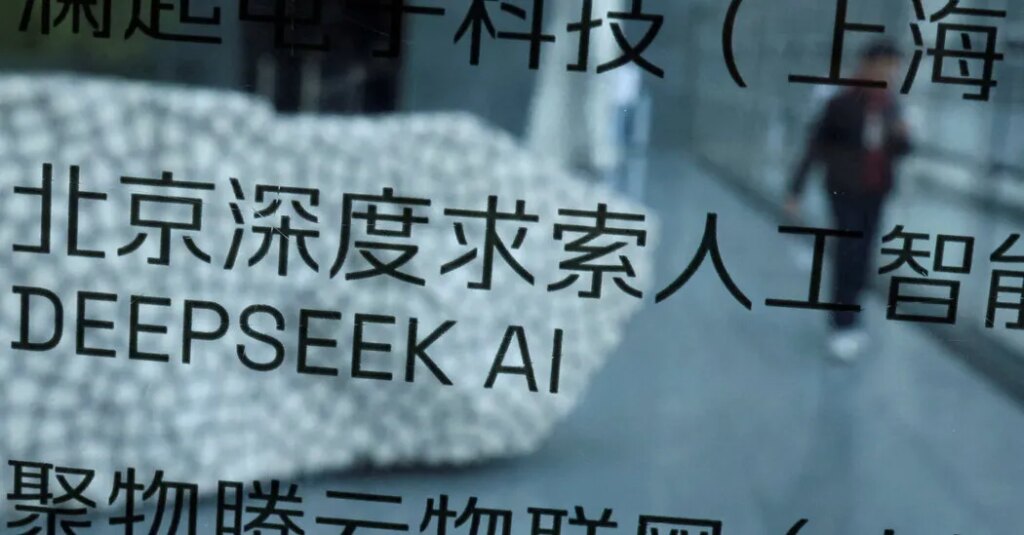
China on Tuesday accused the United States of discrimination “under the pretext of so-called national security” after a U.S. order banned products by the Chinese artificial intelligence giant DeepSeek from the technological systems of many U.S. government agencies.
The American order, published on Monday but issued in July, and the Chinese recriminations inflamed tensions between the two nations amid their frenzied race for A.I. primacy. Some experts have likened the close competition to the nuclear arms race of the 20th century, with potentially huge stakes for humanity.
Citing fears that China may gain access to sensitive U.S. data from DeepSeek to “produce actionable intelligence,” the Department of Homeland Security ordered the removal of all the company’s products — and those from other firms reliant on its open-source offerings — from the informational technology systems in civilian executive branch agencies. It also banned future acquisitions of the products.
In issuing the order, which went into effect this summer, U.S. officials contended that the China’s legal system allows that government extensive access to Chinese company infrastructure, making the U.S. government vulnerable to the exposure of sensitive information. The assertion angered Chinese officials, who on Tuesday accused the United States of using disingenuous national security concerns to suppress Chinese companies.
China’s Ministry of Commerce said in a statement that China had passed laws to protect cybersecurity and data privacy to ensure that its companies can comply with relevant laws worldwide. It called on the United States to “withdraw” any restrictive measures.
“China has consistently opposed the overgeneralization of the concept of national security and the politicization of science, technology and trade issues,” Mao Ning, a spokeswoman for China’s foreign ministry, said at a briefing on Tuesday. “We will resolutely safeguard the legitimate rights and interests of Chinese enterprises.”
DeepSeek stunned the world last year when it announced that it had built one of the most powerful A.I. systems with far fewer computer chips than many thought necessary, and at a remarkably low training cost of less than $6 million.
U.S. agencies accused DeepSeek last month of being “misleading,” saying that figure did not reflect “the true cost” of data acquired maliciously. The accusations echoed those made by major American A.I. companies like Anthropic and OpenAI.
China’s Commerce Ministry called those claims groundless, and part of a U.S. effort to monopolize the A.I. industry. It vowed that “China will take resolute countermeasures” if Chinese companies are suppressed or restricted as a result.
The Chinese government rejected accusations by the F.B.I. and other agencies that DeepSeek and other major Chinese A.I. companies engaged in “aggressive, malicious and targeted” industrial-scale copying of frontier A.I. models developed in the United States “in an attempt to bridge the technological and performance gaps,” most “likely” with their government’s awareness.
Last week, China’s Commerce Ministry and its Ministry of Science and Technology proposed new export and licensing controls on some A.I. technologies to protect its domestic industry, mirroring the American approach. While the Chinese proposal has not been finalized and excludes open-source models that have already been released, the newly listed technologies now face registration requirements.
Tensions between the two countries are growing at a time when some say that coordination is tantamount to the A.I. race.
The United States has in recent years restricted the exports of advanced computer chips to limit China’s A.I. development. DeepSeek and other Chinese companies have raced forward despite the limits. And this past spring, DeepSeek said its new model relied on chips made by the Chinese tech giant Huawei, a milestone in China’s effort to reduce the need for foreign technology.
DeepSeek is among several prominent Chinese companies, like Moonshot AI and Alibaba, that allow developers to download open-source systems free and build products with them, unlike OpenAI and Anthropic, which can charge fees.
That has made Chinese A.I. appealing to American businesses, giving them access to models deemed nearly as effective by many experts at a much lower cost and potentially raising challenges for Anthropic and OpenAI ahead of planned initial public offerings.
(The New York Times has sued OpenAI and Microsoft, claiming copyright infringement of news content related to A.I. systems. The companies have denied the suit’s claims.).
It is not clear how reliant U.S. agencies have been on DeepSeek or on products that integrate its technology. The Homeland Security order gave no specifics, and when reached for comment, the department did not answer questions about the extent to which the targeted products had been integrated.
In a statement to The Times on Tuesday, a spokesperson for the U.S. Cybersecurity and Infrastructure Security Agency said that new exclusion and removal orders addressing DeepSeek were issued on Friday by the heads of the Department of Defense, Homeland Security and the National Intelligence Program requiring agencies to identify and remove DeepSeek and affiliated products.
DeepSeek could not be reached by phone on Monday, and it did not immediately respond to an email seeking comment.
The Homeland Security Department is not the first federal or state agency to restrict or ban the use of DeepSeek in its official systems or devices.
The Commerce Department, the Navy, the Defense Information Systems Agency and NASA have all barred its use, and states including Texas, New York and Virginia have prohibited the use of DeepSeek products in government work.
Other countries have made similar moves. Among them, France and Australia last year blocked the use of DeepSeek tech from all government systems. Italy also banned its products from app stores, citing concerns about data protection.
Xinyun Wu contributed reporting.
The post China Condemns U.S. Ban on DeepSeek A.I. in Government Systems appeared first on New York Times.