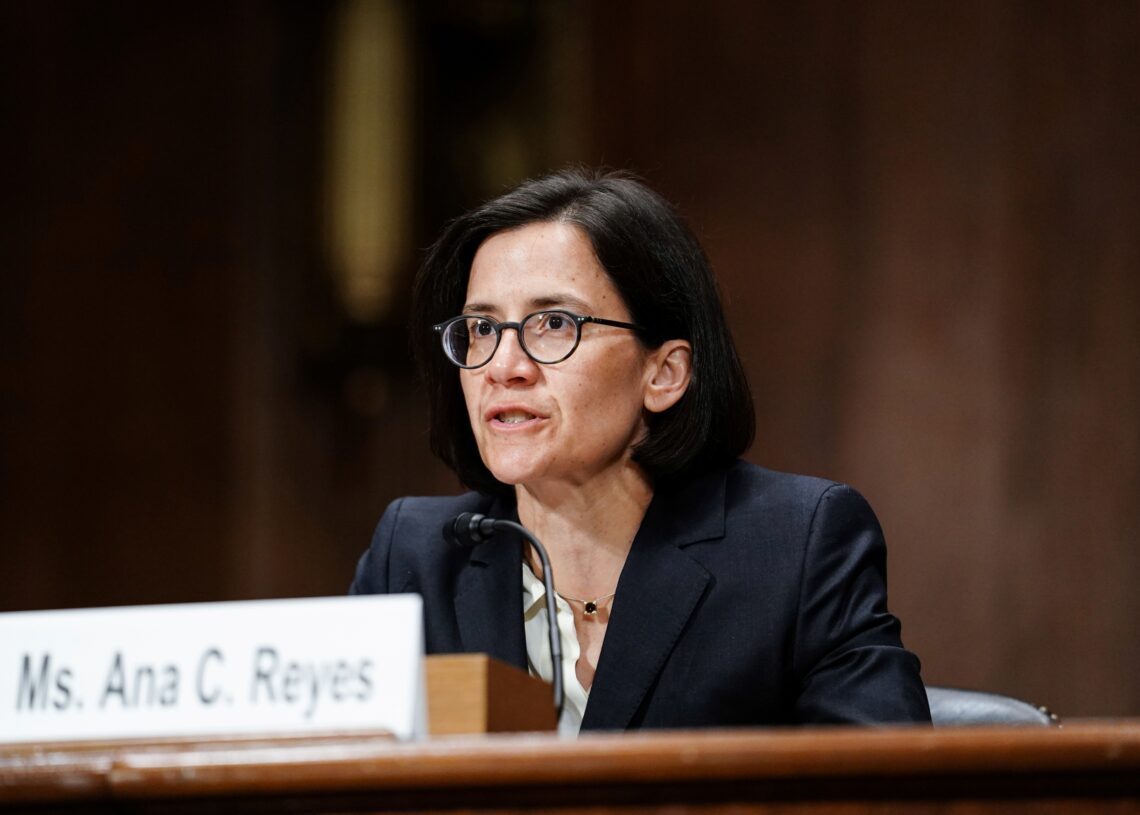
Federal judges across the country regularly clash with the Trump administration, but few have made headlines for their heated exchanges with government lawyers like U.S. District Judge Ana C. Reyes, who is handling a case over President Donald Trump’s controversial overhaul of a historic D.C. golf course.
Justice Department attorneys have accused Reyes of a “deep-seated and unequivocal antipathy” toward the Trump administration. Trump called her a “crazed lunatic” in a social media post Monday.
For her part, Reyes has repeatedly chastised the government for its moves on the golf course, at one point saying she keeps “getting different stories” and another time saying she was “furious” and “beyond disappointed in the government.”
The case centers on the administration’s plans to remake East Potomac Golf Links, a public course on federal parkland, and whether officials have complied with environmental and historic-preservation laws. The confrontation intensified after the National Park Service removed more than 400 trees from the course this month while maintaining that the work was unrelated to Trump’s broader redesign.
Reyes noted Monday that she initially sided repeatedly with the government and resisted efforts to restrict its work but has since questioned its credibility, and temporarily halted further tree removal. The Justice Department sought her recusal from the case last week, accusing her of “open hostility” toward the administration, which Reyes denied.
Here are five things to know about Reyes, who was nominated to the federal bench by President Joe Biden in 2023.
1) She has ruled against the Trump administration in other major cases.
Reyes was the federal judge who ruled in February that the Trump administration could not abruptly end temporary protected status for more than 350,000 migrants from Haiti. The Supreme Court overruled her decision in June, letting the immigration authorizations expire.
In an opinion spanning 83 pages, Reyes upbraided then-Homeland Security Secretary Kristi L. Noem for referring to migrants from countries includin as “killers, leeches, and entitlement junkies” in a social media post.
The five Haitian plaintiffs in the case were a neuroscientist, a software engineer, a lab assistant, a college student and a registered nurse, the judge noted. TPS holders from all countries generated an estimated $5.2 billion in annual tax revenue for the U.S. government, she added.
“On December 2, 1783, then-Commander-in-Chief George Washington penned: ‘America is open to receive not only the Opulent & respected Stranger, but the oppressed & persecuted of all Nations & Religions,’” Reyes wrote in the opinion.
In another major case, Reyes issued a preliminary injunction last year barring Trump and Defense Secretary Pete Hegseth from implementing a ban on transgender troops in the military. “There is no evidence that they consulted with uniformed military leaders before doing so,” the judge wrote of Trump and Hegseth, adding that the administration’s documents implementing the ban were bereft of analysis or data.
“Indeed, the cruel irony is that thousands of transgender servicemembers have sacrificed — some risking their lives — to ensure for others the very equal protection rights the Military Ban seeks to deny them,” Reyes wrote in that 79-page opinion.
The Supreme Court later allowed the transgender ban to remain in effect while the appeals process unfolds. A divided panel of the D.C. Circuit federal appeals court largely upheld Reyes’s injunction this year; the Trump administration has asked the Supreme Court to have the last word on the matter.
2) She gave the maximum prison sentence to the IRS contractor who leaked Trump’s tax returns.
Reyes presided over the criminal case against Charles Littlejohn, a former IRS contractor who pleaded guilty to leaking Trump’s tax returns to the New York Times and those of thousands of other wealthy Americans to the investigative news outlet ProPublica.
At Littlejohn’s plea hearing in 2023 and sentencing in 2024, Reyes was unsparing in her criticism. She gave him the maximum sentence allowed by law: five years in prison.
After comparing Littlejohn to the rioters who stormed the Capitol on Jan. 6, 2021, Reyes said judges had to send a message that “open season on our elected officials” would not be tolerated and that “an independent and steadfast judiciary stands ready to punish anyone who holds his personal political beliefs above the law.”
“Let me be absolutely clear: What you did, in targeting the sitting president of the United States, was an attack on our constitutional democracy,” the judge told Littlejohn.
She also expressed astonishment that the Justice Department during the Biden administration agreed to let Littlejohn plead guilty to only one count of unauthorized disclosure of tax information. More counts probably would have led to more prison time.
The judge’s aggressive stance toward the leak drew praise at the time from one of Trump’s attorneys, Alina Habba, who attended Littlejohn’s plea hearing and addressed the court to request a five-year prison sentence on Trump’s behalf.
“First, I want to say that I appreciate Judge Reyes and her comments,” Habba told reporters outside the courthouse after the plea hearing in 2023. “I am often a critic of any court where I feel that political motivation or bias is brought in. It was very clear that this judge does her job, takes it seriously, and also takes the privacy rights of Americans very seriously.”
In a legal brief last year arguing against a reduction of Littlejohn’s prison term, another Trump attorney, Jesse Binnall, wrote that the five-year sentence “was the only sentence that meaningfully reflected the seriousness of the offense, promoted respect for law, and deterred future unlawful disclosures,” calling Reyes’s ruling “warranted and well-founded.”
But in a Truth Social post Monday about the golf course, Trump described Reyes as “a crazed lunatic whose courthouse tapes will reveal, may be insane?”
3) Her appointment to the D.C. federal bench was historic.
Reyes, who was born in Uruguay and immigrated to the United States with her family at age 5, is the first woman of Hispanic descent and the first openly gay person to serve as a district judge on D.C.’s federal bench.
She was nominated by Biden in 2023 and confirmed by the Senate on a largely party-line basis, with support from most Democratic and two Republican members: Susan Collins and Lindsey Graham.
Before her confirmation, Reyes was a prominent lawyer at Williams & Connolly, representing clients such as the United Nations High Commissioner for Refugees. She graduated from Harvard Law School in 2000.
4) She is “not a hugger,” in her own words.
In a Washington Post profile from 2020, Reyes told how she reconnected after four decades with her first-grade teacher in Louisville, and wrapped her in an embrace even though she is “not a hugger.”
The teacher, Pat Harkleroad, would arrive an hour early to give Reyes remedial tutoring in English during the 1980-81 school year. Those lessons were pivotal, Reyes recalled, because her family had just moved to the United States after living in Uruguay and Spain.
“When I started elementary school, I couldn’t speak a word of English,” Reyes wrote in an email to a Kentucky education official, describing her reasons for seeking out Harkleroad.
Reyes is known for being loquacious on the bench and in writing, often making references to her personal life, pop culture, the writings of the Founding Fathers or memorable episodes from “The West Wing.” And she has a soft spot for her dog.
“Judge Reyes is often joined in Chambers by her golden retriever, Scout, who obtained his own Juris Dogtor, summa cum laude,” according to her official biography on the court’s website. (That is a pun on juris doctor, the Latin term for a legal degree.)
5) A top Justice Department official previously complained about her “courtroom theatrics.”
The golf course case is not the first time Justice Department officials lodged a complaint about Reyes’s courtroom demeanor.
During a hearing last year on the Trump administration’s transgender military ban, Reyes began “questioning a Department of Justice attorney regarding his religious beliefs and then using him unwillingly as a physical prop in her courtroom theatrics,” according to a misconduct complaint submitted by Chad Mizelle, who was chief of staff to then-Attorney General Pam Bondi.
Reyes told the government lawyer arguing in favor of the ban, Jason C. Lynch, to sit down at one point as she made a rhetorical point about discrimination, according to the complaint, and she also made “sporadic” use of the acronym “WTF” as she spoke from the bench.
“Only after Judge Reyes used counsel as a physical prop did she instruct him to come back up to continue the proceedings,” Mizelle wrote. “This directive served no legitimate judicial purpose and transformed an attorney appearing before the court into an unwilling participant in the judge’s unnecessary demonstration.”
The complaint went to the chief judge of the D.C. Circuit appeals court, Sri Srinivasan, who dismissed it last year. Srinivasan said the Justice Department first should have asked Reyes to recuse herself. He also cited a 1994 Supreme Court ruling that says “expressions of impatience, dissatisfaction, annoyance, and even anger … are within the bounds of what imperfect men and women, even after having been confirmed as federal judges, sometimes display.”
Rick Maese contributed to this report.
The post 5 things to know about the federal judge Trump called a ‘crazed lunatic’ appeared first on Washington Post.