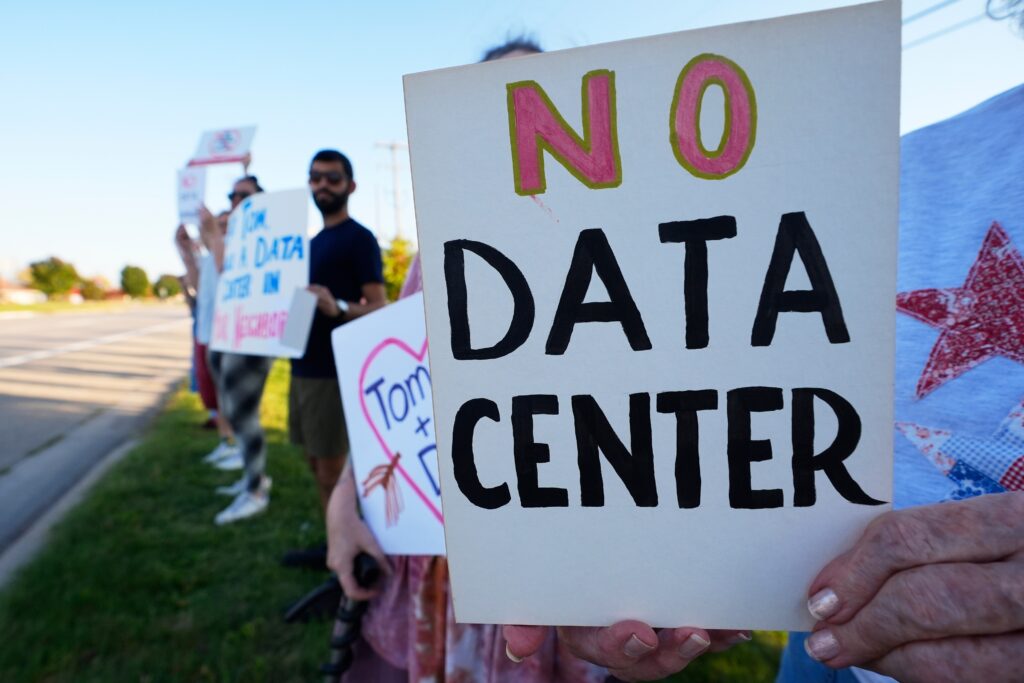
As if Republicans didn’t have enough problems this campaign season, Democrats have recently found a powerful new issue to exploit: tax breaks for data centers.
In Pennsylvania, an ad for Democratic congressional candidate Paige Cognetti says the Republican incumbent, Rob Bresnahan, “actually gave data centers a $20 billion tax break.” Another spot in Michigan hits John James, the Republican nominee for governor, because he “voted to give data centers a $70 billion tax break.” A Republican congressman in Wisconsin is facing a similar attack. According to an ad from the House Majority PAC, a Democratic group, “If AI made its own congressman, he’d be Data Center Derrick Van Orden,” who has supposedly given the data-center industry “over $80 billion in tax breaks.”
It’s a hard-hitting campaign against a nonexistent menace.
The flimsy basis for these attacks is a Republican-backed federal law that contained a grand total of zero dollars in tax breaks for data centers. That 2025 law, embarrassingly titled the “One Big Beautiful Bill,” is a fair target. It recklessly cut taxes without making equal reductions in spending, and it included multiple giveaways with no real justification beyond buying votes. Instead of going after those more obvious flaws, Democrats are distorting one of the law’s best provisions.
Rather than require businesses to write off the cost of investments over many years, the law moves toward “full expensing” — that is, letting companies deduct some expenses as soon as they arise. Under either policy, businesses write off the full dollar amount of an investment. A write-off in later years, however, has lower value: Money today is worth more than money tomorrow, which is why lenders charge interest.
Faster expensing increases a company’s incentive to invest — or, more precisely, reduces an arbitrary penalty on investing. The effect on government is that tax revenues fall in the short run but mostly recover in the long run.
The attacks on these Republicans are false for at least three reasons. First, the so-called tax breaks “for data centers” aren’t for data centers. They apply to a large class of investments. Equipment purchases for data centers don’t receive any greater benefit than equipment purchases for any other investment. Nor does expensing apply to building the structures that house data centers. The provision isn’t a special favor for the industry. It has applied to many billions in data-center equipment purchases because data centers happen to be booming, not because the federal government has put a thumb on the scale for them.
Second, the estimates for the size of the alleged tax break ignore that the policy question mostly concerns when, not whether, taxes are paid. To a large degree, expensing simply moves a tax deduction forward in time rather than enlarging it. Counting the up-front revenue hit but not the later revenue boost overstates the benefit for companies and the cost to governments.
Third, the tax breaks aren’t even tax breaks. Many tax experts support full expensing because, unlike the alternative, it doesn’t penalize investment. The partial expensing policy included in the Republican law is a step toward a tax code that raises revenue while minimizing distortions to the economy. Tax breaks, on the other hand, are departures from that ideal, designed to boost some activities, or the groups that engage in them, over others.
Some states have exempted data centers from taxes that apply to other businesses. Those are breaks. When she ran for president in 2024, Kamala Harris proposed tax credits for “key strategic industries,” including “building new data centers for AI.” That could reasonably be described as a tax break for artificial intelligence, too. What Republicans in Congress passed — the policy that Bresnahan and the others are being attacked for — is no such thing.
There are plenty of real issues Democrats could use against Republicans. “Billions in tax breaks for data centers” is a phony one.
The post The $80 billion data-center tax break myth appeared first on Washington Post.