An urgent message rang through the nerve center of Kennedy International Airport in New York City at 10 a.m. on Saturday. An aircraft, it said, had crashed at the airport.
Details were scant: “Unknown souls on board, unknown fuel on board,” the announcement said.
The simulated emergency had begun.
As the first fire trucks hurried to the scene, representatives from local, state and federal agencies gathered in the Emergency Operations Center, inside a nondescript airport office building, where they would spend the next couple of hours managing the mock crisis. Radio chatter filled the room. Officials fielded phone calls and watched the response on a giant screen.
The Federal Aviation Administration mandates that commercial airports hold a full-scale emergency exercise every three years to test responding agencies’ ability to coordinate swiftly and safely.
The New York Times was granted exclusive access to this simulation, which lasted about two hours and involved more than 100 emergency responders from agencies including the Port Authority of New York and New Jersey, the New York Police Department, the New York Fire Department, Customs and Border Protection, the Transportation Security Administration and the Federal Bureau of Investigation.
This was the first full-scale drill at a major New York City-area airport since the deadly collision between an Air Canada jet and an airport fire truck at LaGuardia Airport in March. (Other types of emergency exercises are held more frequently and have taken place since then.)
Sarah McKeon, the director of aviation for the Port Authority, which runs Kennedy, LaGuardia and Newark Liberty International Airport, credited frequent training exercises for what she called an effective response to the LaGuardia accident, in which all 72 passengers survived but the two pilots died.
In a real emergency, “one of the biggest challenges is a safe and orderly response,” she said in an interview during the simulation. “That real-world test of our emergency plans was a testament to the fact that we do so much preparedness and testing,” she added.
A Smoke Machine and a ‘Snozzle’
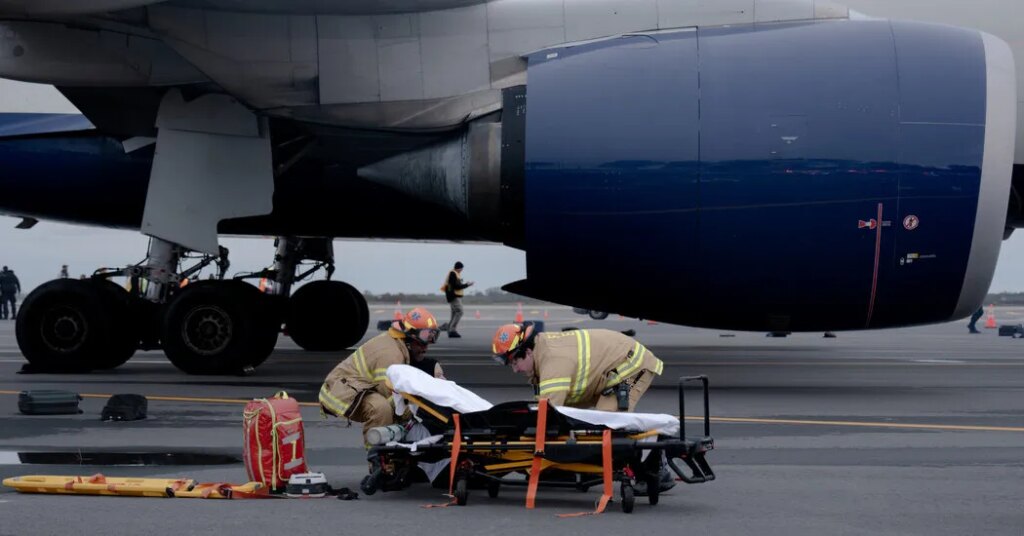
A convoy of emergency vehicles descended upon the scene of the staged crash, tucked in a corner of the airfield away from the runways and out of view of the terminals. Dozens of firefighters and paramedics raced to evacuate passengers down staircases from the jet’s rear doors and move everyone to safety.
Details began to emerge: The aircraft was an international arrival with 102 people on board.
Victims howled and screamed for help, some of them carried away by firefighters and others triaged on the tarmac. Officials set up a mobile command center and a reunification point nearby. Smoke wafted over the alarming scene.
The victims were pretending; the smoke came from a machine. The jet, an undamaged Airbus A330-900 belonging to Delta Air Lines, did not have its escape slides deployed, and unlike a real crash scene, this one had no debris field from an aircraft.
Still, “the drill itself is very realistic,” said Jason Jankowski, the deputy chief of aircraft rescue and firefighting, known as ARFF, at Kennedy. Mr. Jankowski was a battalion chief at LaGuardia when the Air Canada crash happened. That accident, partly attributed to a fire truck operating without a transponder, led the Port Authority to move to install trackers on its emergency vehicles.
During the drill, Fire Department and ARFF units worked together to extinguish an imaginary blaze. Mr. Jankowski called that collaboration essential. “I don’t get to work side by side with the F.D.N.Y. very often, and I don’t want the first time that I work side by side with them to be at an actual emergency,” he said.
A Snozzle, an extendable arm designed to pierce the fuselage of an aircraft to deliver water or firefighting foam inside, stood at the ready, mounted on a truck.
“In a real accident, this whole area would be covered in foam,” Ms. McKeon said, gesturing to the area around the jet.
Keeping Rescuers on Their Toes
Emergency responders did not receive details of the scenario ahead of time. The Port Authority said in a written statement that the element of surprise was “essential for effectively testing the airport’s emergency plan.” Past drills have simulated a water rescue and an aircraft that crashed into a terminal.
More than 100 volunteers, many of them students or members of local service groups, played the victims. All wore white T-shirts and tags around their necks describing their injuries. Some were taken on gurneys to a line of ambulances waiting nearby. Others sprawled on the ground, shouting “Help me!” Police officers escorted those who could walk away from the scene, where they waited in buses or checked in with officials at the reunification point.
Luggage was scattered around the aircraft. Among the bags, a few fabric dummies, also with tags, represented the deceased. Emergency responders later moved the dummies to a side area for examination.
Set back from the aircraft, officials packed into the incident command center, a bus-like communications hub, to coordinate between the accident site and the Emergency Operations Center.
Teresa Rizzuto, the general manager of Kennedy Airport, explained that officials in the command center kept track of where each responding unit was deployed, directing resources to the site as needed. Mr. Jankowski tracked his fire trucks on a hand-held white board.
Outside the command center, two passengers who escaped without serious injuries described to a Port Authority police officer what they experienced in the moments leading up to the simulated crash.
Now, a crowd of passengers was growing at the reunification point.
Survivors shouted questions, some in Spanish and Portuguese, at airline and airport staff. One asked whether she could still get a connecting flight to Miami without her belongings. Another wondered whether he would be deported because he had lost his passport during the evacuation. An airport representative offered them vague reassurances and told the crowd that they would be housed and fed, connected with family and reunited with their baggage if possible.
‘We Will Be Ready’
After the simulation, agency leaders gathered to discuss what went well and what needed improvement.
To ensure officials could speak frankly about their takeaways, The Times was not permitted to attend the review. But in a video interview on Monday, Ms. Rizzuto said the drill had achieved its objectives.
“The exercise totally reinforced the confidence, and the ability, of our airport and our emergency response partners to work together efficiently in a real emergency,” she said.
One area that could have benefited from more preparation, she said, was communication at the reunification point, which was added on the tarmac for the first time in this drill following recommendations that emerged after the midair collision of an American Airlines jet and an Army Black Hawk helicopter near Washington in 2025.
But the exercise, she said, clearly demonstrated the strength of the airport’s emergency plans: “This just adds to the confidence level that we will be ready, God forbid.”
Follow New York Times Travel on Instagram and sign up for our Travel Dispatch newsletter to get expert tips on traveling smarter and inspiration for your next vacation. Dreaming up a future getaway or just armchair traveling? Check out our 52 Places to Go in 2026.
The post How Do Airports Prepare for Disaster? With Fake Screams and Cloth Dummies. appeared first on New York Times.