The brown, creamy Pakistani beef nihari oozed down Sandile Tshabalala’s fingers when the idea struck him:
Wouldn’t it be delicious to stuff the shredded beef into fried dough balls that South Africans call amagwinya to make what he would describe as an African taco? Or perhaps incorporate the beef into a maroon stew of chickpeas and okra that is his take on gumbo.
Dining with Mr. Tshabalala, a self-taught South African chef who goes by the name Sanza, is a constant hunt for ingredients, techniques, flavors and dishes to “smuggle” into his kitchen.
About a decade ago, Sanza, buoyed by an appearance on an Anthony Bourdain show, launched the popular Yeoville Dinner Club, named for the gritty, immigrant-rich Johannesburg neighborhood where he used to live (though he’s now moved to the suburbs). At a long table that seats two dozen, he serves family-style dinners that highlight his unapologetic embrace of immigrants and their cuisine, especially those from other African countries — a stance that is rare in South Africa these days.
Violence against African immigrants has consumed South Africa in recent months. Protesters have taken to the streets arguing that foreigners commit crime, drain resources and take local jobs. South Africans are growing increasingly hostile toward immigrants, according to surveys. Many politicians have latched onto, and in some cases fed, that sentiment.
Sanza, 51, hopes that food can help counter the xenophobia.
Wishful thinking, perhaps, but I saw his optimism as I ate with him at some of his favorite migrant kitchens across Johannesburg. He strolled easily into these hole-in-the-wall joints with plastic chairs, in parts of town that most South Africans would consider too seedy and dangerous to visit. He hugged the cooks from Zimbabwe and Malawi and Congo as though he were at home with family.
“Taste the dish and then find yourself,” he told me over a spread of nihari stew, chickpeas, butter chicken and flatbread at Al Raza, a Pakistani spot in Fordsburg, a South Asian hub in Johannesburg.
“What does it remind you of?” he asked me. “What have you got against the food? And then what about the people who make it? What about their story? That’s how, I think, we wake each other up.”
Sanza was born in neighboring Eswatini, where his South African mother fled to avoid the anti-Black apartheid regime. As an infant, he said, they moved to the South African township of Soweto, where his father, who was from Eswatini, was killed in circumstances still unclear. He was raised in part by a freedom fighter uncle who had spent time in exile in Zambia and Bulgaria, and who taught Sanza about internationalism and Pan-Africanism.
In the mid-1990s after apartheid ended, Sanza moved to Yeoville, a former whites-only suburb now lined with immigrant-owned bars, hair salons and markets. He said he gained much of his appreciation for foreign cultures there.
He attended film school, he said, practiced Rastafarianism, was into urban fashion and hung out at speakeasy jazz joints where legends like Hugh Masekela would show up. He said he worked as a promoter for a culture festival, painted commissioned street murals and danced with a Black ballet troupe. He sold weed from his apartment, he said, and used his down time in between customers to experiment cooking dishes he learned from his grandmother.
He got a girl to fall for him with a chickpea and potato curry, he said. He impressed friends with hearty African stews.
“Most of the time we would be hung over in the morning and there’d be that warm pot that he just warms up with food that we probably had the previous night,” said Paul Mnisi, a friend who met Sanza in Yeoville in the late 1990s. “But man! In the mornings, that food was good.”
Sanza became something of a local celebrity in the late 1990s when he got a job as a D.J. at a newly launched radio station, Youth FM, and hosted a show, Kamikaze Heat, alongside Mr. Mnisi. Sanza’s bluntness sometimes rubbed people the wrong way, Mr. Mnisi said.
Sanza left the radio station after about a decade, then worked as a fixer for journalists and a producer on the reality show Big Brother Africa — jobs that allowed him to travel the world and learn new ingredients and ways of cooking.
Now, restaurants like Chez Lydia, started 10 years ago by the Congolese immigrant Lydia Kenter-Tata, are Sanza’s continuing education. We tucked into Ms. Kenter-Tata’s fumbua — a traditional green leaf and peanut stew — and Sanza explained that it inspired a peanut sauce he uses to stew goat. Ms. Kenter-Tata’s cassava leaf stew incorporates eggplant as a binding agent, and Sanza does the same with his.
“That one is my brother,” Ms. Kenter-Tata said, explaining how Sanza sometimes brings food (recently it was a goat head) to cook with her. That support is now crucial, she said, as immigrant-owned restaurants like hers have seen business plummet because the xenophobic unrest has caused many customers to flee, while others are too afraid to come out.
When Mr. Bourdain visited in 2013, Sanza was running a Pan-African sidewalk restaurant in Yeoville that he had launched in 2010 to capitalize on South Africa hosting the soccer World Cup. His playfulness with borderless cooking earned him the moniker “Gastronomic Smuggler.”
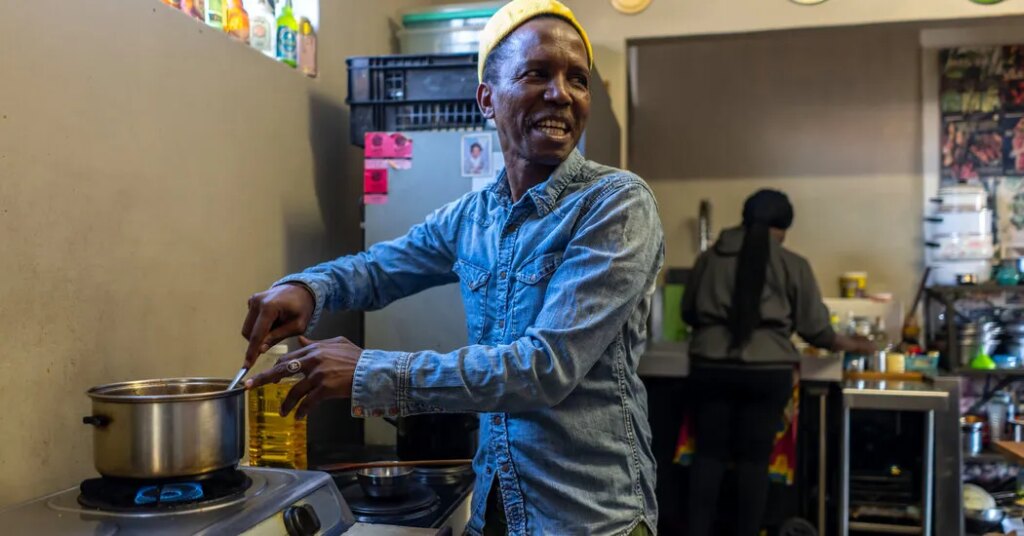
Around 2016, Sanza started his communal dinners in a second-floor shop that feels more like an apartment than a restaurant, with a cluttered kitchen where he cooks mostly on two gas burners sitting atop a chest of drawers.
Guests typically arrive as darkness descends on Yeoville’s chaotic Rockey Street, dropped off by Uber drivers who quickly speed off, fearing carjackings. Sanza leads diners through an open-air plaza of shops, where the scents of hair spray and ganja collide, where Afrobeats bump from speakers and debates rage in Yoruba, Ndebele and French.
Sanza can be a frenetic storyteller, diverting midsentence from one subject to the next. But he regales guests with stories that reveal a worldliness and eye for detail — referencing obscure places like Tip Top Manzese, a gritty artist community in Tanzania’s capital, Dar es Salaam.
When Sanza finishes telling stories — it could be five minutes, it could be 20 — he turns to his seductive spread.
His “Egyptian chicken” is heavily inspired by one of his favorite chicken dishes: a wood-fired tikka at Al Hamra, a Bangladeshi restaurant in Johannesburg, that left our mouths on fire and our fingers stained deep red. Sanza uses paprika on his chicken to mimic that color, spices it with sumac, and adds lemon and olives for tanginess.
His amagwinya (fried dough balls, akin to puff puff in Nigeria, and festival in Jamaica) uses cassava flour and fermented yeast and has a malty flavor so indulgent that you can snack on them all night. His vegetarian gumbo steals from a variety of hearty red stews and sauces — Ghanaian red red, Ethiopian shiro, Italian puttanesca.
And then there’s a one-pot rice he calls fir fir that celebrates the many forms the dish takes around the globe, from thieboudienne in Senegal to diri djon-djon in Haiti to paella in Spain. His is infused with saffron, coconut, cumin and kale and cooked in a fermented mushroom broth.
“The country could be like this,” he told guests, including some tourists, at a recent dinner, referring to his dishes from far-flung backgrounds that coexist side-by-side.
“This is not my food,” he added. “This is food to invoke memory. This is food of all our grandmothers.”
The post A Chef Celebrates Immigrant Flavors in Anti-Migrant South Africa appeared first on New York Times.