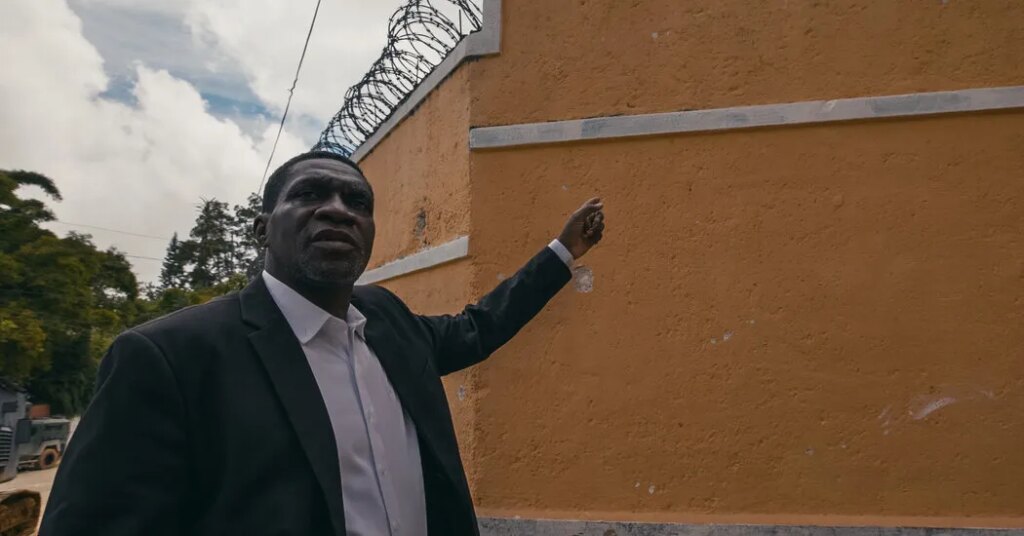
The mayor had a 9-millimeter handgun tucked in his waistband under his suit jacket. Police officers and civilians wearing balaclavas over their faces gathered outside the police station, gearing for battle.
Gangs seeking to control Kenscoff, his picturesque town in the hills above Haiti’s capital, had already attacked twice this summer, burning houses and killing people, he explained.
“The gangs want to kill me, too,” the mayor, Jean Massillon, told a team of visiting New York Times journalists in late September. “I have chosen to stay and fight.”
Police and government officials hadn’t listened when Mr. Massillon repeatedly told them that the gangs would attack, making him something of a Cassandra whose warnings went unheeded until many people were dead.
But Mr. Massillon, a longtime city administrator, refused to leave, even after other residents fled in August. He became the public face of the resistance against illegal armed groups wreaking havoc in his homeland.
He was also a symbol of how the Haitian state has effectively collapsed.
He suddenly fell ill on Oct. 9, while walking up a mountain on foot to reach an area the police had recently cleared of gangs. But the ambulance service had abandoned his city a year ago because of gang violence.
After six years serving as the appointed interim mayor of this town of about 50,000 people, Mr. Massillon died — another victim of Haiti’s yearslong decline and inability to protect its most vulnerable citizens. He was 53.
“There is a total decline of health care and security in Haiti; it’s like the country is dying,” Mr. Massillon’s brother, Christophe, said. “The whole of Haiti will remember that Jean stood up to defend the commune of Kenscoff and never gave up on this, even if he had to pay for it with his life.”
We met Mr. Massillon on the last Saturday in September, when we visited Kenscoff to report on a new United Nations-backed gang suppression force in Haiti.
Kenscoff had long been known as a peaceful mountainous farming village where Haiti’s elite went for weekend respites from the traffic-clogged capital, Port-au-Prince, a dozen miles away. But in recent years, Kenscoff had become a strategic point in Haiti’s battle against gangs that were increasingly making incursions into new territory.
It’s tactical because it borders Petion-Ville, a suburb where most diplomats and wealthy people live.
More than 22,000 people have been killed in gang violence in Haiti since 2021, and hundreds of them have died in Kenscoff.
“Twenty-one months we’ve been resisting and fighting,” the mayor said when we visited.
He showed us the bullet holes in the walls of City Hall.
The first attack, in January 2025, killed 139 people, according to the National Network for the Defense of Human Rights, a leading Haitian human rights organization.
Since then, Mr. Massillon sent at least 200 letters to police and government officials begging for help, the city manager, Emmanuel Pierre, said. He compiled them in a binder, which he was quick to show us.
Gang surveillance drones flew over his house. He fired off more letters.
“I can show you the papers that I wrote to the chief of the police to tell him that something has to be done, because we heard about something that is going to happen in the city,” Mr. Massillon told us.
His letter to the national police chief, Vladimir Paraison, was dated June 30. Between July 4 and 9, gangs arrived, killing 61 people, according to a United Nations panel of experts. The mayor put the body count at 105.
Despite the threats, the Haitian National Police withdrew key personnel and armored personnel carriers from the community, according to Kenscoff’s former police inspector and a report from a leading human rights group.
“We didn’t have any help,” Mr. Massillon said.
On Aug. 23 and 24, gangs conducted coordinated attacks on the city, killing 47 people, according to the mayor and the United Nations.
Yvener Metellus, a member of a local self-defense brigade, found his 79-year-old father burned alive in his home.
“I think the state is responsible,” he said, standing beside the home’s charred ruins.
The head of the National Police, Mr. Paraison, did not respond to repeated requests over several weeks for an interview. The police’s director of communications said he would refer a detailed list of questions to the agency’s high command.
The mayor also wrote Prime Minister Alix Didier Fils-Aimé and the justice ministry. The prime minister’s office referred questions to the justice ministry, which did not respond to requests for comment.
Government officials in the capital had reached out to the local police inspector in charge of Kenscoff before the August massacre, and the commander claimed to have the situation under control, according to a senior Haitian official. The official spoke on the condition of anonymity because he was not authorized to speak publicly on the matter.
The police response may have been complicated, the official said, by the fact that there were tensions between the mayor and the local police inspector, Nikenson Cadet.
Mr. Cadet has been removed from his post and is facing disciplinary hearings.
Mr. Cadet, in an interview, acknowledged that the police had withdrawn equipment and personnel before the latest massacre. But he said that, in his view, this indicated his superiors must have believed he was doing a good job and did not need additional resources.
He, too, had written to his superiors about the threats, but instead he became a scapegoat, he said.
“The problem is that we have a lack of human resources at the police department,” Mr. Cadet said. “We don’t have enough fire power to meet what the other guys have. We are overwhelmed by this situation.”
He said gangs had more machine guns than his officers did and that they had burned an armored personnel carrier.
In the hourslong telephone interview, which was conducted before Mr. Massilon died, Mr. Cadet also accused the mayor of complicity in the attacks. Mr. Massillon, he said, had suspiciously disarmed members of civilian self-defense groups just before the August killing spree.
Mr. Massillon’s brother called the accusation “absurd” and stressed that it was the job of the police, not the volunteer self-defense brigades, to protect the city.
A report by the National Network for the Defense of Human Rights said two members of the self-defense brigade had been disarmed after they committed an unlawful killing. The mayor “strongly denied” disarming them and stressed that he held no authority over them, the report said.
Marie Rosy Auguste Ducéna, who helped prepare the human rights group’s investigation, said the Haitian government was to blame for what happened in Kenscoff. Though the police inspector was the only person removed from his post, she confirmed that he had written at least two letters asking for ammunition, guns and armored vehicles.
“The first thing is the absence, not even the lack, but the absence, of will to protect the population,” she said. “They are never held accountable, really, in Haiti — never.”
Mr. Massillon died before The Times had the chance to ask about the police inspector’s accusations. His family and colleagues said the allegations had upset him, particularly after a political enemy denounced him on local radio.
Dr. Jean William Pape, a Weill Cornell Medical College professor who runs a clinic in Port-au-Prince and has a home in Kenscoff, spoke to the mayor the day before he died.
He said he had sounded tired and had not been taking medication for his high blood pressure.
“When politicians were lying about him on the radio station, he was profoundly hurt,” Dr. Pape said.
Dr. Pape’s home, just steps from the police station, was set ablaze during the August massacre. A security guard, a dozen horses and several dogs were killed.
Dr. Pape said he believes he was targeted because of his support for the mayor, who had spent the past year moving every few weeks to dodge gangs.
Mr. Massillon most likely died of heart failure or a stroke, Dr. Pape said. With the closest ambulance about 40 minutes away, his family drove him from one clinic to another, only to be told he had already died, Mr. Pierre, the city manager, said.
A month after the massacre, the Haitian National Police posted videos of the police and private military contractors taking back gang-occupied territory in Kenscoff. The U.N.’s gang suppression force never responded to Kenscoff, but took over positions in the capital previously manned by the Haitian National Police, enabling the police to deploy.
Townspeople in reclaimed areas are slowly returning, though people from other communities are still too afraid to go back. Several we spoke to had moved four times in two years, each time fleeing a massacre with just the clothes they had on.
Lerionne Louis, 63, is not even sure how many of her relatives died that August weekend. She saw about 23 cadavers.
Bodies are still missing.
“If there’s no security and no police presence,” Ms. Louis said, “that will take place again.”
Michael Anthony Adams and André Paultre contributed reporting.
The post He Warned a Massacre Was Coming. No One Listened. appeared first on New York Times.