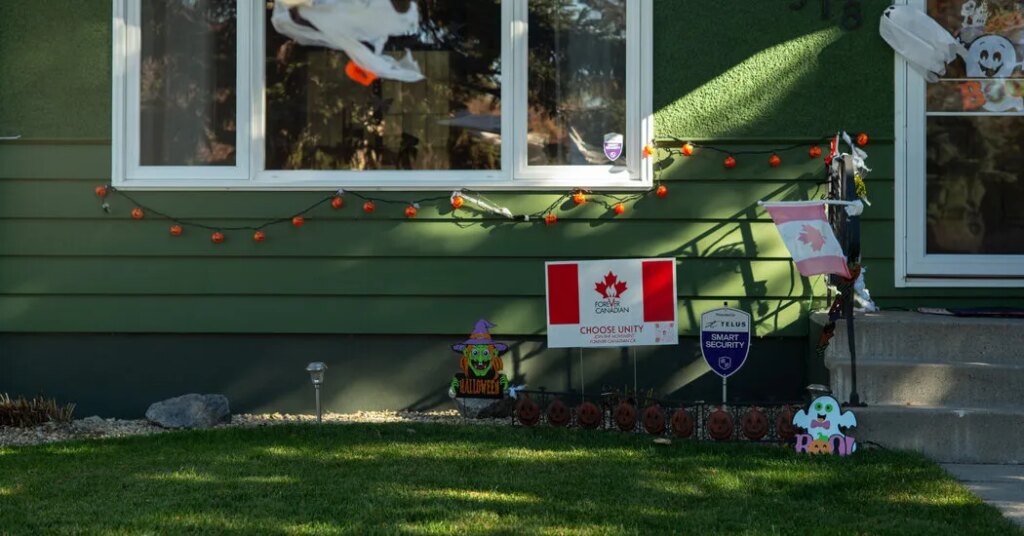
The people of Alberta were voting on Monday on whether to remain in Canada or begin a process aimed at separating the oil-rich western province from the rest of the country.
Voters in a referendum were given the option of holding a second vote on whether to secede, putting the province’s long history of resentment toward Canada’s federal government to the test.
Unlike in Quebec, a province that held two unsuccessful votes on leaving Canada, Alberta’s separatist movement has always reflected a minority viewpoint. Political parties in Alberta built around leaving Canada have all withered.
Some opponents of separatism nevertheless worried that voters might support holding a second referendum to show their unhappiness with the province’s relationship with Canada, even if they did not want to secede.
There were also concerns that Albertans loyal to Canada would not turn out to vote out of a belief that the province would never reject the nation.
Danielle Smith, the conservative premier of Alberta, managed to provoke the ire of people on both sides.
Ms. Smith assumed the leadership of the United Conservative Party largely through the support of separatists who were responsible for ousting the previous premier, Jason Kenney, from party leadership.
Supporters of a united Canada were angry at Ms. Smith for adding the question on holding a second referendum on secession to a previously planned referendum with nine other questions. Those questions focused on provincial powers and immigration.
Her move came after a court blocked an attempt by separatists to force a vote to leave Canada through a petition. Federalists said Ms. Smith’s decision was an effort to circumvent the courts and was unconstitutional.
Separatists were dismayed that Ms. Smith created a vote to hold a second vote instead of opting for a clear question on staying in Canada or leaving.
Ms. Smith said that she would vote to remain in Canada. Secession opponents viewed her support for their cause before the vote as anemic, and many of them say they doubt the sincerity of her pledge to remain in Canada.
Last month in an online forum, Ms. Smith, expressed her support for fighting for Alberta within Canada but also laid out what she described as Albertans’ grievances with the federal government.
“When proud, hard-working people feel their contribution is taken for granted,” she said, “and their livelihood is treated as something to be phased out, some begin to ask a painful question: Does this country actually want us?”
She was referring to environmental policies introduced under a former prime minister, Justin Trudeau, that many Albertans considered an effort to shut down their province’s oil sands.
Business groups, former premiers and local politicians were all firmly on the side of remaining in Canada. Economic studies, including one commissioned by the provincial government, forecast that leaving the country would come with enormous costs.
Looming over the vote was the trade war President Trump launched against Canada, as well as his continued musings about taking over the country as the 51st state.
Some prominent separatists leaders traveled to Washington three times last year seeking support from the Trump administration at meetings with low-level State Department officials.
Prime Minister Mark Carney of Canada, who was raised in Edmonton, the provincial capital, called the referendum a “dangerous bluff.” Mr. Carney was governor of the Bank of England when Britain voted to leave the European Union in 2016.
“Is it helpful to ask these fundamental questions?” he asked in May after Ms. Smith’s announcement of the referendum. “No, it’s not helpful. Of course it’s not. Is it the democratic will of Albertans? Did they vote for this in the last provincial election? No, they didn’t.”
Mr. Carney received an enthusiastic reception at two large rallies for those supporting remaining in Canada last week in Edmonton and Calgary. Ms. Smith did not attend either event.
Many separatist leaders are veterans of the large protests in Alberta during the Covid pandemic that were aimed at public health restrictions. They never laid out specific plans for a independent Alberta and their various factions offered a variety of futures, including a state guided by Christian doctrine. Many of their complaints about Canada are based on economic issues.
About 1.3 million people, just over a third of all eligible voters, cast ballots by mail or during early voting. Because voters had to mark 10 separate paper ballots and then place them into an equal number of ballot boxes, there were long lines at many of the 1,400 polling stations on Monday.
Before the vote, some leaders of the separatist movements suggested that they might not accept the results.
Mitch Sylvestre, a prominent separatist leader, said in an interview last Thursday that he was concerned about potential irregularities in voting. He also questioned the validity of many mail-in ballots.
“I’m not going to stand on a pedestal and start screaming and yelling ‘election interference’ until there’s real good evidence that it happened,” Mr. Sylvestre said. “All I’m saying is I’m very skeptical, as are a lot, or most of, our people.”
The post Oil-Rich Alberta Votes on its Future in Canada appeared first on New York Times.