Nestled in the lush, hilly countryside of north Devon in southwest England, Giles Atton’s farmhouse is a “magical place to live,” he says.
By day, Mr. Atton, 36, looks out from his garden onto fields of grazing cattle. By night, the sky is ink black, his home enveloped in silence.
All that may be about to change.
To the fury of many residents in the countryside around Great Torrington, a town of about 6,000 people, plans are being laid to build one of Europe’s largest artificial intelligence data centers here, alongside a battery energy storage facility. The project would encompass 850 acres of farmland, the edge of which is just a few hundred yards from Mr. Atton’s home.
“We were utterly blindsided by it,” Mr. Atton said. He says he fears “a profound impact on the surrounding environment through noise, pollution, affecting the dark skies.”
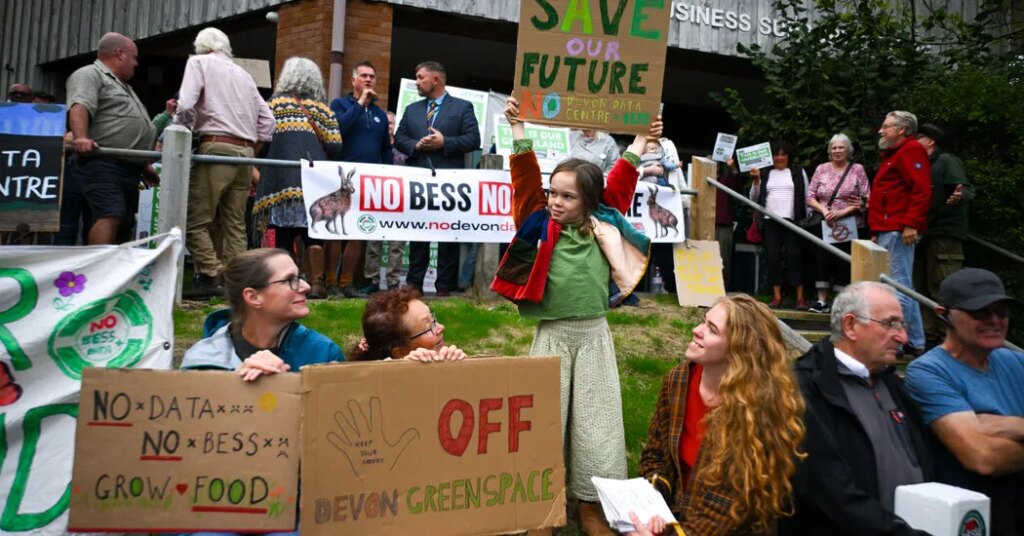
Within days of the plan being made public in June, a local group was created to oppose it.
“They were expecting this to be sleepy town,” said Steve Crowther, who chairs a local chapter of the Council for the Protection of Rural England, a charity supporting the protesters. “And it is actually packed full of retired scientists, professionals, artists, broadcasters — you name it — and they were on their horses, in their armor, within 48 hours of this being revealed.”
The howl of opposition underscores the challenge facing governments around the world as they navigate the increasingly contentious debate over A.I. and the vast infrastructure and resources the technology requires.
A.I. data centers house the computers that train and run A.I. systems. They require huge amounts of power and space because, rather than conducting an internet search, a chatbot or A.I. agent responding to a prompt will perform a complex numerical computation. All that computer processing generates heat, and water is usually required to keep the centers cool.
While the British government has promised to deliver “large amounts of A.I. data center capacity by 2030” as part of its ambition to drive growth, those plans have coincided with rising public fears about the potential threats posed by A.I. At a protest of around 200 people outside a municipal building in nearby Bideford, some residents expressed a sense that they were battling something new and potentially dangerous.
The world could be “heading for something out of a dystopian nightmare,” said Daisy Snow, 30, a product designer and organic farmer. She voiced worries about water, soil health and food security.
Yet data centers also offer a surge of investment into Britain’s stuttering economy. For relatively isolated areas like Great Torrington, the effects could be significant. The town lost two big employers, a dairy company and a meat factory, in the 1990s. Average pay before tax is about £620 (or $827) a week, compared with a national average of £682 a week, according to the local municipality, Torridge District Council.
Xlinks, the British company behind the proposed site, to be known as the Devon data campus, promises to invest over £12.2 billion, creating between 600 and 1,200 jobs once complete. The data center would be supported by an on-site battery energy storage facility.
In Great Torrington, where banners protesting the “Devon data monster” hang in shop windows, it was hard to find anyone with a positive word for the project. One exception was Brian Conrad, 58, a former consultant on energy projects.
Torrington “used to be a bustling town,” he said. While many retirees enjoy how quiet it is now, he noted that young people struggle to find work. “Instead of objecting out of hand, look at ways in which you could actually make this work,” Mr. Conrad suggested. “If you want national data security and you want to protect data borders then you have to have centers like this. We can’t keep on relying on America.”
Others were skeptical that the development would bring good jobs.
“It’s going to be someone to cut the grass and a bit of security,” suggested Ann Shuttleworth, 60, an accounts manager who lives in the nearby village of Ashreigney.
From a hilltop footpath leading across part of the land earmarked for the project, Ange Wilson-Duffy, 61, a retired teacher, said: “If we said ‘yes’ to here, we could say ‘yes’ to anywhere. That opens the door for it to be absolutely anywhere that’s rural.”
The Xlinks plans became public in June, but it later emerged that Torridge District Council had been in private talks with the firm since April 2025.
While that is not unusual in planning cases, it fueled anger in Great Torrington where critics believe Xlinks chose the region to repurpose resources committed for another, unsuccessful project.
The firm had hoped to import energy from solar power generated in Morocco, via underwater cables, into an electricity substation at Alverdiscott, about 10 miles from Great Torrington. The government last year rejected the Morocco plan, saying it wanted to prioritize “homegrown power.”
Xlinks said in a statement that its data campus would “play a significant role in making sure the U.K.’s fast-growing tech sector has the computing capacity it needs to drive economic growth” and promised to “consult closely with residents.” Mark Acton, executive director of the Data Center Alliance, which represents the sector, said that “every country on the planet” is looking for a strong digital economy, highlighting Britain’s “service-led economy which is very dependent on digital platforms.”
Unlike those in some parts of the United States, the Devon data campus would recycle fluid to limit water use, Mr. Acton said. He added that despite the rural location, the site made sense if built near the proposed battery storage facility providing energy.
Mr. Acton described the protesters as “poorly informed” but also accepted the data center sector had “done a poor job of informing people.”
Campaigners are confident they can persuade the municipality to reject the application but worry it could still be approved by the British government, which can authorize nationally significant infrastructure projects.
The proposal has opened sharp divisions.
At a meeting last month of Torridge District Council, the chair accused some opponents of targeting officials with “abuse, harassment and intimidation.”
Xlinks says on its website that the data center would use “land from several local landowners.”
That has prompted speculation about how much landholders might have been offered to have agreed to sell their property.
“I would imagine that it’s an incredible amount of money,” said Mr. Atton, at his farmhouse at the site’s perimeter. The money, he added, may “be life transforming for them, but how does it transform the lives of the people around them?”
The post The A.I. Data Center Backlash Has Reached a Quiet Corner of Rural England appeared first on New York Times.