Gilbert Bigio, a Haitian industrialist widely described as the country’s first billionaire, and who was sanctioned by Canada for ties to criminal gangsin his homeland, died on Sept. 29 in Florida. He was 91.
His death was reported in the Haitian press.
With interests in steel, energy, logistics, consumer goods, construction and banking, Mr. Bigio’s holding company, long known as the GB Group and eventually renamed BGO, touched the impoverished island nation’s economy in every corner.
Mr. Bigio’s family remain major players in what the International Monetary Fund and others have described as Haiti’s tiny economic elite. BGO supplies cooking oils and soap to Haitian households, steel from Haiti’s only steel mill to its builders and deepwater port facilities to its shippers. BGO became a regional economic force as well, owning gas stations in Jamaica and the Dominican Republic.
The elite plays an outsize role in Haiti’s chaotic politics, and Mr. Bigio appears not to have been an exception, though he stayed largely out of public view and rarely granted interviews. In December 2022, Canada sanctioned him, along with two other Haitian businessmen.
“Canada has reason to believe these individuals are using their status as high-profile members of the economic elite in Haiti to protect and enable the illegal activities of armed criminal gangs, including through money laundering and other acts of corruption,” a foreign ministry statement said.
“The sanctions Canada has imposed are intended to put pressure on those responsible for the ongoing violence and instability in Haiti,” the statement continued. “These people must stop providing funds and weapons to criminal gangs in Haiti.”
According to Reuters, the GB Group did not immediately reply to the sanctions; one Haiti expert, Jake Johnston, of the Center for Economic Policy and Research in Washington, said in an interview that Canada’s decision was a largely “symbolic” move with little practical impact. Members of Mr. Bigio’s family did not respond in recent days to queries for this obituary.
Mr. Johnston said Mr. Bigio’s immense wealth — he bought an ultraluxury $132,000 Mercedes Maybach from the estate of the disgraced financier Jeffrey Epstein, The Miami Herald reported — was important to contrast with the brutal poverty of his native land.
“You can’t separate them from the broader context,” he said. “These are the elites who have benefited for decades from a status quo that very obviously does not work for a majority of Haitians.”
In a text message, Fritz Alphonse Jean, the former director of Haiti’s central bank and a former prime minister, noting the steady growth of Mr. Bigio’s company, wrote that “the capital that enabled this expansion was largely generated from Haiti’s economy, itself shaped by weak institutions that were incapable of ensuring a level playing field for all businesses.”
Mr. Jean criticized the absence of “meaningful integration of social responsibility into the operations of the country’s wealthiest enterprises.”
The I.M.F., in its 2025 report, noted that “many if not all gangs regularly cooperate with elites to serve oligarchic interests through kidnapping, murder, and the intimidation of neighborhoods.”
In the absence of a functional government, especially after the assassination in 2021 of President Jovenel Moïse, the gangs now have a virtual stranglehold on political and economic life in the country. They are said to control 70 percent of the capital, Port-au-Prince, and the country’s major highways.
For Mr. Johnston, it is almost inevitable that the country’s leading businessman had some kind of relationship with the gangs.
“If you’re running a port in Port-au-Prince, you’re engaging with armed actors. It’s a condition of doing business,” he said. “The cargo doesn’t leave that port without payments.” He noted that “the story of that port and its relationship with arms trafficking is well established.”
Canada’s sanctions were at least the second time Mr. Bigio had been subject to government strictures. The U.S. Treasury Department reportedly froze assets held in U.S. banks by Mr. Bigio and other prominent Haitians whom the department alleged backed the 1991 military coup that ousted Jean-Bertrand Aristide, Haiti’s first democratically elected president. Sanctions against Mr. Bigio and members of his family were removed after Mr. Aristide’s return in 1994 following U.S. intervention.
Mr. Bigio, the scion of immigrant Sephardic Jews from Syria who was Israel’s honorary consul in Haiti for 25 years, spent some of his time in a 9,200 -square-foot mansion on a man-made island in Biscayne Bay called Indian Creek. Accessible by only a guarded bridge, it is known in Miami as the “Billionaire Bunker”; the Amazon founder Jeff Bezos, among others, have property there.
The Haitian businessman was extensively named in the 2021 Pandora Papers leak, a trove of financial records naming dozens of wealthy individuals who had set up shell companies in tax havens.
“Bigio was connected to at least a dozen such companies, many of which were created in the Bahamas,” the Washington-based International Consortium of Investigative Journalists, which helped disseminate the Pandora Papers, wrote in an online report.
The real-world consequences of this financial sleight-of-hand were dire in Haiti, the poorest country in the Western Hemisphere, the I.M.F. noted in 2020. Between 2015 and that year, Haiti collected tax revenues equivalent to about 13 percent of its economy, ranking it above only Panama and Venezuela.
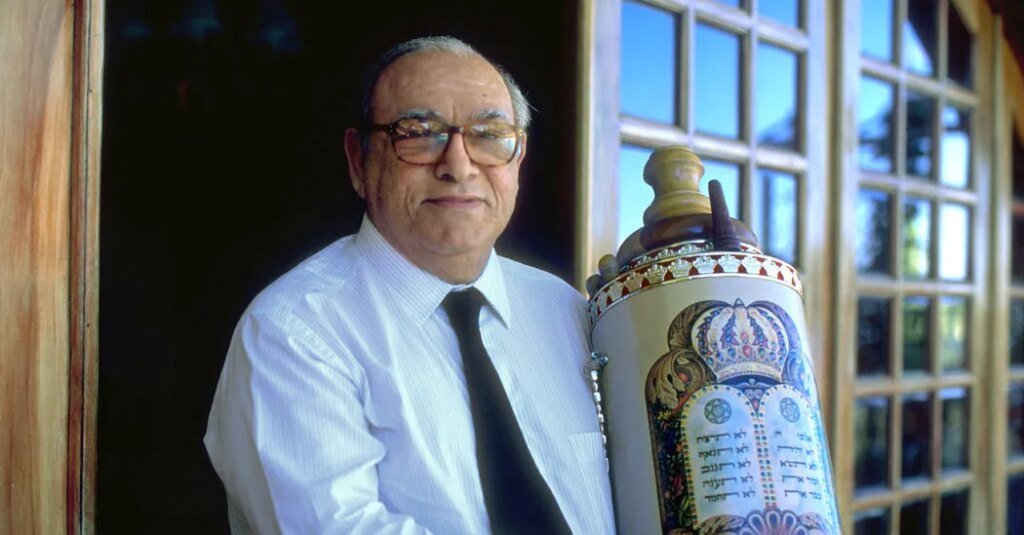
When Mr. Bigio gave an interview, in 2004 with The Herald, it was to deny any political role in his country. He preferred to talk about his part in supporting Jewish ritual, hosting gatherings on High Holy Days, in a country with only a handful of Jews. For years, a large Israeli flag flew in front of his mansion in Pétion-Ville, an affluent neighborhood in the capital. He kept Haiti’s only Torah in his study.
“Our principle, which we respect daily, is not to mix in Haitian politics,” he told The Herald. But that statement ran counter to the observations of the I.M.F., which wrote in its 2025 analysis that “the community of economic elites in Haiti is relatively small but it holds significant influence over politicians,” and that, “like politicians, some of economic elites employ gangs for close protection.”
Gilbert Bigio was born in Port-au-Prince on June 10, 1935, into a family that had come to Haiti from Syria at the end of the 19th century and made its fortune in the cotton-, cacao- and wood-export businesses.
With other investors, he founded Aciérie d’Haiti, the country’s first steel mill, in 1972, and it became the basis for the diversified GB Group. The group employed more than 2,000 people “at the height of his influence,” according to an obituary published by Memorial Keepers. GB Group was the principal developer of Port Lafito, Haiti’s first deepwater container terminal, which opened in 2015.
Mr. Bigio stepped down as head of the conglomerate in 2018 in favor of his son, Reuven. In addition to his son, survivors include his wife, Monique; and two daughters, Yael and Laurence.
Mr. Bigio “built industries where none existed, employed thousands, and gave generously, while also accumulating power in ways that drew international scrutiny,” according to the obituary in Memorial Keepers.
Mr. Johnston, the analyst, dismissed the argument frequently invoked by Haiti’s elites that “‘without us, you would all starve,’” noting that “they have a stranglehold on the economy. Have you been upholding transparency? Have you been paying taxes?”
André Paultre contributed reporting from Port-au-Prince. Sheelagh McNeill and Susan C. Beachy contributed research.
The post A Tycoon Linked to Haitian Gangs Has Died appeared first on New York Times.