“Pretend, please, that I’m on the ballot,” President Trump has been pleading with Republicans in midterm campaign stops. He has a point. With him on the ballot, in 2016 and 2024, Republicans fared much better than they expected. In 2018 and 2022, without him, they stumbled.
But two things can be true at once. Mr. Trump is the party’s great unifier, and going into 2026, he’s the party’s biggest drag.
G.O.P. candidates can read polls as well as anyone, and those in the toughest races are reacting almost in real time. Representative Ashley Hinson in Iowa, Mike Rogers in Michigan and Senator Jon Husted in Ohio have broken with the president on some issues, and all three have called for an end to the fighting in Iran.
The midterm outlook for Republicans may be poor, and Mr. Trump’s unpopularity may be dragging the party down. But by smashing the former consensus in the party, he has allowed new elected figures and influencers to start building a different G.O.P.
The Dallas midterm G.O.P. convention may have looked like yet another event to focus attention on Mr. Trump as the main attraction and the biggest draw. But we actually got a glimpse of the post-Trump road ahead. We saw figures who disagree with Mr. Trump, and with one another, to one degree or another.
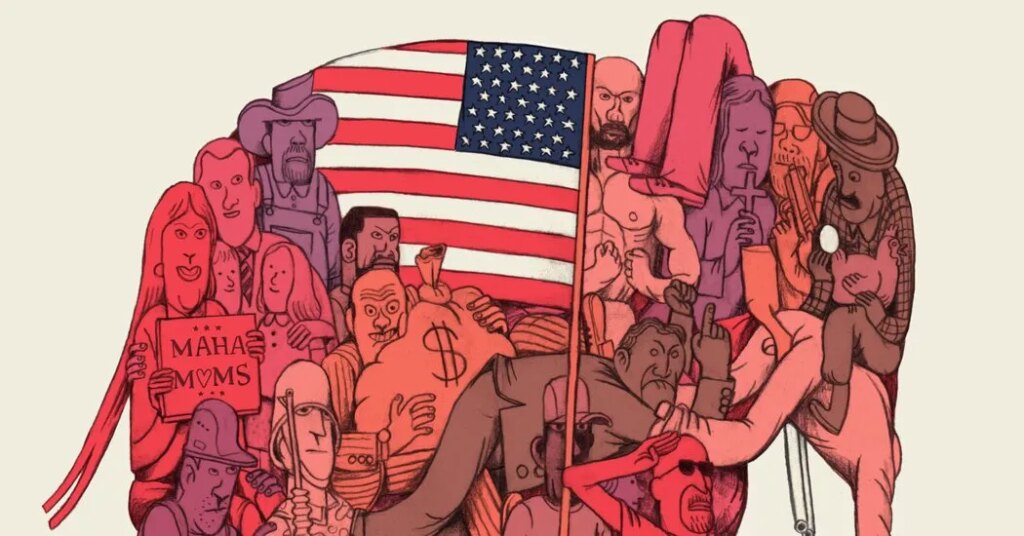
That cacophony of voices representing itself as Republican would have been unthinkable before Mr. Trump. And it is this collection of voices — the mismatched set of impulses and ambitions on display — that may very well represent the future of the Republican Party.
It will be a big tent, and bring in people who didn’t feel welcomed in the G.O.P. before and who may even disagree on some issues — and yet a party with the real potential to grow into a majority. Yes, it will have to transition from one focused around the strong personality and charisma of Mr. Trump to a coalition. It doesn’t lack for potential leaders who could fit that model.
So 2026 may be rough. But in the years ahead, that party may be electorally stronger than what preceded it, even if it is far more diverse and fractious than the old one.
There is a model for what this kind of Republican Party can become. The New Deal Democrats were the most dominant political coalition of the 20th century. That party joined urban Catholics with Southern segregationists, farmers with union workers and, increasingly, Black Americans as well.
A restive coalition, it was held together by patronage and shared enemies. Southern committee chairmen in the House and Senate with seniority shaped the New Deal to fit their region and constituents. Political machines in Chicago, Kansas City and New York turned relief jobs and money into votes from Catholic and Jewish immigrants. Unions organized workers as a matter of loyalty to one another, not to New Deal intellectuals. Farmers got price supports and rural electricity.
The New Deal coalition was undone by historical upheavals like the civil rights era, the Vietnam War and the social revolutions of the 1960s that would split the party. But the long, multifarious life of New Deal Democrats shows that a looser coalitional arrangement can dominate electorally, and even manage enormous internal cultural differences and contrasting priorities for decades.
Before Mr. Trump, the Republican creed was easy to state: smaller government, lower taxes, free trade and global leadership. The party isn’t going back to it whole. Nor does what’s coming look like a contest between two ideologically grouped sides, the Tea Party-style libertarian populists and the conservative nationalists.
That’s too simple and neat. Many nationalists are against wars. Take Vice President JD Vance and Senator Josh Hawley of Missouri. Though he supports the president publicly, Mr. Vance is widely reported to have advised against the Iran war. Both suspect NATO can be a debit on American sovereignty, not just a force multiplier. Mr. Hawley voted against Swedish and Finnish membership in NATO. Libertarian types believe the government is too intrusive in Americans’ lives, and the MAHA movement says regulators are captured by corporations. They are united by suspicion of the state. At the Dallas midterm convention, programming moved through the party constituencies hour by hour: “America First” trade police, school choice and opposition to gender ideology in youth sports, chronic disease and “corporate influence in public health agencies.” Health Secretary Robert F. Kennedy Jr. drew cheers for praising his uncle Ted Kennedy’s authorship of Title IX. John Fetterman, a Democratic senator, sent a video introducing and praising a Republican Senate colleague, Dave McCormick, vowing to “defend the steel way of life” in western Pennsylvania.
Or take the example of glyphosate, a controversial pesticide used on millions of acres of farmland. For years, Mr. Kennedy has railed against its overuse. When the Trump administration declared glyphosate production a matter of national security, Florida Representative Anna Paulina Luna was behind an amendment to strip a liability shield for pesticide makers from the farm bill. She was joined by Chip Roy from the Freedom Caucus. It is another glimpse of party members not walking in lock step but clashing over ideas and positions.
Almost every Republican wants to restrain the reach and ambitions of government, but they no longer agree on where. Just look at how the September outcry about Flock cameras scrambled Republicans. Some Republicans defended them as a tool for law and order, others an unholy alliance between Big Tech and big government against our rights and privacy. Senator Hawley, who chairs the Judiciary Subcommittee on Crime and Counterterrorism, opened an investigation into the company in August, and ripped it in a televised hearing.
Take data centers. A Fox News poll in July found that 70 percent of voters opposed building data centers in their area. Mr. Trump and Mr. Vance defend them, but Mr. Rogers, the Republican Senate candidate in Michigan, backed a moratorium on new ones. Senator Husted supported them in his state but also introduced a bill to shield residents from higher electricity costs.
Debate and negotiation give even the losers a stake in the party. They may not win this time, but there will be other opportunities to fight for their cause. And the contestation over ideas makes a party seem to voters like it is more engaged with the vital questions about the future of the country.
Over a decade ago, Peter Harris, a political-science professor at the Colorado State University, said that the problem with the G.O.P. was that it was “not diverse enough.” He meant ideologically, but he also believed that a little less party discipline and more internal debate would change the demographics of the party. He noted that figures like the stalwart libertarian Senator Rand Paul of Kentucky or the evangelical culture warrior Senator Ted Cruz of Texas serve an important function as “outriders.” These figures, he said, would flummox the party establishment but “excite and engage large numbers of young Americans, racial minorities and others not usually tempted by the G.O.P. brand.”
Mr. Harris was right: The outriders — none more so than Mr. Trump — dragged in exactly those voters. In a New York Times/L2 analysis, between 2020 and 2024, Republicans gained 2.4 million registered voters, while Democrats lost 2.1 million. Democrats lost ground in voter registration in 30 states in that time period. Similarly, Gallup’s three-year trend showed Republican identification broadening among groups that don’t fit into the traditional business wing or the evangelical wing: Hispanics, voters under 30, lower-income Americans. Republicans gained among Catholics and African Americans, too.
This G.O.P. coalition is under strain in 2026. The most dramatic break is among Hispanic voters. In a New York Times report on polls, Democrats lead among Hispanic likely voters on the generic congressional ballot by 35 points. The same pollsters found Kamala Harris, then the vice president, ahead by only seven points in their final 2024 surveys. Republican gains among young voters are also in jeopardy. Polling by Echelon Insights found Mr. Trump’s net approval among 18 to 34 year olds at minus-44 in August.
Voters soured on Mr. Trump for familiar reasons: the deaths of Lorenzo Salgado Araujo and Renée Good, among others, in ICE encounters, an Iran war that drags on and pushes up energy prices and inflation. What ties these complaints together is that Mr. Trump has governed less like the outsider who ran in 2016 and more like the party he had come to change. He signed tax cuts with a Republican Congress and made the market a measure of his success. Instead of draining the swamp, he has presided over a Washington where graft now looks rampant.
But this isn’t a simple reversion to the old status quo either. It looks more as if younger voters and Hispanics are at the volatile edge of longer-term trends. Hispanic voters may swing toward Democrats this year, but as a TelevisaUnivision executive said recently, Latino voters “aren’t locked into one party.” Gallup, meanwhile, found that a record 45 percent of adults called themselves independents in 2025.
These trends are the environment the party sits in now — and they suggest the party has room to grow.
The potential leaders of a future Republican Party seem to be pulling in different directions. This just so happens to be the physics of building a big tent.
Mr. Vance is the likeliest nominee for the 2028 presidential election. His recent book about his conversion to Catholicism puts economic concern for families at the center of his conservatism. Traditional conservatives regularly denounce him for his views on “America first” foreign policy and trade restrictions. Mr. Trump himself noted that Mr. Vance had a “philosophically” different view on Iran, code for advising against it. His more populist views probably work to his advantage in a general election.
Still, even if a Fox News Poll shows that 70 percent of voters are at odds with Mr. Trump on data centers, Mr. Vance has defended the buildout as essential for our competition with China. In Dallas, Mr. Vance acknowledged the discontent and heterogeneity in the Republican coalition, telling voters he wouldn’t ask for agreement on every issue.
Although some cast them as antagonists, and they may have some disagreements on foreign policy, Secretary of State Marco Rubio is quite similar to Mr. Vance. Both were initially hostile to Mr. Trump and eventually became loyal to him and began to echo him on trade and re-industrialization.
Gov. Ron DeSantis of Florida, who has generally been seen as more acceptable to the traditional business-friendly wing, is taking a stance on artificial intelligence that is more populist than Mr. Vance’s. He pushed hard for A.I. regulation in Florida, barring data centers from passing infrastructure and electricity costs on to residential ratepayers. Mr. Hawley is also fighting Mr. Cruz in the Senate over a federal A.I. moratorium.
The older Reagan-Bush Republican Party may get the closest thing to its own champion in Gov. Brian Kemp of Georgia, who not only hews to the conservative movement’s orthodoxy on taxes and small government but whose political persona has been shaped by his clashes with Mr. Trump over the 2020 election. A Kemp nomination would represent the return of the repressed.
Still, Mr. Kemp’s own survival in the Trump era is instructive. The state party accepted him even though he refused an explicit demand from Mr. Trump. In Mr. Kemp there is a lesson: There is a way for competent politicians to survive big internal battles, manage a fractious coalition and still win.
There are also the many well-known figures and influencers who have become influential in various parts of the G.O.P. coalition and the wider new media world that now surrounds it.
Tucker Carlson is a wild card. He has all but sworn a vendetta against President Trump over the war in Iran. Mr. Carlson’s current passion over issues of foreign policy regularly drives him to describe America, or its politicians, as being enslaved to the ambitions of President Benjamin Netanyahu of Israel or his government.
Mr. Carlson also shows that the party’s coalitional openness is a two-way street. It’s one thing to cheer when Senator Fetterman crosses over to cheer a Republican senator. It’s another to watch the party’s most influential podcaster praise a Democrat — something Mr. Carlson did when he said he wouldn’t vote for Mike Rogers in Michigan at gunpoint and lauded the agenda of the Democratic nominee, Abdul El-Sayed, as “literally Trumpian.” A coalition loose enough to let Mr. Fetterman in the front door is also loose enough to let Mr. Carlson escape.
The MAHA moms and the wellness right look to figures like Jillian Michaels, a fitness trainer and a TV personality. There’s the manosphere in its varieties, from extreme misogyny to more mainstream “save our boys” concerns among parents who see their sons failing to thrive in school. There are the national populists who tune in to Steve Bannon’s “War Room.” And there are people Mr. Bannon denounces, like the tech bros and A.I. optimists on the “All-In Podcast.”
There are the foreign-policy restrainers who think the liberal world order is a threat to America’s independence and solvency, and there are the hawkish diaspora groups from Iran, Venezuela, Ukraine and Cuba who want the G.O.P. to press harder on foreign policy. And there are still the stalwarts: gun owners and pro-lifers.
Yes, Mr. Trump’s personal charisma and the way he could turn any controversy into one about himself rather than the substance have papered over these differences for a decade.
When the midterms end, the party will go through a rambunctious primary in 2028 — and eventually it will rally behind a nominee. Throughout, the G.O.P. will disagree about tariffs, A.I. and foreign policy.
What will unify this fractious coalition after Mr. Trump is a common enemy in the liberals of the credentialed class. That class staffs the very institutions — such as universities — that Americans have come to broadly distrust. The G.O.P. will continue to cast its antagonist as a national H.R. department: intrusive, entitled and not really more qualified than you, just empowered.
Republicans must beware of a big vulnerability of coalitional politics: factional capture. In the past, the G.O.P. has suffered when it could be caricatured as a party beholden to the country club or as the political wing of an evangelical tent revival.
Democrats are now suffering from this very problem with the dominance of their college-educated faction and their values. Their influence on the party is disproportionate to their numbers.
The most important battle line between the parties in the years ahead might come down to a simple question: who can appeal to normal people? Winning that competition requires, at the very least, demonstrating that your party isn’t hostage to one faction and threatening to rule everyone by its norms.
But it bears noting that normal people can seem politically weird. The same person can be paranoid about Flock cameras and enthusiastic about A.I., antiracist but gender-critical, distrust the Food and Drug Administration but want food additives to be better regulated.
A coalitional party doesn’t exhaustively try to resolve those contradictions, just contain them and draw what is useful from them without letting one faction or figure try to speak for 330 million citizens.
Mr. Trump shattered the image of the G.O.P. as a vehicle dominated by the conservative ideological movement. Now the post-Trump Republican Party is freer to rebuild itself again as a more fractious coalition.
The traditional stalwarts for small government are still in there, and still have influence. But the party is no longer in their grip. They may find that the party lasts longer and goes a little harder under conditions of anarchy.
Michael Brendan Dougherty is a senior writer at National Review.
The Times is committed to publishing a diversity of letters to the editor. We’d like to hear what you think about this or any of our articles. Here are some tips. And here’s our email: [email protected].
Follow the New York Times Opinion section on Facebook, Instagram, TikTok, Bluesky, WhatsApp and Threads.
The post The Republican Party Is a Mess. It Will Emerge Stronger for It. appeared first on New York Times.