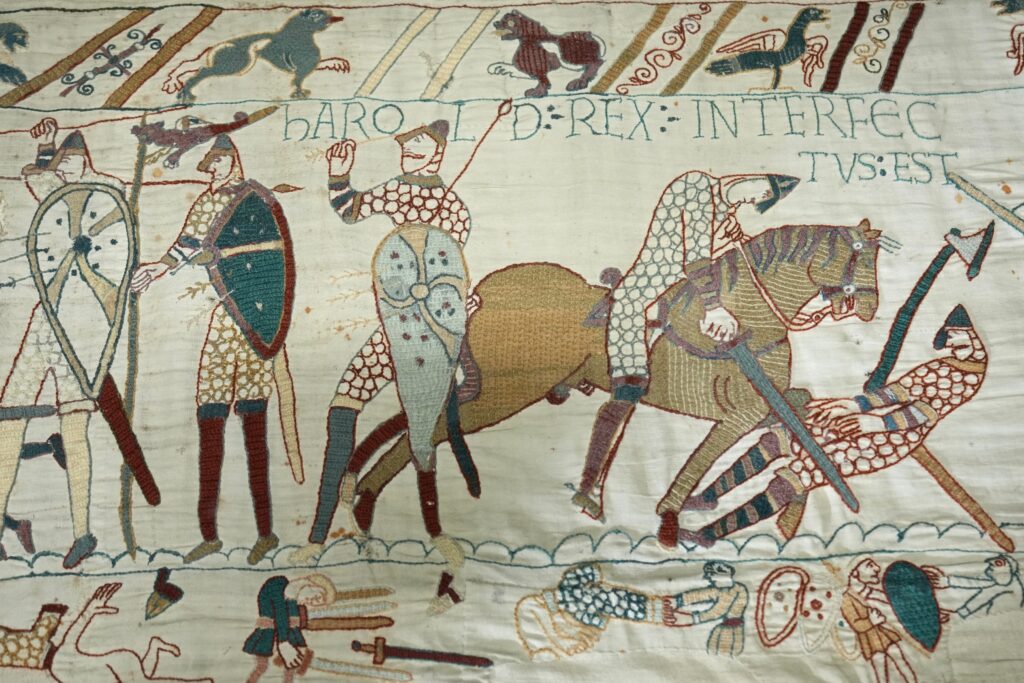
BATTLE, England — A display of 230 feet of medieval embroidery known as the Bayeux Tapestry is turning out to be a blockbuster for the British Museum. The first batch of tickets sold out in a day, and the museum is extending its opening hours to deal with the crush.
Curators call the public’s interest “extraordinary.”
The show, centered on the tapestry that is on loan from France, runs through July, but the United Kingdom is clearly having a Bayeux moment, spilling over into podcasts, BBC documentaries and political debate about the country’s past and future.
Who are the English people, really? What happened to the old Anglo-Saxons? Did everyone just become French? They don’t call it the “Norman Conquest” for nothing. It’s complicated.
The fragile embroidery — on its first visit back to England in nearly 1,000 years — was commissioned by the victors, so historians advise adding a pinch of salt to a storyboard that unspools the narrative of William, Duke of Normandy, and his bloody invasion of England 960 years ago.
(That the tapestry itself survived moths, mold, fire, the French Revolution and the Nazis is also amazing).
The tapestry’s cinematic climax is the Battle of Hastings, which took place in the south of England on Oct. 14, 1066, a date memorized by every schoolchild in Britain. About a quarter of the 76 yards of Bayeux embroidery show scenes from the battle, in which William crossed the English Channel with an invasion fleet to defeat the last of the Anglo-Saxon kings, Harold Godwinson, in an epic clash of armies.
Picture 7,000 or more warriors on each side, going after each other with axes, swords and spears for a whole day.
Each year this epic gore-fest is brought to life by the English Heritage preservation charity, which hosts what the Telegraphcalls the “Super Bowl of battle re-enactments” in the shadow of the ruined Benedictine monastery built by William to commemorate his triumph. This year’s show was sold out.
On opposing sides of Senlac Hill below the Battle Abbey, hundreds of reenactors awoke last weekend in two living history camps — one for the Saxons, and one for the Normans.
In the mist, they emerged from canvas tents, where many had slept on sheep skins, wrapping themselves in wool cloaks. They lit smoky fires and ate 11th century breakfasts of porridge, bacon and eggs out of wooden bowls.
The groups are self-administered and strict about making sure their hems are not machine stitched. They model their tunics, amulets, helmets, wimples, tools and weapons on archaeological finds. As the paying public began entering the camps, participants called out to one another, “We’re authentic!” — as a film director might shout, “Action!”
It was time to hide any bit of kit from the 21st century, so as not to break the spell, either for onlookers or the reenactors themselves, who confess that spending two days in damp medieval-style shoes, armed to the teeth and without mobile phones can feel a bit like time travel.
Two major organizations — the Vikings and Regia Anglorum — supply cast members for the recreation, and they take their roles seriously, learning to form shield walls, shoot rubber-tipped arrows, jab with spears, swing Dane axes. They train for months on the safe use of reproduced medieval weapons, which are heavy, metal and can bruise, but not cut, as the edges are blunt.
Before the battle, the sides mustered, as safety officers walked among them inspecting the blades to make sure there were no “sharps.” On the Saxon side, the fighters repeated old jokes, like, “This is our year.” They also bellowed, “Death to the usurper!”
Mitchell Lawrence, the reenactor who played the soon-to-be deceased King Harold II (spoiler alert: He’s shot in the eye with an arrow), received visitors outside his tent, allowing selfies by the public.
Lawrence, as Harold, exhorted his men not to break. “If the shield wall falls,” he warned, “England falls.”
Darren Orritt, one of the king’s elite bodyguards, called the housecarls, said he guessed that he and his mates would be considered “losers” by President Donald Trump. He shrugged. The housecarls would push back hard against the actors playing William’s troops.
“We want the Normans to remember if this wasn’t scripted, they would be the losers,” Orritt said.
Among the soldiers lining up to greet King Harold was Denis Leforestier, a university student from France who is getting his master’s degree in history. He pledged his support to the Saxon king.
Afterward, he commented: “This is a big moment in European history and, as you can sense here, even in this recreation, how it would have been a very, very bloody battle.”
Leforestier said it was good both to read history and to try to experience a little of it, too. He was impressed by the banners flying above the Norman army, blessed by the pope, “which give you the better understanding that this was a Christian versus Christian battle.”
If there were 500 reenactors playing foot soldiers in this year’s show, plus two dozen armored riders on horseback, Leforestier said, “imagine the real day, 2,000 men on horses? Thousands more on foot?”
The battle, according to the tapestry, entailed repeated charges, “arrow storms,” strategic retreats, feints, cavalry assaults and, finally, a melee.
Where did they pile all the dead? Leforestier wondered.
As the sides marched onto the field, the show’s announcer egged the crowd to cheer for a side, as if Hastings were a professional wrestling bout. It was obvious where his loyalties lay. He called William “the head of the snake” and “a master of trickery.”
“Booo!” roared the crowd.
Raffi Thomas, a reenactor from a group originally founded by students at the University of York, said, “I think the audience identifies more with the Saxons as English. But, you know, we English really are Normans, too.”
During the show, King Harold casts the Normans as invaders, pillagers and rapists who will murder English children. The Saxon king exhorts his men to fight for England — or else.
William the Conqueror, as he became known, did transform England, moving it away from Scandinavia and toward continental Europe. He installed a new ruling elite, turned slavery into serfdom, introduced surnames, built stone castles with moats and established a strict feudal system of land ownership. The language of the upper crust also became Old French.
Cathy Murphy serves as the Konungr, or leader, of the Vikings, Britain’s oldest and largest early medieval historical reenactment society. She blamed the Victorians for casting the Anglo-Saxons as romantic, heroic and doomed, “which they were,” she said, “but that’s not the whole story.”
“What we are — and the public doesn’t always get it — … is both sides of the battle. We are the product of Normans and Saxons, and everybody else,” Murphy said, adding that medieval English were born of the Romans, Vikings, Celts and others.
She noted that England had a Danish king, King Cnut, when it was ruled as a part of the North Sea Empire.
The battle unfolded as told by the tapestry. At first the Saxons held. They repelled the Normans, who must run up the hill to clash. At one point, William seemed to fall from his horse, but he lived on and rallied his forces.
The announcer reminded the crowd that this is hand-to-hand fighting to the death: “hacking, cutting, thrusting, slicing off hands, gouging eyes.”
After Harold’s defeat, William thundered past the crowd atop his horse, as the announcer implored: “Give homage to your new king! To your new overlords!”
Some boos. Then a few more “yeahs.”
In the end, who doesn’t love a winner?
The post U.K. revisits its bloody history in medieval tapestry and battle reenactments appeared first on Washington Post.