I became an Austrian citizen before I ever stepped foot in that country.
In 2020, a law went into effect that allowed descendants of Austrians persecuted by the Nazis to apply for citizenship. The process was incredibly smooth for me, because my family had a detailed testimony of my maternal ancestors’ oppression.
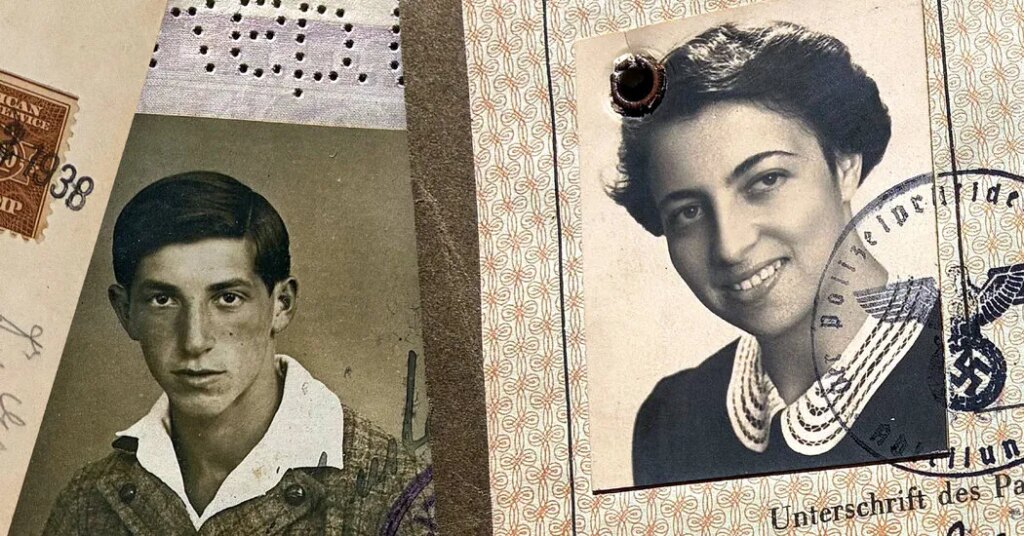
The University of Vienna has records of my grandparents’ expulsion from medical school in 1938, the year Jews were stripped of their citizenship after the Anschluss. My Opa was able to leave soon after, and my Oma followed in early 1939. My grandfather had tutored an American boy in the early ’30s and secured a coveted visa because that family sponsored him.
The Documentation Centre of Austrian Resistance had the information about my Opa’s parents. They were deported from Austria, along with nearly 1,000 other Jews, to a ghetto in southeastern Poland in 1941. It is unclear how they died — whether they withered from illness or malnutrition, whether they were among the hundreds shot in the ghetto, or whether they managed to make it to a concentration camp before they perished in late middle age. All we know is that the ghetto was liquidated in 1942, and they did not survive the war. My Oma’s parents were able to flee to Switzerland and got out just in time.
In spite of all of this, my grandparents loved Vienna. They spent the majority of their lives as American citizens and were grateful to build a life here, but they considered themselves Austrian until they died. Oma and Opa even took offense if you insulted or misperceived their homeland. This always confused me. I wanted to ask: How could they defend a place that tried to destroy them? A country that dragged its heels in making amends? Unlike Germany, it took Austria until the 1980s before it began to meaningfully reckon with its role in the Holocaust. But I never pressed. Like many refugees, my grandparents did not want to talk much about the past.
I wished that my grandparents had been alive for me to ask for their blessing in receiving citizenship as a kind of reparation. I wanted this gift from the Austrian government to mean more than a dark-red passport printed in a language I don’t understand. I have been thinking about all of this unceasingly since this past summer, when my parents sold some land my grandparents owned and, with it, the worldly connection to them in America.
The only answer to any of these questions came from an oral history my brother did with Oma in 2005. She was willing to talk about her pain in this context, knowing it would be kept for posterity. Oma did not seem bothered by the fact that she never got to finish medical school. Opa, who was a year ahead of her, served as a doctor in the U.S. Army and became a family physician, supporting his wife and children well.
“Between the First and Second World Wars was a wonderful time to grow up in Vienna,” she told my brother. My Oma said it was intellectually stimulating, exciting and bohemian — the city of Freud, Mahler and Krause. The Alps are only about an hour from Vienna, and we have grinning photos of them hiking and skiing in the ’30s. “It really was antisemitic, but somehow it was gemütlich,” she said, using the German word for cozy or comfortable.
Success Can Make You a Scapegoat
Why did Vienna feel like home to my grandparents, when their own parents had not even been born in the city? When I read the historian Douglas Smith’s new book, “The City Without Jews: Life and Death in Nazi Vienna,” I began to understand my grandparents’ relationship to their home country more deeply.
Through the diaries, letters and family history of Mignon Langnas, a Jewish nurse and mother of two who was one of a few thousand Jews to remain in Vienna through the Nazi occupation, Smith traces how Jewish life came to flourish in the city in the late 19th and early 20th centuries.
Under Austro-Hungarian Emperor Franz Joseph, legal discrimination against Jews was abolished in 1867. Waves of antisemitic pogroms in Eastern Europe around this time meant Jews in my great-grandparents’ generation flooded into Vienna, which was already a multiethnic center made up of Hungarians, Croatians, Italians, Slovenians and Poles. “The empire’s Jews felt safe and secure,” Smith writes. Some historians, like Smith, posit that Jews were the “only true ‘supranationals,’” in Vienna because, unlike the Poles or the Slovenians, Jews had no national homeland “distinct from and predating the empire.”
Smith explains how successful Jews were in Vienna. They assimilated into Germanic culture — in my teen years, my Oma gave me a dirndl that had been my mother’s — and made up a bulk of the city’s physicians, financiers, journalists and artists. Jews fought valiantly for the empire during World War I, and some became decorated war heroes despite the loss. Austria was hacked out of the larger empire in the aftermath of the war, creating a tiny alpine state that “nobody wanted,” with an economy in free fall, Smith writes.
Because they had so successfully integrated into Viennese society, many Jews thought the Nazis would not be able to take over the country. A new constitution had been enacted in Austria in 1934 that gave Jews equal protection under the law. My Oma’s relatives assured her that Kurt von Schuschnigg, the Austrian chancellor, would keep them safe. “He’ll straighten everything out. Nothing is going to happen,” they said.
Though there were many poor and struggling Jews in Vienna — my grandfather’s family among them — Jews’ outsize success compared with their raw numbers made them an easy scapegoat for Austria’s woes. “They were accused of stoking unemployment, of taking jobs from the native-born Viennese, of worsening the scarcity of food and fuel, and of turning a housing shortage into a crisis,” Smith writes.
In the end, Hitler was able to easily trample over von Schuschnigg, annexing Austria in March 1938. “The city’s non-Jewish inhabitants had changed in an instant,” Smith’s book recounts. “The world had been turned upside down. Life had become new and terrifying. ‘You felt like a rat,’ Karl Gruenwald, ten years old at the time,” said.
One of the things my Oma talked about with my brother was how painful it was when her Catholic friends looked through her on the street. Her so-called friends turned away when Jews were beaten and humiliated. She felt scared of her own shadow. In 1938, when my grandmother was in her 20s, she witnessed her own elementary school being turned into a prison where thousands of Jewish intellectuals and professionals were tortured.
When Freud, who thought he would be safe in Austria until the very end, was forced to leave for London, he summed up the refugee experience this way: “The feeling of triumph on being liberated is too strongly mixed with sorrow, for in spite of everything I still greatly loved the prison from which I have been released.”
This Place Should Be Gemütlich
After reading Smith’s book, I came to feel that my grandparents’ love for Austria was a form of resistance. By refusing to concede their Viennese identity, they were insisting that they belonged. By accepting the gift of citizenship, I am digging out my dirndl and saying: I belong too.
This insistence is particularly resonant in this moment in the United States. Comparisons to Nazis are often used recklessly. But after reading Smith’s book, I find it hard not to see parallels with how popular right-wing “intellectuals” think it’s fair game to discuss “the Indian question” and whether it’s a “problem” that South Asians are going to the University of Texas and thriving there, cheering on the football team while wearing cowboy hats. “Some Republican state officials have repeatedly accused immigrants of taking jobs from Americans,” my newsroom colleague Amy Qin notes in an article about rising racism toward the South Asian community.
This dangerous rhetoric, which suggests that white Christians are the only true Americans, is not used just against Indian immigrants. You hear it when Vice President JD Vance says that Angie Nixon, who is running for U.S. Senate in Florida, should “get the hell out” of the United States if she is a socialist, adding, “You don’t belong in America if those are your views.”
You see it used against Muslims, especially those who are critical of Israel and supportive of the Palestinian cause. President Trump has repeatedly gone after Abdul El-Sayed, who is running for U.S. Senate as a Democrat in Michigan, calling him “Mohammed” and claiming that he is a “RADICAL Extremist, Terrorist Sympathizer.” You see it in ICE aggression and Trump’s desire to end birthright citizenship and the administration’s attempt to build a case against Representative Ilhan Omar of Minnesota in the hopes of denaturalizing and ultimately deporting her.
And there has been a resurgence of bald antisemitism in the past decade. Most recently, young Republican activists in several states have had group chats leaked that reveal sympathy for Hitler and vile anti-Jewish sentiments. Antisemitism exists on the left as well. Jews are more likely to be victims of hate crimes than any other group, despite our tiny numbers overall.
As the economy shows few signs of improving, and Trump enters the back nine of his presidency, we should note the historical precedent. Any whiff of the great replacement theory should be roundly condemned. We are all Americans; no group belongs here more than any other. Put another way: This place should be gemütlich.
End Notes
-
I do not usually believe in signs from the universe, but I received a sack full of my grandparents’ letters and documents the week that Smith’s book came out. My Opa wrote these letters to my Oma during World War II. The documents include everything from my grandparents’ grammar school records to my Oma’s attempts in the 1990s to get reparations for the property the Nazis stole from her family. I’m going to continue to go through this material over the next several months, and I may relate those explorations in this newsletter. I’d love to hear from you if you have undertaken a similar exploration of your family’s past or if you have any suggestions for me as I research: Drop me a line.
-
A few years ago, I visited Vienna and attempted to write about receiving Austrian citizenship. But I abandoned it because I kept sounding like I was stoned — What even is a country, man? — because borders shifted so much in that pre- and postwar era. But I read many fascinating books as I was trying to work through my ideas, including “I Belong to Vienna,” by Anna Goldenberg, whose Jewish ancestors, like Mignon, were able to remain in Vienna throughout the war. Another essential read if you are interested in Austrian history is Stefan Zweig’s “The World of Yesterday,” a memoir of growing up in Vienna under the Hapsburg empire. And, finally, don’t miss my Opinion colleague Sarah Wildman’s beautiful “Paper Love,” about her Viennese Jewish grandfather and the love he left behind when he fled Austria.
The post Why My Grandparents Still Loved the Country That Rejected Them appeared first on New York Times.