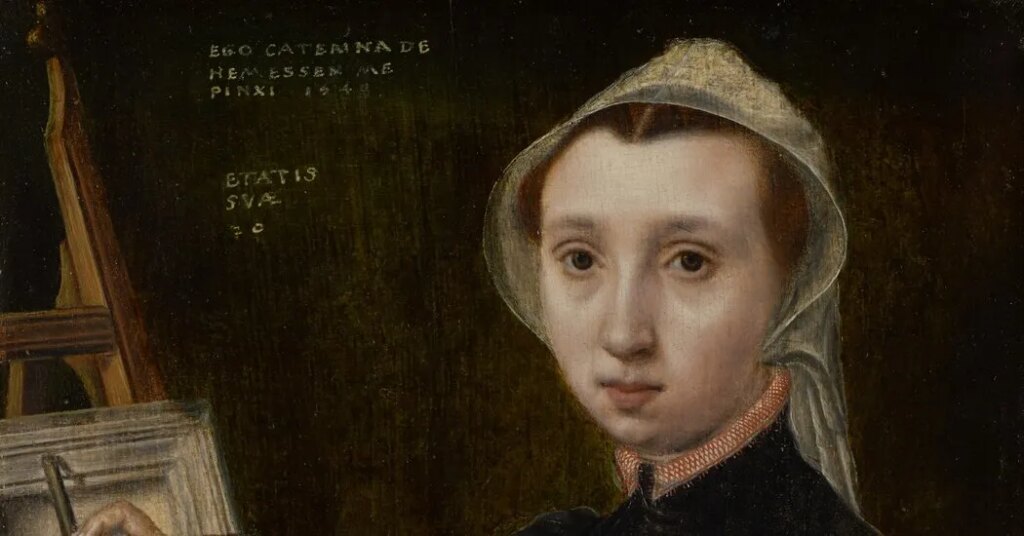
Nearly 500 years after she painted a portrait of herself at an easel and signed her name at the top, establishing herself as an artist, Catharina van Hemessen finally has a show dedicated to her work.
Titled “Van Hemessen and Father,” the exhibition runs at the Snijders and Rockoxhuis museum in Antwerp, Belgium, through Jan. 31. Eleven of van Hemessen’s 19 known works, which are small-scale portraits and religious scenes, are on display alongside those of her father and teacher, Jan van Hemessen. In March, some of Catharina’s works will travel to the National Gallery in London for an exhibition focused entirely on her.
Although Catharina had a role in her father’s workshop in 16th-century Antwerp and independently produced paintings that were well-received by her contemporaries, her place in history books — unlike his — was never secure.
“She was almost eliminated in writing about art,” said Karolien De Clippel, the head of collections and research at the Royal Museum of Fine Arts Antwerp, who first began digging into van Hemessen’s life in the 1990s as part of her master’s thesis.
In the 1500s, van Hemessen was distinguished enough that one Italian historian called her an “excellent miniaturist.” But in the following centuries, according to De Clippel, historians described her work as “weak” or “characterized by naïveté” — or they ignored her.
“We’re lucky that she signed her works,” said De Clippel, who attributed the dearth of interest in van Hemessen to a “paternalistic discourse.”
Because of women’s social and legal standing during van Hemessen’s time, there are few records of her life beyond her marriage certificate, some 16th-century biographical tidbits and her paintings, 14 of which are signed. Although the signatures confirm those paintings’ provenance, there is growing evidence, gathered through technical examinations and infrared imaging, that she also worked on paintings attributed to her father.
In recent years, fresh analysis has uncovered that a number of works by prominent female artists, including Artemisia Gentileschi, Michaelina Wautier, and Orsola Maddalena Caccia, were misattributed to the male family members who ran workshops in which the women had roles. (The name of the Snijders and Rockoxhuis exhibition is an intentional reversal of how such female artists were described: as a daughter, wife or sister of somebody else.)
This was partly because the nature of these workshops, said Maarten Bassens, the head curator at Snijders and Rockoxhuis: Different hands contributed to the artworks they produced, as well as to making copies, all of which were sold under a single name.
Since many of van Hemessen’s known works are portraits, Bassens added, it is possible that within her father’s workshop she “specialized in small-scale figures with their own identities.”
“There are two paintings in our display that left the workshop under Jan’s name but where Catharina likely also played an important role in the execution,” Bassens said, referring to “Christ and the Woman Taken in Adultery” and “Christ Driving the Money Changers from the Temple.” “In a way, she’s also forgotten because she worked under the family’s brand name,” he said.
Van Hemessen, who was born in 1528, grew up in Antwerp, a cosmopolitan city that was a nexus for international trade and home to a prosperous art market. Two of her brothers were also involved in the family workshop, and they had the opportunity to travel to Italy to further their artistic education. Van Hemessen, because of her gender, did not.
“She was living in a house of painters, so you can imagine that she started painting at a young age, and she learned through being in the studio and seeing what her father did,” De Clippel said.
The position of women in 16th-century Antwerp was mixed. As a woman, van Hemessen was not allowed to become a member of the artists’ guild where her father held an elevated position, but there are records of women working as merchants, investors, teachers, midwives, caterers and surgeons. Elementary schools, where students learned math, writing, grammar, reading and multiple languages, were open to both girls and boys.
Given that van Hemessen signed her paintings in Latin, it’s likely that she was well-educated. Certainly, she gives the impression of confidence in her self-portrait, said De Clippel. “She’s wearing quite fashionable clothing, which means she has self-esteem. She’s very proud to present herself seated at the easel.”
Bassens praised her portraits for “great attention to detail,” pointing to the golden embroidery on a pair of gloves and the intricate patterns on the transparent tulle in a 1551 portrait of an unknown woman. The elaborate textiles of van Hemessen’s sitters signify their wealth, which means that van Hemessen had access to people from elite circles, whether as clients, friends or acquaintances.
In 1554, she married a musician named Kerstiaen de Morijn, and in 1556 they moved to Valladolid, Spain, where de Morijn served as a court organist. There are no known works by van Hemessen painted after 1556.
The art historian Jennifer Courts has argued that by depicting herself in a self-portrait as someone with education, painterly skills and social graces, van Hemessen might have been pitching herself for a higher social role — for example, as a lady in waiting the court where her husband worked.
Since concrete details about van Hemessen’s biography are sparse, it is difficult to confirm Courts’ hypothesis. Even so, De Clippel said, museum exhibitions like the one at Snijders and Rockoxhuis offer opportunities to understand the many unexpected paths female artists took in the past.
“We have to consider the whole picture and the context in which these female artists worked: the possibilities they had, but also the constraints,” De Clippel said. “It’s one thing to show the artworks. It’s another to show the artworks and tell the story behind them.”
The post She Signed Her Painting in 1548. Nearly 500 Years Later, It Finally Goes on Show. appeared first on New York Times.