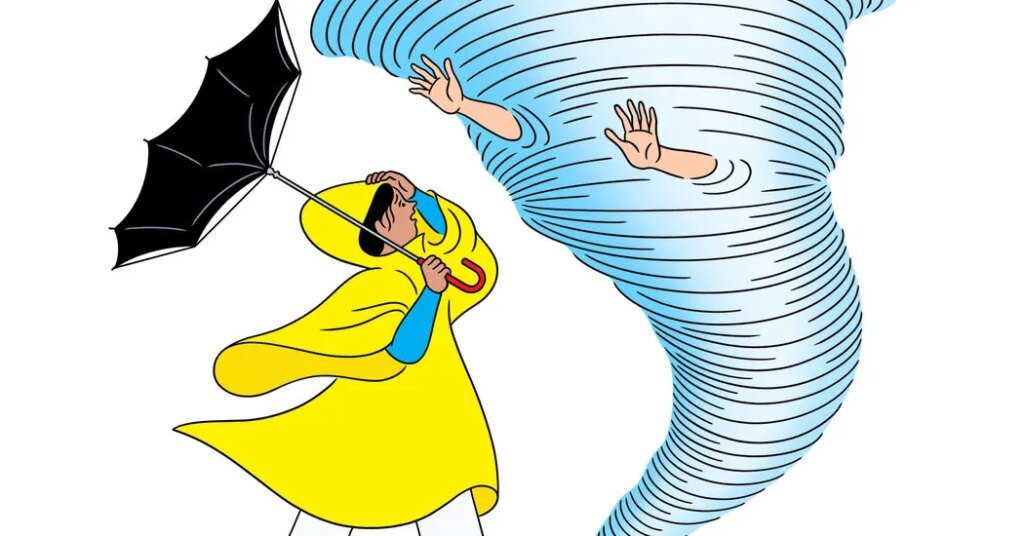
I have a longtime friend who lives with a severe and escalating mental illness. She is open about the diagnosis and has made great efforts to follow medical advice, take medication and submit to monitoring. Recently she had a dramatic manic episode that evolved into psychosis and, eventually, hospitalization. My question is what I owe a friend when their conduct toward me during such episodes crosses my own boundaries.
Over the years, my friend has repeatedly come to me with what she has described as emergencies, drawing me into situations that have ultimately exhausted my emotional resources and led me to withdraw from the friendship. During this most recent episode, she told me that she was pregnant, and spent nearly a week trying to figure out the logistics of setting up an abortion. I spent many hours helping her. Eventually, however, it became clear that this abortion was not actually going to happen. Later she told me she had had a miscarriage.
I now doubt that this pregnancy occurred at all, and I suspect that some earlier emergencies were products of paranoia or mania. During these crises, I would often drop everything to help. Later she would dismiss what had happened as no big deal or refuse to acknowledge it.
I don’t blame my friend for being mentally ill. I know the illness has had a profound effect on her spouse, child and close family. What I don’t know is how to respond once things come back down to earth. I have not been able to re-establish the friendship because I can’t shake the feeling that she lied to me about this particular episode and perhaps about others. I am strongly committed to abortion rights, so this was exactly the sort of emergency I would feel compelled to respond to. That made it especially painful to feel that I had been drawn into a crisis that may never have existed.
I also don’t know how to establish boundaries with someone who, during an episode, may not be experiencing reality as I am. I’m unsure how much she remembers afterward. Honesty matters enormously to me, and friends often come to me with things they feel they cannot tell anyone else. I wonder whether this has made me particularly susceptible to emergencies that seem tailored to capture my attention.
I don’t know how to tell my friend how hurt and manipulated I felt by demands that later proved unreal, especially if she may not remember making them. Yet I miss the friendship, and this has gnawed at me. She has struggled to recover and is still not doing well. How do I protect myself, and what do I owe someone who has been profoundly, though perhaps not deliberately, dishonest with me? — Name Withheld
From the Ethicist:
One thing that makes this so difficult is that you’re not dealing with a single, continuous moral agent who is aware of what she has done, willing to answer for it and determined not to do it again. People can’t take full responsibility for things they don’t quite recall doing. An apology usually involves not just the expression of regret toward a past misdeed but a resolution to do better in the future.
If your friend said, “I’m very sorry that I wronged you, but I make no commitment not to do it again,” she would hardly be presenting themselves as a responsible moral agent. Yet they would be representing their situation accurately. It sounds as though they can become manic even while taking their medications as prescribed. If they aren’t in control of whether or when that happens, they can’t simply promise that the conduct won’t recur.
Immanuel Kant suggested long ago that we can take two perspectives on human action. We can view ourselves, when deliberating, as free agents whose decisions arise, in a reasonable way, from our beliefs and desires. We can also view ourselves, objectively, as creatures enmeshed in a world of cause and effect, whose actions arise from prior states of our bodies, minds and environments. Certain mental illnesses make it hard to regard someone from the first perspective. And so you might think of this person as two people, only one of whom is your friend.
The person you miss can fairly be asked to acknowledge properly what their illness has cost you. When mania takes over, though, you need to respond to them as a patient, as someone who’s effectively a puppet of irrational forces. If a toddler is terrified by a monster under the bed, after all, you don’t spend six hours looking for monsters and devising a monster-elimination plan. You might glance under the bed, but your job is to address the terror. In the same way, you’ll need to learn when a story about an emergency is symptomatic of an episode, and respond to the episode itself. Although rapid speech, grandiosity or mounting paranoia can be warning signs, you may not always be sure that your friend is entering a manic phase. Just be vigilant, and set limits of your own, turning to her family or medical team when you suspect that an apparent emergency is a symptom of her illness. That means trying to avoid resentment and blame, and providing whatever help you reasonably can toward getting them safe and medically cared for. What you owe the first person, in short, is to help keep the second person from taking over.
Readers Respond
The previous question was from a reader wondering about voting ethics. He wrote:
My friend lives in a very red state but is a lifelong Democrat. During this year’s primary, he and some like-minded friends were considering registering as Republicans in the hope of helping a more moderate Republican win the primary. Others said this would be unethical. I don’t see why. Elections are meant to give voters some say in who governs them. If the Democratic candidate has no realistic chance of winning, what is wrong with choosing a party affiliation that at least gives my friend some meaningful choice among the likely officeholders? Would the answer be different in a purple state, if he and other Democrats registered as Republicans to support the primary candidate they thought would be easiest to defeat in the general election? — Name Withheld
In his response, the Ethicist noted:
Your vote is meant to express a preference, though that preference can be informed by a sense of what outcomes are possible. What your friend had in mind was to vote for the Republican who, among the plausible contenders, he would most want in office. … Cross-party voting aside, primary voters in a purple state might support someone they thought would be a stronger general-election candidate for their party, even if, all things being equal, they would have preferred another of their party’s candidates. That’s strategic voting, of a familiar kind: choosing someone you’re reasonably content with partly because that candidate has a better prospect of defeating someone you strongly oppose. Politics remains the art of the possible. By contrast, if your friend voted in a primary for someone he regarded as a weak candidate in order to help another party, he’d be engaging in sabotage. … He’d be misusing a procedure meant to give voters a say in choosing a party’s nominee. It’s also a risky maneuver: seemingly unelectable candidates sometimes get elected. …Those who game the system have only themselves to blame if their designated loser ends up in office.
(Reread the full question and answer here.)
⬥
I don’t really see this as an “ethical” question. To the degree that it is, I think it’s more a reflection of the unethical hurdles and limitations placed by the political parties of some states to foreclose broad participation. The subtext of the question seems to suggest that such a person would be somehow gaming the system. I don’t agree. Several states have nonpartisan primaries. I would argue the ones that have partisan primaries are the ones that are trying to disenfranchise people. I consider myself a true independent, having voted for candidates of both parties for both local and national office. That said, I am registered as a Democrat in New York City simply because if you’re not voting in the Democratic primary, you’re really not voting. I don’t think that’s gaming the system or somehow being deceitful. It’s operating within the limitations of a system that was created by the party structure. — Mark
⬥
If people went to all the trouble of registering in the other party, why shouldn’t they be allowed to vote? They’re not coming anywhere close to breaking the law. And it’s certainly not unethical. — Michael
⬥
Voting for a candidate that I dislike as a way of advancing the interests of a candidate I prefer is a legitimate use of my vote. In a democracy, nobody should question or challenge another person’s reasons for voting the way they do. — Nancy
⬥
Politicians have flipped parties in order to prolong their careers; it seems only fair that voters should have the same right. — Simon
⬥
You can vote with your heart, or you can vote strategically. If that means crossing parties, so be it. — Mary
The post What Do I Owe a Friend Whose Mental Illness Pulls Me Into Imagined Emergencies? appeared first on New York Times.