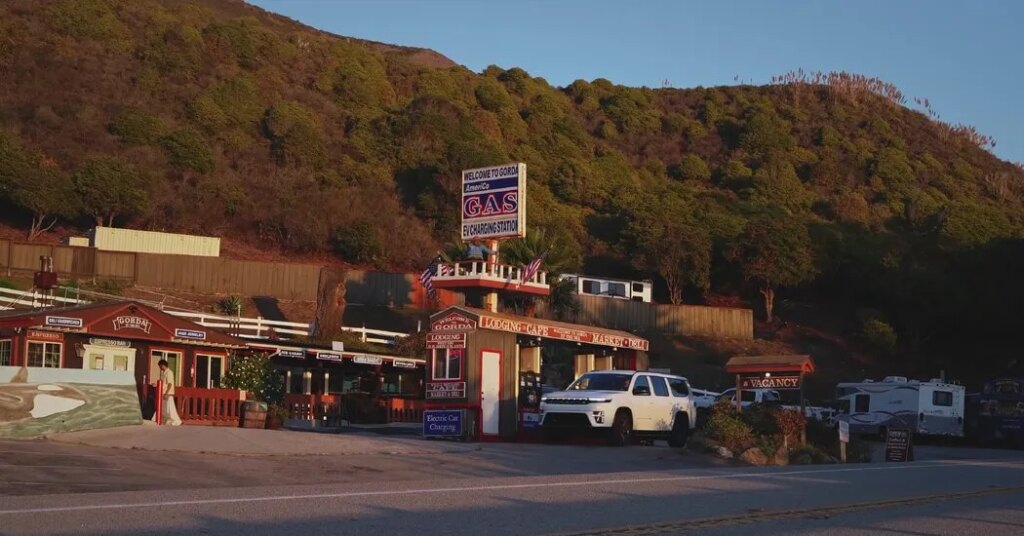
Gorda is the sort of place that one stumbles onto while headed elsewhere.
Although it is in Big Sur — that romanticized ribbon of California where the highway is carved into the mountains and the cliff walls plunge into a glittering sea — it is a modest hamlet that sits on a less prominent stretch.
There is no cell service for miles, so Gorda materializes without warning. It is not an actual town but an outpost that consists entirely of a restaurant, three mini marts and cabins for rent, along with housing for about a dozen employees in the back of the complex.
Even the people here will tell you this place is not a destination. Perhaps the most popular request of travelers is the code to the restroom.
In the spring, however, Gorda and its fuel station of four pumps received a smattering of attention.
A gallon of premium unleaded gas was going for $9.999 — the highest number many pump displays allow. (Gorda does not sell diesel, which would be even more expensive, because truckers avoid the area.)
It was an outrageous figure even in a state where the average price per gallon at the time hovered around $6, the steepest in the nation.
Ten-dollar unleaded seemed to be a symptom of war, the affordability crisis and the shriveling California dream all at once.
The owner of the station, Leonardo Vargas Flores, was not bothered. Most patrons headed only to the mini marts anyway, where the inflated cost of a small bag of chips ($5.99) never caused a stir.
It wasn’t long afterward that Mr. Vargas Flores, 61, decided to call his fuel supplier based in Fresno and ask for help. Someone from the company soon arrived and updated the software that runs the gas station’s meters. The decimal point on the displays could finally be moved to the right.
By the end of summer, Mr. Vargas Flores had bumped the price up to $10.49.
Fueling a community
Gorda has, in fact, often sold the most expensive gas in the contiguous United States.
It has to do with its dependency on tourism and its remote location, 27 long and winding miles north of Hearst Castle on the iconic Pacific Coast Highway.
Because of its isolation, Gorda operates off the grid and relies on generators that guzzle several thousand gallons of diesel each month, whether customers come or not.
Inflated prices help sustain it through tough times, like when wildfires, landslides and repairs shut down the highway.
“When it’s busy, I save a little bit of money to put me through the winter,” Mr. Vargas Flores explained on a recent Wednesday morning as Gorda stirred to life. “It’s a good feeling if you can make it work.”
Wearing a Dickies shirt, jeans and boots, he scuttled about as a ring of keys jangled on his belt loop. Employees walked down from their no-frills quarters, which consist of single rooms with shared bathrooms. Customers trickled in to order coffee.
Born in Mexico, Mr. Vargas Flores was a teenager when he arrived in Big Sur on a whim and took a job as a dishwasher at an inn. By then, Gorda had been in the spotlight for being purchased by four siblings, ages 11 to 16, who purportedly needed a tax shelter in the late 1970s for money they earned selling horse manure.
When Mr. Vargas Flores began working at the Gorda road stop in 1997, it was owned by a married couple, Sherwin and Mary Miller. Mr. Miller, a doctor, passed away in 2007. A decade later, his widow wed Mr. Vargas Flores, who was already managing the place.
Now Mr. Vargas Flores sat inside the diner, Whale Watchers Cafe, eyeing it with anxiety. Less than a dozen tables had been seated since it opened at 8 a.m. Some of the guests had opted to share a dish after perusing a lunch menu that offered a bacon cheeseburger with fries for $36. Business had shifted profoundly since the 1990s when the restaurant would stay open until midnight, jammed with boisterous crowds.
“You start to stress: ‘Why am I open? Like, what am I doing?’” Mr. Vargas Flores said.
Last month, two fires closed the highway, and then a generator fizzled out. Mr. Vargas Flores managed to find one he could rent for $5,000 a month that was 85 miles away. He and an employee maneuvered through rural roads for six hours, most of it spent pulling the 10,000-pound machine behind a white truck.
“Yeah, that was a day,” said Betty Brogdon, 59, a waitress who has worked at Gorda for two decades. (“I answered an ad in a newspaper that said, ‘Come live in paradise,’” she said, “and here I am.”)
Employees say they are like family, with the usual joys and annoyances. Sometimes staff members share a big meal or give one another rides to pick up supplies. Last year, they celebrated their co-workers’ daughter who, at 15, is the only kid living at Gorda. They danced at her quinceañera held in the parking lot.
At that time, the highway north of Gorda was in the middle of a three-year shutdown after disastrous landslides. Business was worse than during the pandemic. Firefighters and road crews were often the only guests in Gorda’s cabins.
It had seemed that this would finally be the year for Gorda’s comeback. The highway had been repaired; road trips were a thing again.
Then the Iran war broke out. The cost of fuel ratcheted up, as did Gorda’s overhead.
A wanderlust crowd
The truth is, in person, Gorda’s gas prices are not often met with outrage.
After all, this is a thoroughfare frequented by the wanderlust crowd. Travelers have chosen this rugged road for the chance to feel adrift, to be arrested by a view that only the mountain’s edge can offer. With vacation money in hand, what’s a few more dollars for a gallon?
So you will find people like Karla Villa and her boyfriend, Sigi Morales, who pulled up on a Thursday in a silver Acura sedan. The two were making their way from Southern California to San Francisco for a Los Angeles Dodgers game.
They did not hesitate to pump four gallons, reasoning that the price was necessary in such a remote region. Big Sur, they said, was an area where one rolled with the punches.
“You’ve got to chance it with the coastline,” said Mr. Morales, 44, who owns an upholstery business.
An hour later, three brothers visiting from Germany piled out of a rented blue Nissan Rogue. Although they had nearly half a tank, they bought $60 worth of gas.
“I guess it’s kind of expensive, but we are not really sure,” said Jonas Becker, 28, a police officer.
His younger brother, Leon, an economics student at Technical University of Munich, shrugged. “It can’t be much worse than Germany right now,” he said.
Back home, they said, gas rose to about 2.30 euros per liter, prompting the government to cut fuel taxes.
But none of the brothers wanted to try to do the volume and currency conversions to understand how it compared with Gorda. (It would have translated to roughly the same.)
The Beckers were five days into their first visit to America. They had come for an adventure down the highway that had not disappointed. Although much of the region was shrouded by dense fog that day, the ocean view had dazzled.
It was a similar experience for the family from India, the group of friends from Poland, the couple from New Jersey, the siblings from San Francisco, the young woman from London introducing her boyfriend to a drive she had taken years ago.
For all of them, as their cell service vanished, so, too, had their sense of direction. They knew nothing about Gorda, only that they were pleased to have happened upon it.
‘Like visiting grandma’
A handful of years ago, Mr. Vargas Flores made plans to bring solar power to Gorda. It has been a painstaking process with an ever-changing price tag. The cost of installation had risen to more than $3 million, initiated by a family loan, and it is not yet done.
Gorda would still need backup generators to fill in some gaps. But solar makes the enterprise less reliant on fuel for its own operations. “I just need customers to come in and buy things,” Mr. Vargas Flores said.
The revamp is much appreciated by Victoria Nuñez-Lazaro, the 15-year-old Gorda resident, who works the cash register after school, bantering with customers between poring over textbooks. (At her tiny K-12 school, she is the only high school student.) She worries about Gorda’s “old-timey vibe” and shrinks when she reads critical reviews.
“It could use, like, a little bit of refurbishing, right?” Victoria said. “I try to tell people that we’re doing the best we can. It’s a quaint little spot, like visiting grandma on the weekends.”
There is no real panic about Gorda’s fate. Around the Central Coast, it is known as resilient, hardy. Even as the prospect of destructive weather and landslides from a “super” El Niño looms.
Mr. Vargas Flores, for his part, is relieved to have changed the software on his pumps.
“In the future, the gas is going to go maybe $12, maybe $14, I don’t know,” he said.
Gorda does have a charging station for electric vehicles, although it requires first turning off power to the cabins. It has been a regrettable purchase, he noted.
It never gets used.
The post $10 a Gallon at This Gas Station by the Sea appeared first on New York Times.