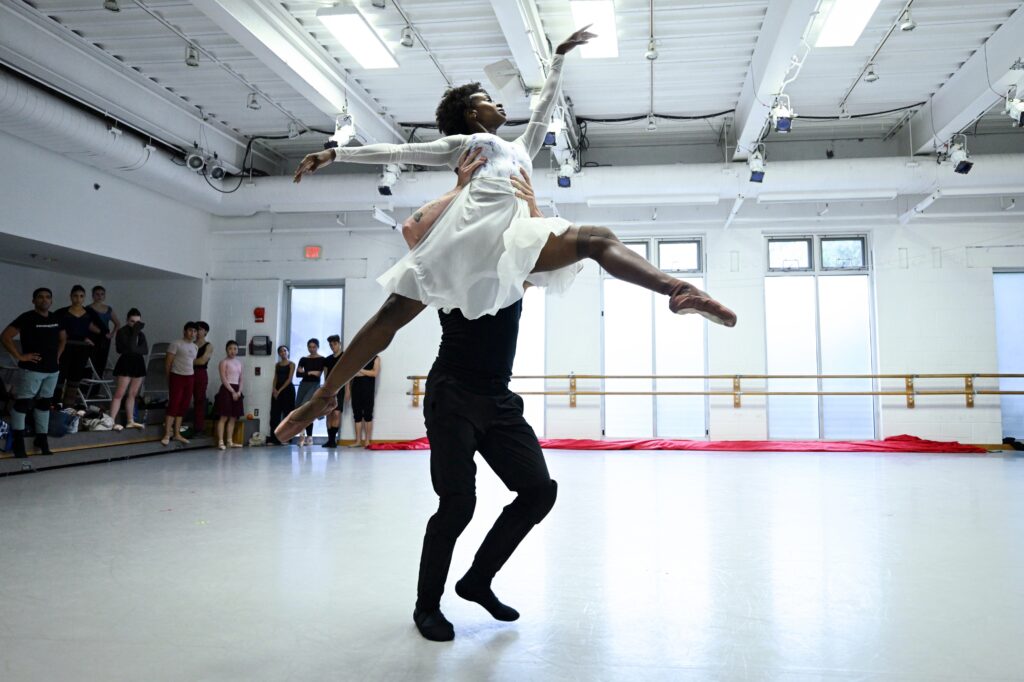
In 1976, when the Washington Ballet chasséd onto the American dance scene, no one knew whether the scrappy young company of 17 dancers would be going strong for a few seasons, let alone a half-century.
“We didn’t know. We didn’t know anything! We just went from one show to the next,” says Julie Miles, one of the troupe’s original dancers.
That perseverance paid off: The Washington Ballet is celebrating its 50th birthday this season. The anniversary year launches Oct. 30 with “Go-Go 50,” a mixed-repertory bill that includes choreographer Chanel DaSilva’s world premiere “An Artist’s Prayer,” set to music by the local band Black Alley.
“Go-Go 50” will also feature older works by current artistic director Edwaard Liang, Trey McIntyre and TWB’s first resident choreographer, Choo-San Goh. It’s a lineup that exemplifies some of the company’s hallmarks: a willingness to gamble on new work, an embrace of diverse repertoire, and an ability to capitalize on the culture and cachet of its hometown.
All these traits manifested soon after native Washingtonian Mary Day established the company as a chamber-size troupe that could provide opportunities for high-achieving students from the Washington School of Ballet, which she had founded in 1944 with her former teacher Lisa Gardiner. The new company would operate out of the same space on Wisconsin Avenue NW that housed the school — Day’s home, to which she added studio space. The demise in 1974 of the National Ballet, which had been a Washington presence, left the city especially open to the new venture.
Day wanted the company to tackle original work, not just trot out usual-suspect classics (although the early repertoire included Balanchine, as well as Martin Buckner and Day’s version of “The Nutcracker”).
“She said early on that what you need for a company is space, dancers and a choreographer,” recalls Miles, 68, who had been a student at the school. “She didn’t just say, ‘Space, dancers and then, you know, we stage old ballets.’ She wanted to be part of a new creative force.”
So while still preparing to launch the company, Day recruited a prodigy she had heard good things about: Goh, a blossoming choreographer and Dutch National Ballet dancer who had been born in Singapore to Chinese parents. He joined the company in 1976, and Washington Post dance critic Alan M. Kriegsman soon became a champion. Goh “propelled the Washington Ballet to international status on the jetstream of his talent,” Kriegsman wrote in 1985, looking back.
“It’s remarkable that [Day] could look at a 28-year-old Chinese man from Dutch National Ballet and think, ‘This is the future of Washington ballet.’ I mean, it was a leap of faith that was just extraordinary,” says Janek Schergen, who in the 1980s was TWB’s ballet master and is now artistic director of the Singapore Ballet and the Choo-San Goh & H. Robert Magee Foundation.
When Goh joined the company, “he was just spilling ballets out,” Miles says. “So our job was just to keep up with him — up with his energy and his talent.” If not for Goh, she says, “I’m quite certain there wouldn’t be a 50-year version of the Washington Ballet.”
The troupe performed early on at hometown venues the Marvin Theatre and Lisner Auditorium. But as befits an institution from an embassy-peppered city, TWB soon scored triumphs of international scope. Dancer Amanda McKerrow made headlines in 1981 when she was 17, becoming the first American to win a gold medal at the prestigious International Ballet Competition in Moscow. The next year she began a decades-long career with American Ballet Theatre.
And the young Washington Ballet landed tours to Asia, Europe and elsewhere. The “Washington” in the name positioned it as “a cultural ambassador when we traveled,” says Schergen, 75. “That got us a lot of places and did us a lot of early favors.”
It also helped, Miles says, that the company “traveled pretty light because we all wore unitards. We did a lot of unitard ballets. The Danskin tank unitard was our go-to, just dyed in a different color, and all of that done definitely in the basement or in the garage of Washington Ballet.”
In 1987, Goh died of AIDS-related illness at age 39. “It was just a shock,” Miles recalls. The next year, the company performed for the first time in the Kennedy Center Opera House, dancing fare that included Goh’s “Momentum,” set to Prokofiev’s Piano Concerto No. 1. When the first chords sounded, “that’s where I got kind of teary,” says Miles, who is now on the faculty of Maryland Youth Ballet. “Like, ‘I wish Choo-San could be here.’”
Immediately after Goh’s death, the Washington Ballet “was a bit of a mess,” she says, but under Day’s leadership, “it just kept going,” including tackling pieces by other contemporary choreographers.
By then, TWB’s appetite for new work was firmly established. That adventurousness and risk-taking may have been necessary, given a certain venue that has historically loomed large.
“We always had the Kennedy Center, and world-class companies always come and do big ballets all the time, and we have to compete with them,” says Maki Onuki, a Washington Ballet dancer for more than 20 years. “So I think the only way for us to be good is to be unique.”
Seemingly tailor-made to shape that uniqueness was Septime Webre, a high-energy choreographer who took over as artistic director in 1999 after leading the American Repertory Ballet of New Jersey. He saw an opportunity to develop pieces for his new troupe that were not just original, but also attuned to its hometown’s identity.
“Washington, D.C., is a city, probably more than any, that resonates with American history and the importance of American culture,” says Webre, 62. His choreographic responses to that resonance included his 2004 “The Nutcracker,” now a beloved holiday tradition, whose Washington-centric touches include Georgetown and Tidal Basin settings and characters like George Washington. His subsequent ballets included the riffs on American literature “The Great Gatsby” (2010), “Hemingway: The Sun Also Rises” (2013) and “Sleepy Hollow” (2015).
During his tenure, which ran through 2016, Webre also made sure to program such full-length classics as “Don Quixote” and “Le Corsaire.” Offering these standards helped grow the audience, he says, and the company’s dancers “needed to dance that repertoire to be their best, and for us to attract, and retain, really great talent.”
Talent like Brooklyn Mack, a star and audience favorite who danced with TWB for nine seasons from 2009 through 2018 and particularly appreciated the range of fare.
“There’s definitely lots of companies with diverse repertoire, but I would say that even among those, especially in the [United] States, that the Washington Ballet stood out,” says Mack, now an international principal guest artist.
Mack helped deliver a major achievement in 2015 when he co-headlined the company’s first full-length “Swan Lake,” at the Kennedy Center, dancing the role of Prince Siegfried opposite guest artist Misty Copeland, an American Ballet Theatre star, as Odette/Odile. The partnering of two Black dancers in the lead roles of the iconic work was, at minimum, exceedingly rare and attracted national attention.
Under Webre, who in 2017 became artistic director of the Hong Kong Ballet, the Washington Ballet’s budget grew significantly. On his watch, too, the company launched community outreach initiatives such as DanceDC — a partnership with D.C.’s public school system — and programming at THEARC in Southeast Washington.
Webre’s tenure also saw an acrimonious labor dispute that led The Post to reportthat “hammering out a first-ever union contract had nearly buried the company, bringing performances, and fundraising, to a halt; poisoning the rapport between Webre and his dancers; and thrusting the messiest aspects of company operations into public view. It took two federal mediators to finally produce a contract with the American Guild of Musical Artists, the dancers’ union.”
In retrospect, Webre says, the unionization “forced us to grow up and, essentially, operate on a daily basis in a way that was more dance-artist-centric.”
In 2016, following a long career at American Ballet Theatre, the celebrated ballerina Julie Kent became TWB’s artistic director with a mandate to burnish the company’s artistry and increase its size. While still featuring new work, the repertoire arguably became less idiosyncratically populist than in Webre’s day. In 2018, The Post reported that TWB was grappling with debt and empty seats.
But under Kent’s leadership, the company weathered the pandemic, partnering with Marquee TV for streaming performances. “We were able to continue to support the dancers with work, with credit,” including new commissions, thereby “making the terrible, frightening circumstances an opportunity to continue to move forward,” says Kent, now co-artistic director of the Houston Ballet.
Kent, 57, says she is proud of other TWB achievements she oversaw, such as “the caliber of the dancers, the articulation of their technique, their ability to speak the language of a variety of different choreographers.”
“Growth isn’t easy,” she says, “and I think taking risks and moving forward is part of what we are expecting of arts organizations.”
The company moved forward in a different way in 2023, naming Liang as artistic director, the first person of color to hold the post. He had begun making dances for the troupe in Webre’s day and fallen in love with the company’s can-do collaborative ethos and the dancers’ investment “in every choreographer they worked with,” he says. (The current anniversary season, to be mounted at several local venues, includes Liang’s world premiere “Dracula” at Harman Hall.)
Ashley Murphy-Wilson, a TWB dancer since 2015, has worked under three artistic directors. “Every time we change leadership, it brings a little bit more layers to the cake, if you will — in terms of pushing forward, in terms of technique, in terms of artistry, in terms of growth,” she says.
Liang says the company is financially stable and can take stock of its hopes and plans. “How do we want to set out our mission and vision to be Washington Ballet — in, and of, the nation’s capital?” he asks. “What artists do we want to collaborate with? What unique ballets do we want to stage?” Those questions, he adds, reverberated at “the inception of Washington Ballet, when Mary Day and Choo-San Goh created this company together.”
“We are now in a place where we can dream.”
The Washington Ballet ‘Go-Go 50’ Oct. 30 to Nov. 1 at the Warner Theatre, 513 13th St. NW. washingtonballet.org.
The post The Washington Ballet turns 50. It was built on taking chances. appeared first on Washington Post.