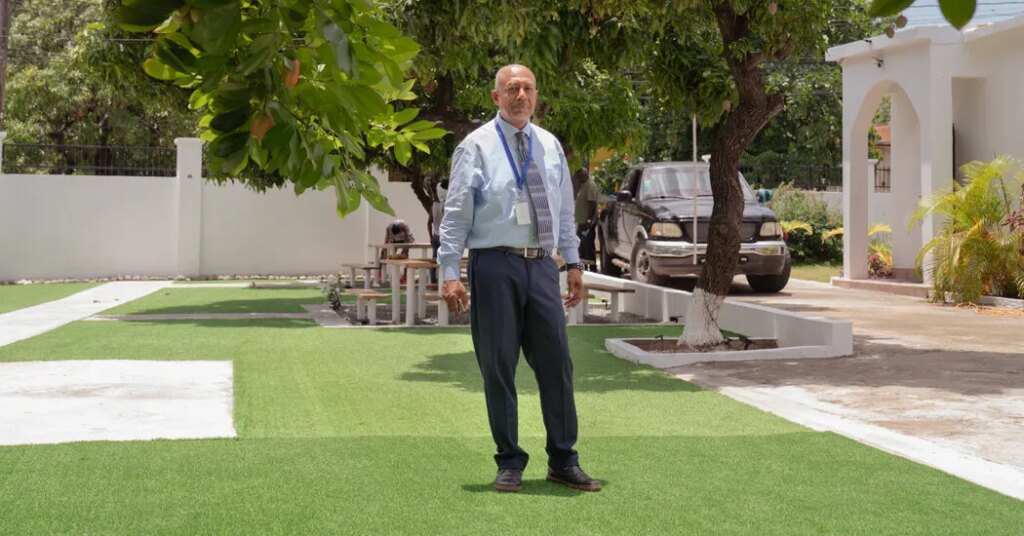
Alvin McLean has been passing his two phones around since noon. He walks through rows of people seated under a tarp on the tarmac of the Norman Manley International Airport in Kingston, Jamaica, helping them place more than 200 calls to parents, cousins, ex-girlfriends. By the time he leaves the airport at 4:30 p.m., there are still about 10 men standing outside, some dressed in the light gray sweatsuits issued by Immigration and Customs Enforcement, or ICE.
For these men, many of whom have not been back in Jamaica in several decades, this phone call is their last chance to find someone, anyone, to come and pick them up. Mr. McLean tells them that he understands, having himself been recently, and abruptly, returned to a place that is home on paper but in reality is foreign.
Mr. McLean, who was deported in May 2025, is the program director at the Family Unification & Resettlement Initiative, or FURI, a nonprofit that provides support for people who have been deported, including basic information, like how to get an ID, and help with finding a job and a place to live.
While the Jamaican government has historically described deported migrants as a challenge to economic development and national security, Mr. McLean sees them as a potential resource. A rising wave of deportees — after January 2025, deportation flights from the U.S. increased from one per month to two — has meant an influx of individuals who have spent most of their lives studying and learning outside Jamaica.
Keton Cole was among these returning arrivals. He had moved to the United States in 1993 and joined the Marine Corps in 1996. Shortly after his green card was renewed last June, he decided to visit Jamaica for the first time in decades. When he returned to the United States, he was detained at John F. Kennedy International Airport.
It remains unclear to Mr. Cole why he was detained, given his legal status. The U.S. Department of Homeland Security did not respond to requests for comment for this story. Shortly before he was deported back to Jamaica last September, Mr. Cole was connected to FURI by a friend of his wife’s. As he sat in detention, Mr. Cole began to prepare for how he would support himself.
Using a brochure that Mr. McLean created on how to start a business in Jamaica, Mr. Cole was able to quickly open a diesel particulate filter-cleaning business, like the one he ran in New York.
Mr. McLean, 58, had also spent most of his life in the United States, having moved to New York when he was 5. In his 20s, he was convicted of murder and other charges — crimes he maintains he did not commit — and sent to prison.
During his 33 years incarcerated, he eventually became director of the transitional services center at the Shawangunk Correctional Facility in New York State, where he worked with people preparing for release, including those facing deportation. He saw people encountering stumbling blocks at every stage.
In 2009, he produced a 136-page manual on how to support deportees and mailed it to the consulate. Jamaica’s Ministry of National Security connected him with FURI’s founder, Carmeta Albarus.
Ms. Albarus, a New York-based sentencing mitigation specialist who is originally from Jamaica, started FURI in 2002, with her own money. She kept seeing clients who had been deported from the U.S. and returned illegally, and now faced severe sentences after again running afoul of the law.
“I was like, ‘Why didn’t you just stay down there?’” said Ms. Albarus. “They told me, ‘There’s nothing down there for us. There aren’t any services for us.’”
With some support, she believed, deportees could find productive and fulfilling lives in Jamaica. “I decided to put all my resources into doing this,” she said.
Mr. McLean became an ambassador of sorts for FURI, distributing brochures inside the prison and guiding people through the weeks before and after deportation.
Last April, he was set to be released from the Green Haven Correctional Facility in Stormville, N.Y., after 33 years of incarceration. His children — he has two in the U.S. — came to pick him up. Instead, he was taken into ICE custody.
Over the next month, he says, he was moved to detention facilities throughout the country, ending up in Louisiana.
“It was a traumatizing experience,” said Mr. McLean. “I was in the same clothes for five days at a time, no access to a shower, shackled for up to 18 hours.”
Mr. McLean still has an attorney working on his wrongful conviction case, but after decades in prison he did not want to be held indefinitely in a detention facility, and agreed to be deported.
“I just wanted to be free,” he said.
When Ms. Albarus heard that Mr. McLean would soon be deported himself, she asked him to become FURI’s program director.
His day-to-day work often goes far beyond the scope of services advertised by FURI, which he estimates serves about 75 people a month. The organization is run on a shoestring budget by volunteers — Mr. McLean is paid a small stipend — and can do only so much to meet the varied needs of its clients.
Ms. Albarus sends enough, including small donations from friends, to cover expenses, which are about $2,000 a month, not including the stipends.
At a symposium in January, Antoinette Richards, a program director at the Planning Institute of Jamaica, said the Jamaican government sees its role as focused on policy, leaving on-the-ground support to small, strapped organizations like FURI. (The Jamaican government did not respond to repeated requests for comment for this story.)
On the Fridays after the flights come in, Mr. McLean often takes backpacks filled with toiletries and snacks to Open Arms Development Center, a shelter for the unhoused, where arriving deportees are taken if they lack housing.
On this Friday morning, he presents a purple backpack to Germaine Cassie, who is sitting alone on a concrete bench in the courtyard, still dressed in the gray sweatsuit he’d arrived in the day before.
Mr. Cassie, 49, is grateful but seems dazed. He had been in the U.S. since 1992. At the time of his deportation, he and his wife, an American citizen, were two weeks from the due date for their second child. In March 2025, she filed a spousal petition to begin the process of getting Mr. Cassie a green card; when Mr. Cassie got a letter to check in with ICE, he believed it had to do with the petition. He went to the ICE field office in Tucson on his way to work, where he was detained and deported.
“I’ve been misled, been kidnapped; I’ve been lied to. They told me I’m not facing deportation,” said Mr. Cassie. “I have an attorney. They’re getting the paperwork for me to go back right now, because it’s illegal.”
Even if the deportation was a mistake, Mr. McLean tells him, it will take a while to work through a legal remedy. He shares with Mr. Cassie resources he might use to adjust to life in Jamaica.
For Mr. McLean, this is the work: not a resolution, but a steady presence.
“I made a commitment to this when I was in prison, that I would help FURI get on its feet and become an organization that can really give people meaningful help, which it can’t do right now. We’re doing surface-level help,” he said.
Mr. McLean wants FURI to be able to provide comprehensive, long-term assistance to all its clients. If the organization can bring in enough through grants and donations, he believes, the growing influx of arrivals could be a brain gain.
“If you ask a Jamaican person, can you paint? ‘Yeah man, mi can paint.’ Can you fix a car? ‘Yeah man, mi can fix cars.’ There’s no Jamaican that will tell you that they can’t do something. And it’s not just telling you they’re skilled, most are,” says Mr. McLean. “I’m living in paradise. Jamaica is paradise. Let’s help build it into the kind of country no one wants to leave.”
The Headway initiative is funded through grants from the Ford Foundation, the William and Flora Hewlett Foundation and the Stavros Niarchos Foundation (SNF), with Rockefeller Philanthropy Advisors serving as a fiscal sponsor. The Woodcock Foundation is a funder of Headway’s public square. Funders have no control over the selection, focus of stories or the editing process and do not review stories before publication. The Times retains full editorial control of the Headway initiative.
The post A Recent Deportee Aims to Make America’s Loss Jamaica’s Gain appeared first on New York Times.