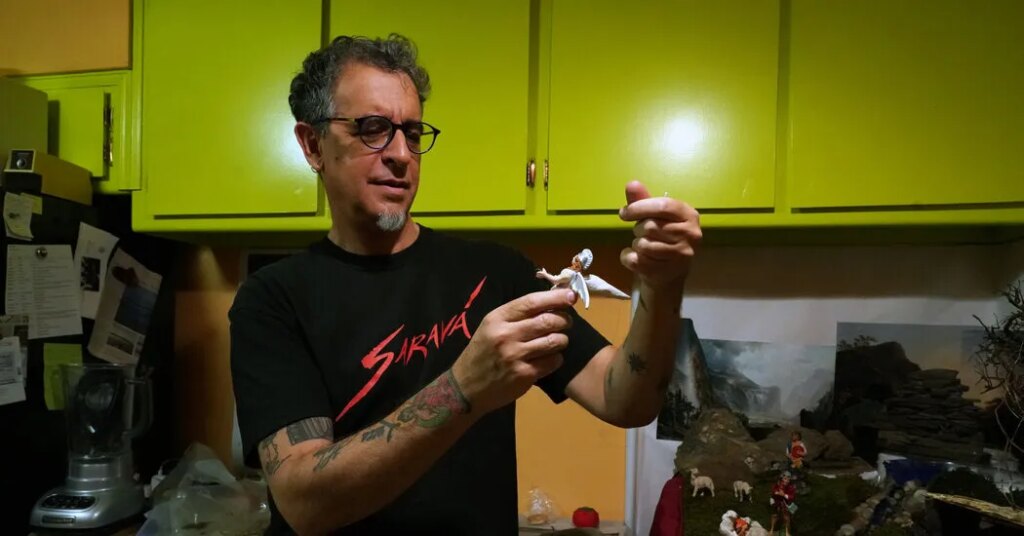
Joseph Sciorra, a cultural historian, ethnographer and folklorist who passionately and veraciously commemorated the traditions of his fellow Italian Americans, died on Oct. 5 at his home in Ridgewood, Queens. He was 71.
The cause was a heart attack, his wife, Zulma Ortiz-Fuentes, said.
A son of Italian immigrants — and brother of the actress Annabella Sciorra — Dr. Sciorra (pronounced SHE-oh-rah) spent the last 27 years directing academic and cultural programs at the John D. Calandra Italian American Institute at Queens College of the City University of New York.
“With a fieldworker’s eye and an archivist’s discipline,” a tribute from the institute noted, Dr. Sciorra “reshaped the study of Italian American culture. He insisted that vernacular expression was not ephemera to be patronized, but rather a living archive of memory, devotion and identity, worthy of serious scholarly attention.”
The statement added that he “documented, interpreted and championed Italian American cultural productions, leaving no corner of the field untouched: yard shrines, sidewalk altars, religious processions, presepi, decorated flowerpots, the music of accordion-lit nightclub dance floors and more.” (Presepi, plural of presepio, are elaborate and intricate Nativity scenes.)
In 1989, Dr. Sciorra joined hundreds of mostly Black marchers, led by the Rev. Al Sharpton, the civil rights activist, to protest the killing of Yusuf Hawkins, a Black teenager who had been shot in the chest by white people in a predominantly Italian American neighborhood of Brooklyn.
Some residents mocked the protesters by brandishing watermelons. Dr. Sciorra, a graduate student at the time, carried a homemade sign that proclaimed “Italians Against Racism.” “People pointed in my direction, laughing, cursing, spitting,” Dr. Sciorra later recalled.
The death of Mr. Hawkins, he noted, “engendered an examination of conscience and values among Italian Americans in ways that simply did not exist before.”
In 2020, Dr. Sciorra and another Italian American scholar wrote an essay denouncing the “heroification” of Columbus, requesting that Congress rescind Columbus Day from the litany of federal holidays, and explaining that with the explorer’s “steady fall from grace Italian Americans have had to make sense not only of the atrocities attributed to him and his image but also to discover their place in a new world without him.”
Dr. Sciorra helped raise money to place a tombstone in 2023 on the unmarked grave of Pietro (Pete) Panto, a dockworker and union organizer who spoke out against waterfront corruption and went missing in 1939 and whose body was discovered two years later.
As a cultural historian, Dr. Sciorra documented local ethnic icons, including the casitas (“little houses” that often adjoin community gardens) of the South Bronx. He also showcased the artistic memorial murals on the Lower East Side dedicated to neighbors who were killed, often in gang-related attacks, and who, he said, were “being honored in a public way for a death that was in most cases also public.”
A prodigious author and essayist, he wrote “Built With Faith: Italian American Imagination and Catholic Material Culture in New York City” (2015), a catalog of lawn shrines fashioned in Brooklyn and Queens by Italian Americans and, to some extent, Hispanic residents. “Built With Faith” received the Italian American Studies Association book award.
“If they put that much time and energy into building a shrine, it’s usually because of a vow,” Dr. Sciorra told The New York Times in 1989. “These people really believe that they have been helped by a supernatural entity, that a miracle happened. The shrine is part of a reciprocal, devotional act.”
He helped revive artistic interest in a 1930s handmade shoeshine box — bedecked with gilded knobs and beaded fringe — created by an Italian immigrant bootblack. The work had been exhibited at the Museum of Modern Art in the 1940s but then was returned to the creator’s family and largely disappeared from public view. Thanks in part to Dr. Sciorra’s research into the piece, it was purchased in 2014 by the Fenimore Art Museum in Cooperstown, N.Y.
Dr. Sciorra edited “Italian Folk: Vernacular Culture in Italian-American Lives” (2011) and was an editor of “New Italian Migrations to the United States” (2017). From 2011 to 2016, he edited the Calandra Institute’s Italian American Review and had been the publication’s editorial director since 2017.
His essay “‘Italians Against Racism’: The Murder of Yusef Hawkins (R.I.P.) and My March on Bensonhurst” received the Anne and Henry Paolucci Prize in Italian American Writing in 2003. Another piece, “Protesta Per Sacco & Vanzetti,” which focused on songs about the arrest, trial and execution of the Italian-born anarchist immigrants, won the Studs Terkel Award from the Working-Class Studies Association in 2021.
Joseph Umberto Sciorra was born on April 4, 1955, in Brooklyn. His father, Enrico Sciorra, was a veterinarian, and his mother, Anna (Anniballe) Sciorra, was a seamstress.
After graduating from South Shore High School, Joseph received a bachelor’s degree in anthropology from Brooklyn College of the City University of New York in 1980, a master’s degree in performance studies from New York University in 1987 and a doctorate in folklore and folklife from the University of Pennsylvania in 1996.
In 1984, he married Ms. Ortiz-Fuentes. Besides his wife and sister, he is survived by two children, Akela Sciorra-Ortiz and Lucca Sciorra-Ortiz; and two brothers, Nicholas Sciorra and John Sciorra.
“Italian Americans are often represented in the broadest caricatures — whether undereducated, bigoted people from the outer boroughs who are overly concerned with their own body image or, of course, the ubiquitous Mafioso image,” he told The Times in 2013. “There’s very little room in the media for an interesting and nuanced depiction.”
Too often, he said, the children, grandchildren and great-grandchildren of Italian immigrants have their sense of Italian American identity “created by the ‘Godfather’ movie narrative, as opposed to any story told by their own godfathers.”
The post He Mapped Yard Shrines, Sidewalk Altars and Flowerpots appeared first on New York Times.