Talk about a nightmare.
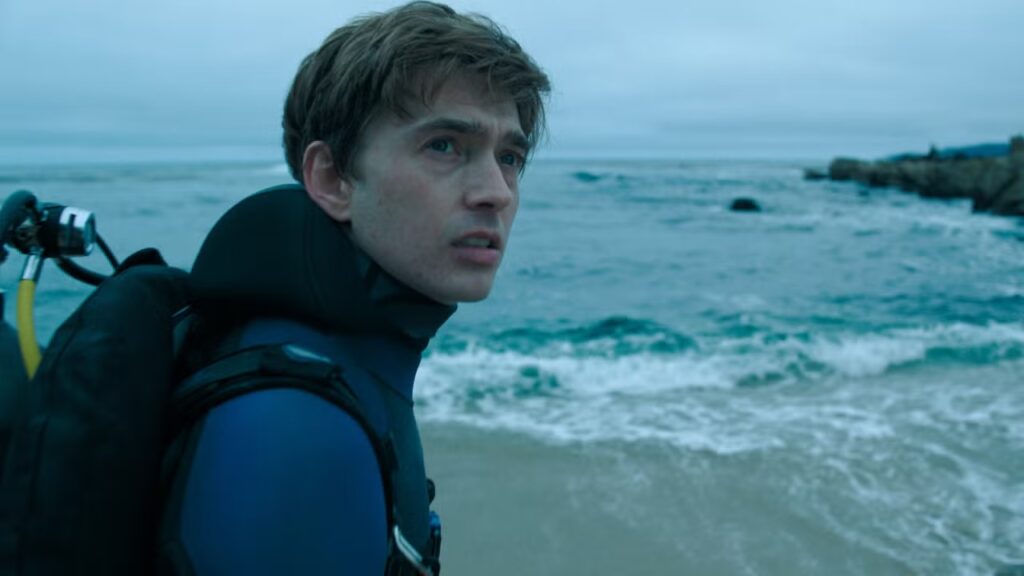
In “Whalefall,” Austin Abrams plays a young man who has just lost his father and winds up inside the belly of a giant whale. The whale doesn’t eat him, exactly. While searching for his father’s remains, he runs afoul of a giant squid, which grabs him and pulls him into the whale’s mouth as the whale consumes it. (As in Noah Baumbach’s “The Squid and the Whale”, the two are lifelong enemies.) With about an hour of air left, he has to figure out how to escape the whale or give up. Alongside the very practical challenge of escaping, he spends that time dealing with the emotional fallout of his father’s death and what that loss means to him.
Directed by Brian Duffield, who wrote the screenplay with Daniel Kraus, author of the book on which the movie is based, “Whalefall” is a uniquely thrilling experience — claustrophobic, psychological and deeply felt. Watching the movie, you can feel how difficult it must have been to shoot. Duffield explained that bringing “Whalefall” to the big screen was truly an arduous task.
“100% knew it was going to be a pain in the ass and it was 100% more difficult than I thought it was going to be. But having said that, I feel like it should be hard,” Duffield said. “There’s not that many of us that get to have a studio theatrical release a year. Who knows if it’ll happen again? I’d rather work really hard and leave it all on the field and just push myself and test myself. And thankfully I had a partner in Austin that I think was, as an actor, really looking to be challenged and pushed in a similar way.”
Because they were able to shoot “Whalefall” in Los Angeles, Duffield said, they had access to “the best crew in the world,” all of whom were “excited about how unusual and difficult it was.”
“I don’t want to make it sound like it was a miserable shoot. It was like a hard shoot, but I think everyone was really excited about getting to take a swing and to work hard on something unique and unusual, especially in terms of a studio setting, because you know they’re few and far between,” Duffield said.
We wondered how much of “Whalefall” was on the page versus what was discovered in the editing room. Duffield said much of it was on the page, but the practical realities of production also influenced the final film.
“It was such a difficult movie to shoot that sometimes, the shot we have of Austin, we have 36 frames and we use all 36 frames, and then everything else is not usable in the take because of technical reasons or water covers the lens or something,” Duffield said. “Like all filmmaking, your best laid plans go awry. The material you hope to have on day one of shooting is never the material that you have at the end of the shoot. It’s always somewhat similar, somewhat at times completely different, and then sometimes when you’re in post, you’re like, Oh, this element is really strong that no one expected, and you foster that element over other elements.” One of the elements they discovered along the way is a bioluminescent jellyfish that also winds up inside the whale. Abrams’ character, Jay, befriends the jellyfish, in a way, and uses it as a living flashlight as he tries to climb out. It’s actually shocking how quickly you form an emotional bond with the jellyfish, which, like Jay, is trapped in a situation by accident. In the original novel, Jay is closer to Beaky, the squid beak he rips out of his hand, giving it a personality and using it as a tool for his escape.
“In the shooting of it, Austin came to life in a huge way with the jellyfish, in real time on the day, and then and then in the edit we were just like, The jellyfish is working,” Duffield said. He and legendary editor Pietro Scalia minimized Beaky in favor of the jellyfish. “We tried to give the jellyfish as much screen time as possible, even if it wasn’t shot that way, just because it was really sparking something unique in Austin’s performance and gives it a very nice new color in the movie at a time that you really need it.”
Duffield went so far as to say that if he’d known the jellyfish would play as well as it did, he would have written the script differently to give Jay and the jellyfish more time together. “We went back and tried to just add as much jellyfish earlier on in the movie to help it out a little bit. But filmmaking is a living, breathing organism and you’re always just kind of wrestling with it and fighting with it,” Duffield said.
Part of that process happens during the testing phase, when the studio takes an unfinished movie and screens it for unsuspecting viewers at a mall in Paramus, New Jersey. Usually, viewers are recruited from the surrounding area. The studio then asks for their feedback. “Whalefall,” however, was an especially difficult movie to test for several reasons.
Duffield said the movie is so “sound-driven” that sound design was one of the last elements they finalized. “I remember the first test screening we had, no one could understand anything Austin said in the whale because you could hear all the mechanics and everything,” Duffield said. The movie received a good score from the test audience, but every feedback card mentioned that viewers couldn’t hear the dialogue. Even Kraus, who Duffield estimates has seen the movie 20 times, approached him after the London premiere and said he understood some of the dialogue for the first time.
“I was really lucky that I was with Disney and Steve Asbell, who I think is really protective, and knows that the testing process is like a little bit of a necessary evil, and we didn’t really have big changes to it,” Duffield said. On his previous movie, the nifty silent alien-invasion film “No One Will Save You,” which premiered on Hulu, there was one test screening in which the movie didn’t feature any aliens. “The audience just thought Kaitlyn Dever was a crazy woman, running away from things in her mind,” he said.
Duffield likes to compare the process to a pregnancy.
“When a baby’s born at nine months, everyone’s like, Oh, that’s such a cute baby. And if you cut him out at three months, people are going to freak out. But there’s nothing really wrong with the baby. You’re just showing the baby way too soon,” Duffield said.
To him, the testing process is “a mystery that I’d like to solve,” and he believes it’s “an inherently broken idea, especially for effects-heavy movies or movies like this that are ambitiously different than what an audience is used to seeing.” Instead, he relies more on screenings for friends and family, usually made up of fellow filmmakers who can see where the movie will be in six months, rather than just what’s unspooling before them. He finds this much more helpful, both because he trusts their opinions and because they’re used to the same process of refinement and iteration. That’s not to say he totally discounts the usefulness of test screenings.
“I feel like if I ever just make like a rom com. I bet they’d be really helpful. But the movies I make, I don’t think test screenings have been helpful at all,” he said.
On the day we talked about “Whalefall,” Duffield had posted a list on Letterboxd of movies that inspired him while making the film. (The list was, of course, called “Whalefallin’”.) At the time, his descriptions of why he chose the movies weren’t up on Letterboxd yet. So we asked him why he chose some of the movies on the list, which also includes “Brokeback Mountain” and “Inherent Vice,” home to his favorite Brolin performance.
The first movie we had a question about? Oliver Stone’s hot-button assassination thriller “JFK,” arguably one of the best films of the decade. And one that is very far removed from the story of a man getting trapped inside a whale.
“Pietro edited ‘Whalefall’ and edited ‘JFK,’ which I think for my money is the best editing of all time. And I think what’s something that I learned with Pietro is like you can kind of do anything in editing as long as you’re really convicted about it,” Duffield said. (Scalia won the Oscar for editing “JFK,” by the way.) “I think ‘JFK’ is just a masterclass of editing and just they you know they change film elements. They just kind of throw it’s like whatever works. They’re just doing at what feels like random, but it’s all in service of this this mystery and I think Pietro really helped me develop bravery in terms of the edit. As long as we’re making a choice with conviction, you can kind of do anything in editing. That’s why ‘JFK.’”
The other movie we were curious about was “Cloud Atlas,” the Wachowskis and Tom Tykwer’s adaptation of David Mitchell’s Russian-nesting-doll-like novel, starring Tom Hanks, Halle Berry and Jim Broadbent, among others.
“What I love about the Wachowski sisters is also one of the things I kind of love about M. Night Shyamalan movies is that they’re really emotionally forward, and obviously this movie has some pretty audacious emotional swings in it. By the third act it is definitely as emotionally forward as a movie can get,” Duffield said.
He said the Wachowskis are not cynical filmmakers. It’s an earnestness that Duffield finds “invigorating filmmaking.”
Specifically, when discussing “Cloud Atlas,” Duffield said, “The Wachowskis do a thing in ‘Cloud Atlas’ where the cross cutting between the stories are driven by the emotions, and that’s something that we did a bunch of in in ‘Whalefall,’ as well. I knew some of those big emotional swings and some of those scenes where Austin’s character is driving the narrative emotionally, even though he is completely passive in terms of he’s inside of a whale that’s being attacked, you know he can’t really do much about it.”
Duffield said he was also thinking about how the filmmakers behind “Cloud Atlas” “were able to drive the story just purely on a on an emotional level instead of a narrative level.”
“Whalefall” is in theaters now.
The post ‘Whalefall’ Director Brian Duffield Explains How ‘JFK’ and ‘Cloud Atlas’ Influenced His Stuck-Inside-a-Whale Thriller appeared first on TheWrap.