Crime used to be so out of control in Caracas that Miguel Dao, a professional kidnapping negotiator, was hired to secure the freedom of three different captives in a single day. But it’s been three years since Mr. Dao has had a single kidnapping to negotiate.
The homicide rate in Caracas has plummeted in recent years, a remarkable shift for a city once known as the world’s murder capital. Street robberies are rare. Kidnappings, both extended high-ransom cases and “express” abductions lasting about a day, have all but disappeared.
Mr. Dao, a former director of Venezuela’s equivalent of the F.B.I., said he was a critic of the country’s authoritarian government. But he called the sharp decline in crime under its watch an “accomplishment by any measure.”
“I applaud them for this triumph,” said Mr. Dao, 77, who owns a law firm in Caracas, Venezuela’s capital. “I just don’t know if it will last.”
The devastating earthquakes in June underscored how fragile the newfound sense of peace might be when fears emerged that the city’s social fabric might fray. But crime has remained largely under control, and visitors in the aftermath were astounded by how safe Caracas felt.
The sense of safety in the capital, and in some other parts of Venezuela, ranks among Latin America’s biggest security turnarounds.
This shift is often overshadowed by changes in another authoritarian country, El Salvador, where President Nayib Bukele reduced crime largely through mass incarceration, inspiring imitators around the region.
Different factors — some the stuff of nightmares — drove Caracas’s security gains.
Bypassing the legal system, police squads executed thousands of poor young men, according to United Nations investigators, in a campaign targeting the demographic most likely to join criminal gangs. Mass migration also played a role, with gang members constituting a small percentage of the millions who fled Venezuela’s economic collapse.
I lived in Caracas when it was still one of the world’s deadliest cities. Talk of kidnappings dominated dinner parties. People stopped going at out night. Fatal assaults by smartphone thieves grew so common they were called “Death by Blackberry.”
Reporting from the city’s morgue, I wrote about how Venezuela had more than 16,000 murders in a single year, three times the number of civilian deaths from violence during the same period in Iraq, when the war there was raging.
Hugo Chávez, then Venezuela’s leader, responded by denouncing me on national television. My family and I went into hiding until he focused his ire on something else. When we left Venezuela in 2011, the ever-present fears over violent crime were woven into the fabric of daily life.
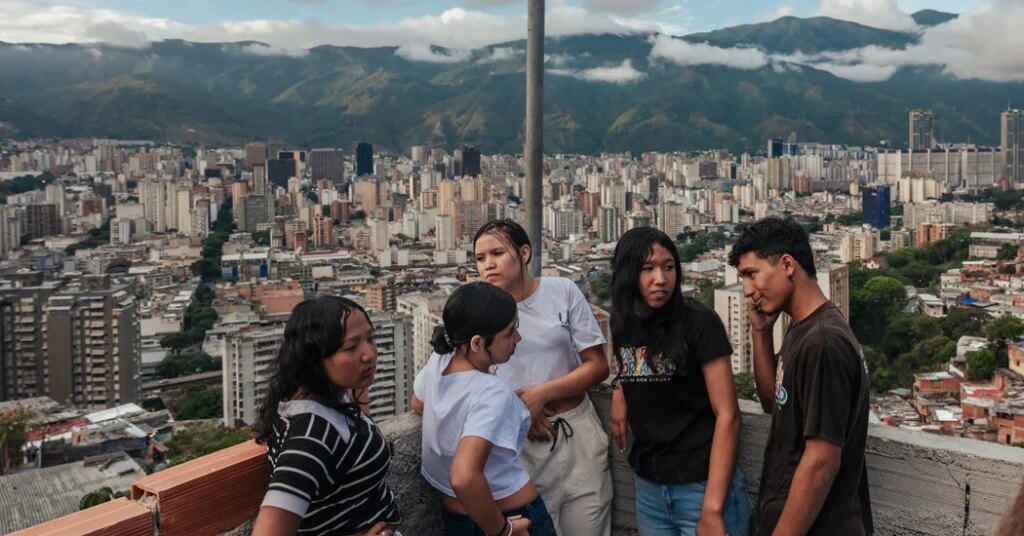
When I returned to Caracas this year, I was stunned. A city legendary for instilling fear in hardened travelers felt safer than other large Latin American cities, like Bogotá or São Paulo.
Multiple walking tours were reintroducing Caraqueños to their own city. In well-lit plazas, couples lounged on benches well after dusk. Nightlife was back with a vengeance in former no-go zones.
One of the strangest aspects of this new normal was how little regular people, and Venezuela’s leaders, talked about it. Instead, many in Caracas seemed focused on simply making ends meet. Unlike in El Salvador, the authorities weren’t constantly boasting about the reduction in crime.
Luiz Izquiel, a criminologist, attributed this ambivalence to the brutal methods the government used to bring crime rates down. (Venezuela’s government did not respond to several requests for comment.)
“It’s one thing for Bukele to boast of creating one of the world’s largest prisons,” Mr. Izquiel said, alluding to CECOT, the prison complex that is a symbol of El Salvador’s security policies.
“It would be quite another if Delcy were to celebrate killing thousands of Venezuelans in the name of peace,” he added, referring to Delcy Rodríguez, who replaced Nicolás Maduro as Venezuela’s leader this year.
Around a decade ago, Mr. Maduro started what he called Operations for the Liberation of the People, ushering in highly militarized police raids into low-income areas. The stated objective was to dismantle armed gangs.
But instead of reducing crime through the judicial system, the strategy consisted largely of extrajudicial executions. It primarily targeted young men, describing the justification for their killings under the bureaucratic label of “resistance to authority.”
Venezuelan security forces killed at least 6,856 people in just one 18-month period in 2018 and 2019, United Nations investigators found, then often manipulated crime scenes to make it look as if the victims had been resisting arrest.
The International Criminal Court responded with its own investigation. But in July, Venezuela said it would withdraw from the I.C.C., following the example of countries like the Philippines and Burundi, which also left while under the court’s scrutiny.
The Trump administration, which wields exceptional control over Venezuela’s government, has supported the move as it tries to dismantle the I.C.C., driven primarily by the court’s warrants against Israeli leaders and the potential for the I.C.C. to examine the U.S. military’s conduct.
Trump officials announced sweeping new sanctions on the I.C.C. this month after Norway awarded the Nobel Peace Prize to Navi Pillay, a lawyer who served as a judge on the court.
Legal experts say the I.C.C. retains jurisdiction over the atrocities in question even as Venezuela seeks to leave the court. Meanwhile, those who lost relatives in the police raids are still picking up the pieces.
Millanyela Fernández said Richard Jesús Briceño, her son, was 23 and had no criminal record when a police unit swept into their neighborhood of La Vega in 2021 and fatally shot him before her eyes.
“They forced my son to his knees and shot him right in the chest, through the heart,” said Ms. Fernández, 46, a maid. “I opened the window and screamed at him not to kneel down. But he followed their orders, and they killed him.”
Venezuela’s new leader Ms. Rodríguez made an unusual mention of the security gains in January, saying the country’s homicide rate had reached a low point of 3 per 100,000 people in 2025.
It’s undeniable that security has improved in Caracas and much of the rest of the country, but criminologists expressed skepticism over that figure, which would give Venezuela one of the lowest murder rates in the Americas.
Venezuela’s government did not provide data to support her assertion, and it’s been years since authorities published comprehensive crime statistics or even census data.
Along with the dearth of reliable information about criminal activity, the authorities have made it clear that anyone publicly criticizing security policies, or even asking about the current situation, could face consequences.
In one case last year, a journalist, Nakary Mena Ramos, was detained for months after interviewing people over whether street robberies were on the rise because of the return of deportees from the United States.
That case exposed another hypersensitive issue for authorities: mass migration’s role in easing unlawful activity, and the potential for crime to return as deportations rise.
Some in Caracas view the calm as a temporary reprieve relying on hard-line policies that are starting to ease. Ms. Rodríguez recently announced a plan to remove police checkpoints in cities around Venezuela, potentially eliminating a deterrent.
Even so, other factors have contributed to the decline in crime.
When Venezuela’s economy cratered, many people simply had less money and fewer valuables to steal. Street crime also lost some of its allure when Venezuela informally adopted the U.S. dollar and began introducing electronic payment systems. The lack of local currency in circulation reduced opportunities for muggings and express kidnappings.
After incursions into low-income areas, the authorities also raided prisons, which had become the operational headquarters for some gangs.
The result, some Caraqueños say, is a veneer of safety in which the street gang era has been replaced by an institutionalized system in which police and military forces wield control over both territory and extortion rackets.
On the ground in Cota 905, a labyrinthine squatter settlement, people are trying to adapt. Until 2021, the area functioned as a self-governed criminal stronghold where gang members stashed kidnap victims.
Then the authorities embarked on a multiday operation that killed or scattered the leadership of the gang controlling Cota 905. Security forces hunted down and killed the gang’s leader, Carlos Luis Revette, better known as El Koki.
Dozens of other innocent young men were killed in the police raids, residents said. The trauma over so much bloodshed lingers even as Cota 905 became much safer.
Now walking tours take visitors deep into the area. The day-trippers, mostly from moneyed parts of Caracas, dance salsa with residents before the outing ends in a half-destroyed watchtower that was El Koki’s base of operations.
Neyda Cuauro, who sells soft drinks to visitors, said she and her neighbors had no idea how long the new calm would last.
“It’s safer now, but look how we got here,” said Ms. Cuauro, 44, pointing at her front door, still stippled with the impacts of gunfire from the police raids. “No wonder our children run when they see the police.”
Isayen Herrera contributed reporting.
The post Caracas Is Eerily Safe. State Death Squads Made Sure of It. appeared first on New York Times.