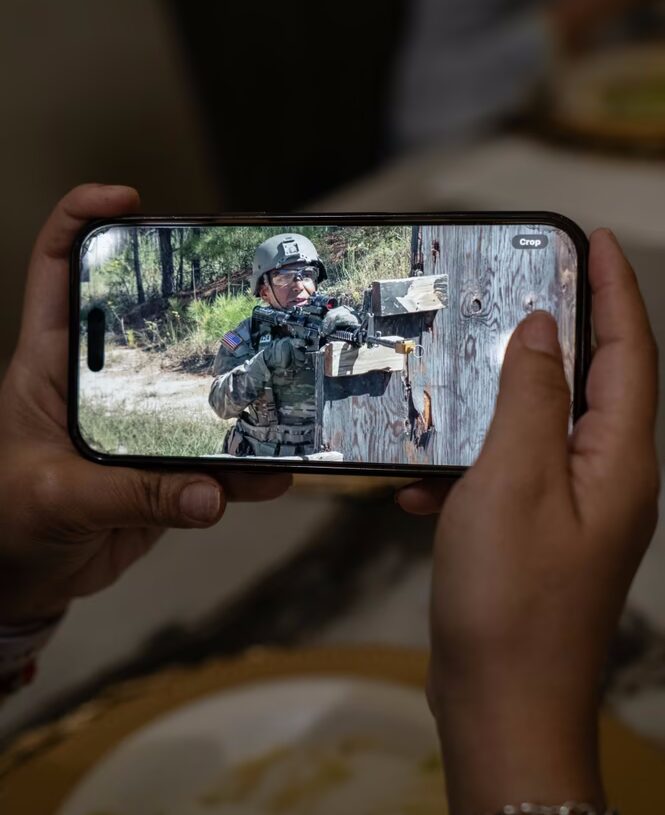
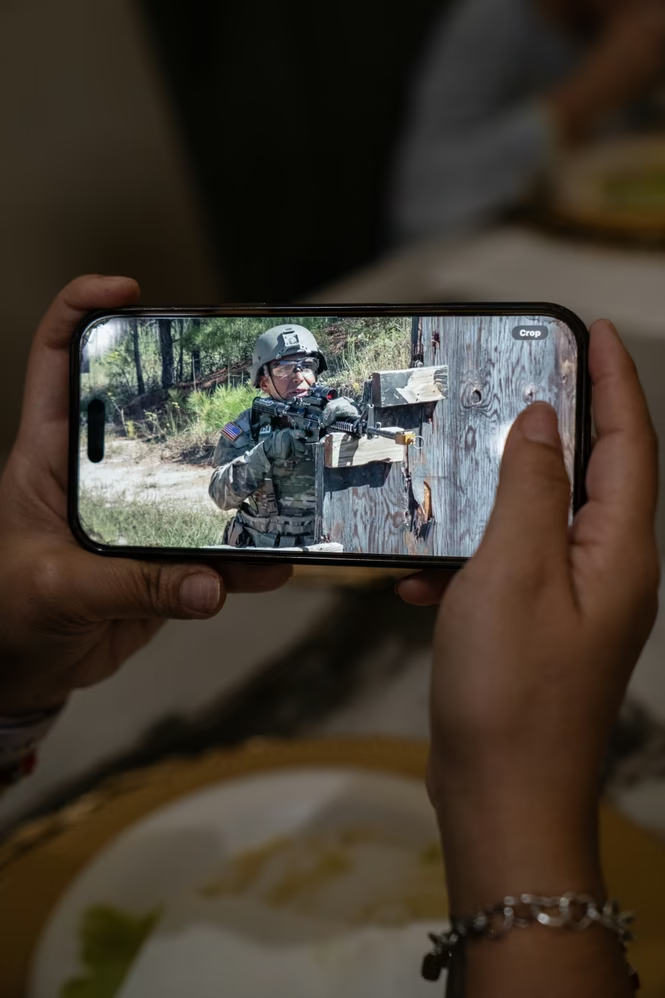
Giovanna Perez loaded her four kids into the car on September 21 and drove from their home in Weslaco, Texas, to Naval Air Station Corpus Christi. She had a 9:30 a.m. appointment to pick up the ID cards that would allow them to access military medical insurance, facilities, and commissary stores. Her husband, Pedro Gutierrez, had recently enlisted in the Army and left a month earlier for basic training at Fort Benning, in Georgia.
Perez approached the military guards at the gates with some trepidation. Her parents illegally brought her across the U.S. border from Mexico when she was 6 years old. Now 35, she and Gutierrez have been together since they were 17 and have carefully kept her immigration status a secret. Gutierrez is a U.S. citizen, but marriage does not give legal status to someone who is in the country unlawfully. When the Obama administration started the DACA program to protect immigrants like Perez who had arrived as children, she did not apply, for fear that the government might someday use the information against her family.
Perez told us that her husband believed that joining the Army would allow him to serve his country, give his family access to health care—including the costly medications his son takes—and potentially protect his wife from deportation. He had already submitted her application for a benefit called Parole in Place, which offers a path to legal residency for the close relatives of service members. Officials at Fort Benning had assured him that she would have no trouble getting IDs for herself and the children, and that it didn’t matter that she didn’t have a Social Security number, Perez told us.
At the gates of the Navy base, guards told Perez they had no record of her appointment. She remained calm as they directed her to a nearby office to get a visitor’s pass. That’s when two military officials took the family into a room for questioning. “In my head, I thought it was just protocol for the safety of the base, but it started getting weird,” Perez said. As she answered, she told us, one of the military officers appeared to be relaying her responses to someone through text messages.
Two other men entered the room. They wore khaki pants, she said, not military fatigues. The patches on their shirts said U.S. Immigration and Customs Enforcement. It appeared to Perez that they’d been waiting for her, at the base or somewhere nearby. The men told Perez to report to the ICE office in Harlingen, Texas, in three days. Her older children, ages 17, 15, and 11, were confused. “My kids were just, like, What’s going on?” Perez told us. “Are they gonna detain you? Why are they doing this to us? I thought you were supposed to be safe.”
Perez didn’t know what to tell them, and she had no way to call her husband. When she went to the ICE office three days later, she was booked and issued an order to appear in immigration court. She suspected the military shared her information with ICE. And now the government was trying to deport her.
Perez’s attorney, Alex Martinez, told us he’s trying to determine whether other families have been targeted in similar ways. He suspects that the government has been using Parole in Place to gather information for immigration-enforcement purposes—the opposite of what military recruits are led to believe.
“There’s no bigger betrayal to our soldiers than to use their trust in a program, set out by our government to protect their families, and ultimately use it to destroy their families while they’re serving our country and putting their lives on the line,” Martinez told me. “You’re stabbing your own soldiers in the back.”
The Associated Press in August identified at least 50 cases in which close family of active-duty service members were arrested by ICE. What’s different about Perez’s case is that U.S. military personnel appeared to be working with ICE to identify a potential target and use a long-standing military-recruitment tool—the promise of legal status for loved ones—to facilitate an arrest.
ICE confirmed to us in a statement that Navy personnel had reported Perez to immigration officers when the family arrived at the base. The Department of Homeland Security and ICE “value the contributions of all those who serve in the U.S. military,” the statement said. “Having a family member in the military is not a free pass to violate our nation’s laws. Military service by an immediate relative does not automatically grant parole, lawful status, or immunity from immigration enforcement.”
Perez told us the ICE officers seemed to be expecting her, told her they knew that Gutierrez had applied for Parole in Place, and asked questions about a trip her son had taken with his grandmother to Mexico years earlier.
Neither the Army nor the Office of the Secretary of Defense responded to requests for comment, but one defense official told us that there have been “varying degrees of cooperation between military installations and the Department of Homeland Security” for more than a year. The official declined to be named because he, like others we spoke with, was not authorized to talk publicly about this issue. Another official told us that DHS often made such requests to installations at a local level, but there were inconsistent degrees of cooperation. The Navy declined to comment.
Read: Trump loves ICE. Its workforce has never been so miserable.
Within months of Trump’s second inauguration, military mental-health specialists began telling us that service members within their units were fearful about how the administration’s crackdown on immigrants could affect their families. They described spouses afraid to go on base while their partner was deployed, family members too scared to leave their home, and uniformed service members accompanying loved ones to immigration appointments or hearings with the hope that their presence would make immigration officials or judges pause. Such worries, the specialists said, were becoming a distraction for those serving, particularly during deployments. It was an early sign of a break in a long-standing bargain: A government that asks Americans to take extraordinary risks would not add stress that could distract service members from their missions.
Defense Secretary Pete Hegseth frequently touts the military’s surging recruitment numbers. Less often mentioned is the military’s success in recruiting from some of the country’s most heavily Hispanic communities, including the Rio Grande Valley of South Texas, where Perez and Gutierrez live. Hispanic recruits accounted for nearly 27 percent of new Army soldiers last year, up from just less than 20 percent in 2020, according to Army statistics. This population remains key to the Army meeting its recruiting standards even as service members from these communities have reported that their families have been targeted by ICE.
Military law enforcement cannot provide direct support to civilian law enforcement, under the Posse Comitatus Act, a 19th-century law that was intended to keep the military from meddling in the affairs of southern states. But to secure an installation, military police can inspect those who enter. “Anytime somebody makes an appointment on a military base, that information could get shared throughout the federal government,” Margaret D. Stock, an immigration lawyer and former Army Reserve officer who helped develop the Military Accessions Vital to the National Interest (MAVNI) program, told us. Under the Trump administration, those who serve, along with their families, are no more protected from immigration enforcement than those submitting their data to any other government agency. “The military is no longer immune from this,” Stock said. Some troops are asking for overseas assignments where they can live with their family members, far from ICE agents.
In April, ICE officers arrested the 22-year-old wife of a U.S. soldier when the couple moved to an Army base in Louisiana. The woman, Annie Ramos, was born in Honduras and had a previous deportation order issued in absentia when she was a toddler. Ramos was released after Senator Mark Kelly of Arizona, a Democrat, spoke with Homeland Security Secretary Markwayne Mullin on her behalf.
Bobby Pulido, a Democratic candidate in the Rio Grande Valley who is running for Congress, has cited her case as an example of ICE overreach by the Trump administration. “The scary part is they’re doubling down on it. They don’t care,” Pulido said in a video clip with Perez that his campaign posted on social media on Wednesday.
It used to be that the military was seen as a potential pathway to U.S. citizenship. Military service can qualify noncitizens for expedited naturalization, and the Pentagon has at times recruited people who were not permanent residents. More than 180,000 members of the U.S. military have become naturalized citizens since 2002, according to U.S. Citizenship and Immigration Services. In 2008, at the height of the wars in Iraq and Afghanistan, the Pentagon launched the MAVNI program, which allowed some immigrants who were living legally in the U.S. but were not citizens to enlist based on specialized skills considered vital, including medical expertise and foreign-language proficiency. The program expired in 2017 and was not renewed. The government established the Parole in Place benefit in 2010, allowing family members to remain in the United States and apply for legal status. Approval is discretionary and does not guarantee a green card. But the promise remains a powerful recruiting tool for the armed services in immigrant communities.
Perez said she has no criminal record and no previous deportation orders. She met her husband at a quinceañera party when they were teenagers in Laredo. Gutierrez drove commercial trucks but decided to enlist in the Army to secure health-insurance coverage for the family and college-tuition aid for their older children. Fixing Perez’s immigration status was another incentive for him, she told us.
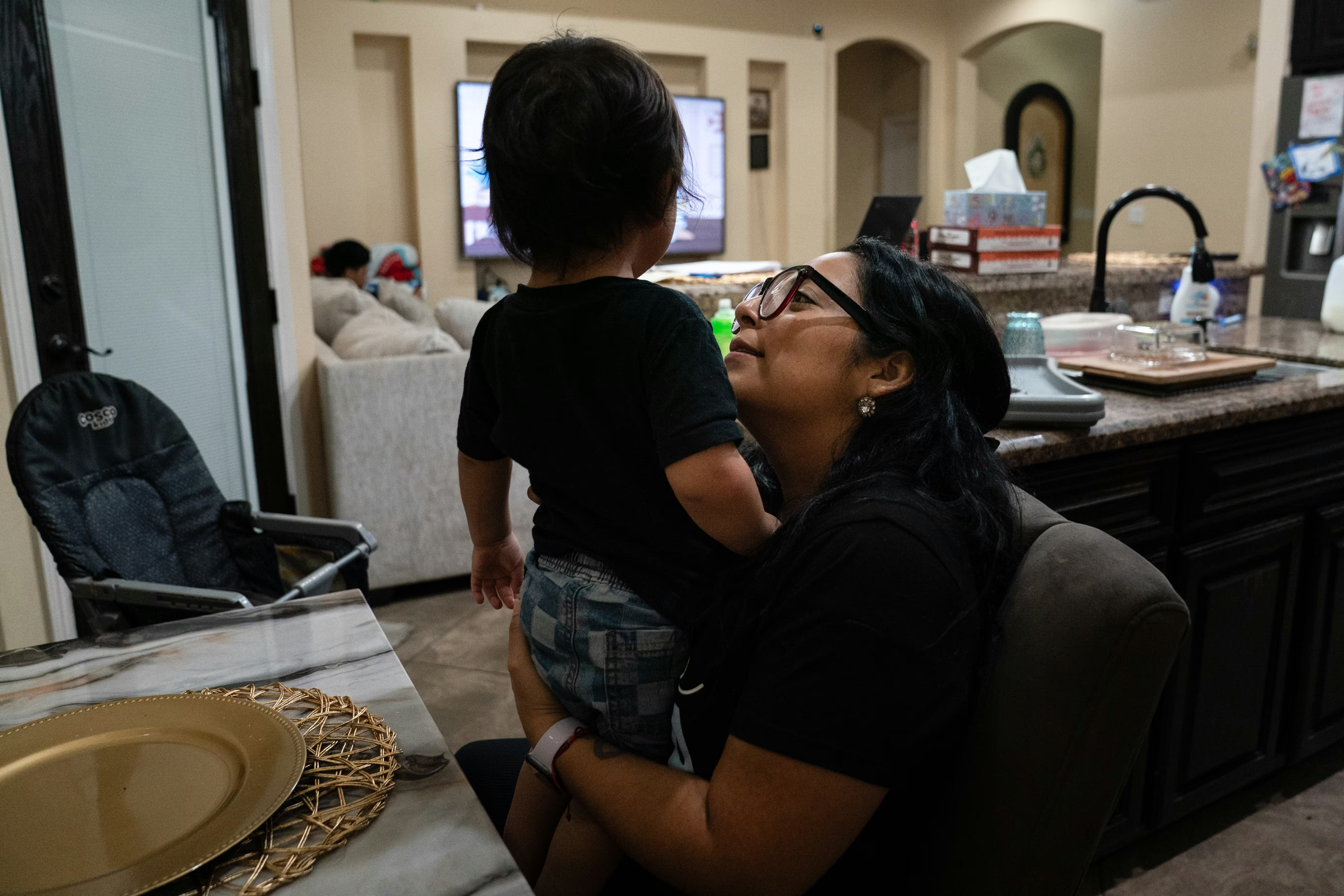
It was in a 20-minute weekend phone call that Gutierrez learned the country he was serving had been trying to deport his wife and separate his family. Had Perez been sent to a detention center, as many immigrants are, Gutierrez would have been forced to leave basic training to care for his children—a governmental loss of not just a new service member but also roughly $50,000 in sunk training costs, according to Army estimates. Perez stays home to take care of their 2-year-old, and she told us she has no idea what would happen to her children if ICE sent her to Mexico. “I have no one,” she said. “I’m by myself.”
Her husband will graduate from basic training on November 5, and Perez and her children plan to drive to Georgia for the ceremony at Fort Benning. They were issued their military IDs, so they should be allowed onto the base. Perez told us that she’s in a discussion group with other military families who are asking a lot of questions about who will be allowed to attend the graduation. Five days after the ceremony, Perez will be due back in court in Texas.
The post He Joined the Military. They Reported His Wife to ICE. appeared first on The Atlantic.