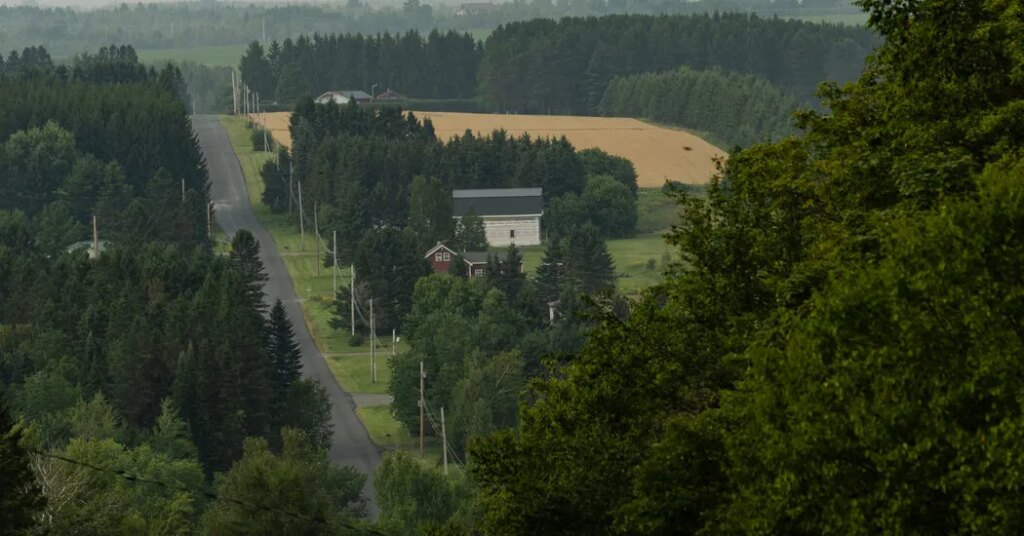
The story of northern Maine is the story of rural America: Fewer jobs, a declining population and a deeply ingrained feeling of being forgotten, or looked down upon, by the liberal population centers calling the shots.
That sense of alienation helped fuel the rise of President Trump. It has also shaped the critical U.S. Senate contest in Maine, where both candidates — Senator Susan Collins, the Republican incumbent, and Troy Jackson, the Democratic challenger — grew up in Aroostook County, a vast wilderness bordered by Canada on three sides and defined by its geographic isolation.
Each candidate refers often to their roots in “The County,” as Mainers know it. During their final debate on Thursday night, responding to a pointed question from Mr. Jackson about her respect for working-class voters, Ms. Collins again noted her Aroostook County roots and her first job there picking potatoes.
Ms. Collins, 73, first won her seat in 1996. By now, almost everyone in Maine knows that she helped out in the fields during harvest breaks from school in Caribou, where her ancestors founded a lumber business in 1844.
But it is Mr. Jackson, a fifth-generation logger who grew up poor in the remote St. John Valley, who is trying to ride the populist wave that first lifted Mr. Trump.
Mr. Jackson, 58, a longtime state lawmaker, has credited his hardscrabble upbringing in Aroostook for giving him a keen awareness of economic disparities, a suspicion of corporate power and a drive to deliver more affordable housing and health care in a state where incomes lag behind the rest of New England.
He has described himself as “somebody with grease on their hands” who “talks funny, didn’t go to the right school.” To powerful people, “that is what we are — nobodies,” he has said.
Ms. Collins has won her home county decisively in all five of her previous elections. But to some northern Maine voters, Mr. Jackson’s fresh appeal to working-class concerns feels more authentically connected to the moment — and to their corner of the state — than Ms. Collins’s frequent claim of being a “County girl.” (She has been a resident of Bangor, south of Aroostook County, for more than three decades.)
“I feel like she stopped being from The County awhile ago,” said Toby Jandreau, a public defender and unaffiliated voter in Fort Kent, who left the Democratic Party a few years ago and felt it had abandoned northern Maine. He plans to vote for Mr. Jackson.
What his candidate lacks in charisma, Mr. Jandreau said, he makes up for in passion and hard work: “You know the saying, ‘all hat, no cattle’? Troy’s all cattle, no hat.”
The region where the two candidates came of age is sometimes referred to as “the other Maine” — the distant, agrarian edge of a tourism-dependent state better known for its ski resorts and coastal enclaves. Aroostook County is about the size of Rhode Island and Connecticut combined, but only 5 percent of the state population lives there. Allagash, the town where Mr. Jackson is from, has a population of about 230; the drive from Portland, Maine’s largest city, takes almost six hours.
The landscape of the county ranges from dense woods, once described by an awed Henry Thoreau as “a standing night,” to green and gold potato fields rolling like striped blankets all the way to the horizon.
And it’s so close to Canada that many locals grew up speaking Acadian French.
Like other rural places, Aroostook County routinely grapples with the question of its own survival. It is losing population faster than anywhere else in Maine and has closed schools, nursing homes and birthing centers. Young people in particular have migrated south, to Portland, Boston and beyond. In the state with the oldest population in the country, Aroostook residents trend even older.
“We’re the forgotten people up here and so we fix our own problems,” said Penny Thompson, the town manager of Caribou.
Many residents cited harsh winters, limited infrastructure and sparse populations as factors that strengthen community ties. “You’re a furnace fail away from death unless you know your neighbors,” Mr. Jandreau said.
Demographic and economic uncertainty have also driven a shift to more conservative politics. Mr. Trump won Aroostook County in 2016, 2020 and 2024, while the state as a whole backed the Democrat in all three elections.
Mr. Jackson’s politics, too, have evolved. Before he became a progressive Democrat, he was a Republican who opposed abortion rights and gay marriage.
He traces his political awakening to his upbringing in the Aroostook woods, where he watched his lumberjack father protest “a massive wage cut by a large landowner,” he recalled in 2023.
“When the landowner came out and threatened to replace all of the workers with Canadians,” he said at the time, “I understood then and there that the men who hold all the power will make all the decisions without giving a single thought to workers.”
Later, working as a logger himself, Mr. Jackson frequently left his young family to live in far-flung logging camps. In the 1990s, he, too, protested the hiring of Canadian woodcutters, before going on to represent part of Aroostook County in the state legislature. He served 20 years, including six as Senate president, where he was known for his occasional sharp temper and his distinctive Allagash accent, a unique brogue reflecting his Scotch-Irish ancestry.
Mr. Jackson has acknowledged sharing home territory with Ms. Collins. But he draws a sharp line between them.
“We are both from Aroostook County, but the similarities end there,” he said at a town hall last month. “I am working-class and she’s management. She always has been.”
In the tight race, one of a handful that will decide control of the chamber, Mr. Jackson has tried to capitalize on the anger felt by many voters toward Ms. Collins. She has long enjoyed bipartisan support from Maine voters who value her long tenure and powerful connections. But many came to see her in recent years as a loyalist of Mr. Trump, enabling his agenda regardless of the harm it caused.
Those frustrations fueled the rise of Graham Platner, the former Democratic nominee whose fiery populist campaign drew intense national attention before it ended abruptly in July, after a former girlfriend accused him of rape. He has denied the allegation. Mr. Jackson was his hastily chosen replacement.
Within Maine, Aroostook County — and the coastal Down East region that Mr. Platner calls home — share a separateness that has preserved their distinctive character, said Mark Brewer, a political scientist at the University of Maine. “It feels different there,” he said, “and in some ways, nothing is more Maine.”
That matters in Maine politics, where being “from away” — or not “Maine enough” — can doom a candidate. Mr. Jackson has suggested that he is the only true Mainer in the race, casting Ms. Collins as a Washington insider who long ago left her Aroostook County identity behind. She has pushed back, walking in parades in Fort Fairfield and Madawaska last summer and recently running a campaign ad that shows her perched upon a giant pile of potatoes.
Like Ms. Collins, Maine voters often pride themselves as being “moderates” with an independent streak. Nearly one third aren’t registered with either major party. Split-ticket voting is common, a phenomenon that contributed to Ms. Collins’s last win, in 2020. In interviews, Aroostook voters of all political affiliations praised Ms. Collins as a hustler who’s delivered for her state for decades — even as some also criticized what they saw as her failure to stand up to Mr. Trump.
Roger Felix, 59, an Army veteran and registered Republican in Caribou who has supported Mr. Jackson in past races, said he will vote for Ms. Collins for Senate. He sees her seniority as an asset.
“It’s about deeds, not words,” he said. “I’ve seen the value that she’s brought to the state.”
The area’s lumber mill closures have intensified economic stress, but Jeremy Desjardins, a logger from Wallagrass, has hope that Mr. Jackson could “breathe new life” into the industry. Mr. Desjardins, 50, an unaffiliated voter who once labored in the woods with Mr. Jackson, backed Ms. Collins in five straight elections. Next month, he said, he will vote for Mr. Jackson.
“Susan Collins has done good,” he said, “but she’s done her time.”
The post How the ‘Other Maine’ Has Helped Shape a Senate Race appeared first on New York Times.