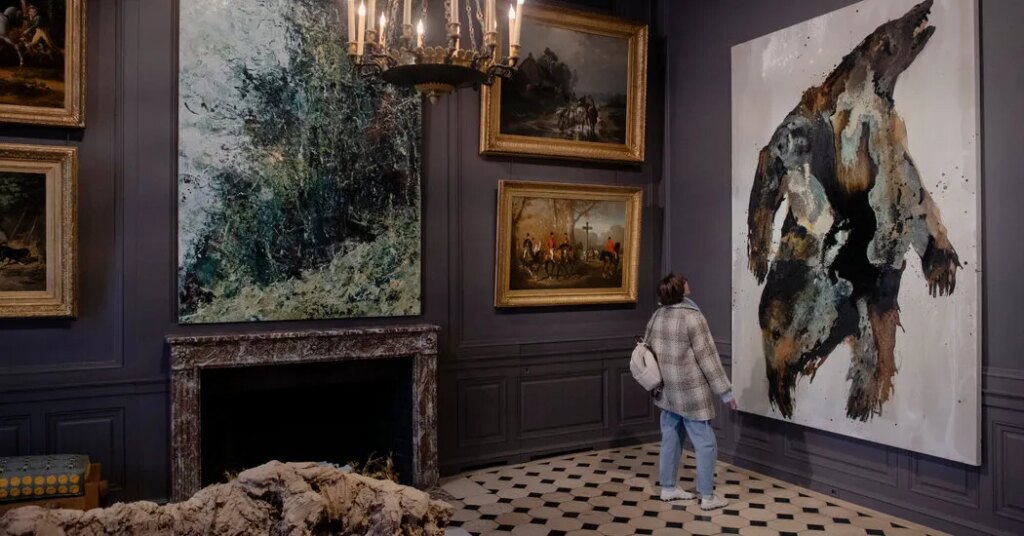
Tiptoe past the standoff between the taxidermied stag at the window and the wolf, teeth bared, before the Renaissance tapestry, and a narwhal tusk will catch your eye in a dark corner of the grand salon. Beyond it is a cupboard-size room so dark that stepping inside feels almost illicit.
Odd treasures line this room’s black shelves: a perfect ostrich egg set like a relic amid blue and red glass orbs; a 17th-century Italian powder flask; a teddy bear shoved into a gourd-shaped jar of formaldehyde, button eyes peering strangely through the yellow liquid.
The selection, inexplicable yet intentional, stirs up the uneasy thrill of having stumbled across something you might not have been meant to see — a private altar, or ingredients for some dark magic. What is someone planning to concoct with that rhinoceros horn?
This is the Musée de la Chasse et de la Nature — the Museum of Hunting and Nature — in the heart of the Marais district in Paris.
Founded in 1967 by François and Jacqueline Sommer, a married couple who were hunting enthusiasts, the small, private museum occupies two adjoining mansions, or hôtels particuliers, dating back to the 17th and 18th centuries. Though the couple never lived here, it is staged as a collector’s home, exhibiting their collection of hunting-related art and objects alongside rich Louis XV and Louis XVI furnishings and taxidermy galore.
“It’s a joyful cabinet of curiosities,” said Alice Gandin, who became the museum’s director last year. “It’s a world of the imagination, not a pedagogical museum. We play with the art and décor to create a scene; it’s a bit like theater.”
Despite its whimsy, the museum cannot avoid its central subject.
“If you take away hunting, you take away the museum,” Gandin said. The museum takes no moral stance on the practice, she said, but uses it to pose difficult questions about our relationship with animals and the natural world — “what we hunt, what we eat, what we love and what we hate.”
These questions hit hardest in the trophy room, where severed heads of animals from around the world — including some, like the kouprey, a wild ox of Cambodia, that are now most likely extinct — pack the walls above gun cabinets. Stuffed specimens like a baby elephant and Bengal tigers stalk the shelves.
Since a major expansion and redesign in 2007, the museum has regularly invited contemporary artists from around the world to intervene in the permanent collection, giving them free rein to place their own works among its objects in two or three takeover shows each year. It seeks to acquire a few from each, allowing the collection itself to evolve.
“Each time, it’s a game with the artist,” Gandin said. “They ask, ‘How can I create something here in this museum, which is already so full?’”
Lionel Sabatté is currently taking his turn with “Ce Qui Reste” or “What Remains,” on view through February. A finalist for last year’s Marcel Duchamp Prize, one of France’s most prestigious contemporary art awards, Sabatté is also presenting a bronze sculpture, “Champs d’Oiseaux (“Fields of Birds”)” in Jean Perrin Square near the Grand Palais as part of Art Basel Paris’s public art program, from Oct. 20-25.
Sabatté first exhibited at the museum in 2017 and was eager to return. “I always discover new things — an animal I haven’t seen, an element I missed,” he said. “I have the impression that it is an infinite museum.”
Visitors are greeted in the courtyard by “Mort Fertile” (“Fertile Death”), a new site-specific sculpture of a bronze stag. A counterpoint to the majestic antlered trophies upstairs, the beast is shedding its antlers, lowering its head to plant them into the ground like branches.
Sabatté said he was struck by how rarely art depicted this ordinary moment in a stag’s life. “We always want to accumulate more, and always feel losing something is a disaster,” he said. “Nature teaches us that the moment of loss can actually be one of strength.”
That idea runs through his work. He has sculpted flowers from dead skin and enormous black wolves from dust collected in the Paris Métro, making something new from what has been cast aside. He sees an unexpected kinship between artists and hunters: Both are willing to confront things others prefer to look away from, like death. Hunters must look it “squarely in the eye,” he said, while artists do so “in another way, without killing.”
Before Sabatté, the French artist Annette Messager, a past Golden Lion Award winner at the Venice Biennale, had her own run of the place.
Messager, now 82, had not realized before the show how many animal-related pieces she had created since the ’70s. Her playful, macabre works, which feature taxidermied animals, mutilated stuffed toys and disembodied limbs, fit in so well with the museum’s holdings that they were at times hard to distinguish. “You have to look, you have to search,” she said.
She removed guns from display cases and replaced them with limp fabric ones. She put a taxidermied rabbit carrying a gun beneath a 17th-century painting of a hunter and his rifle. Works were tucked in dim corners, under tables or high overhead, such as a taxidermied bird hidden in a room full of hawks despite a bright blue stuffed animal head it wore like a balaclava.
The setting was nothing like the white-cube galleries Messager was accustomed to. “This museum is very, very busy, very charged,” she said. “It’s very demanding. It makes you think differently.”
Not everyone is charmed by the new additions. On a recent afternoon, Christian Petrequin, a retired hairdresser in his 60s from Lyon, said the contemporary works had “nothing to do with this place,” which “lacked harmony.” He was not opposed to contemporary art, he said, but thought it belonged in a neutral setting.
But Olivier Delaby, an actor visiting from Caen with his 12-year-old son, Micha, delighted in the contrasts. In France, hunting and fishing carry deeply traditional associations with nobility and terroir, he said; by disrupting that world from within, the incongruous contemporary works feel political without being didactic. “I find it very punk,” he said. “There’s politics, and at the same time, there’s a lot of poetry.” (Micha had a simpler take: “I like it, and it’s a little weird.”)
Messager herself likes to leave room for mystery.
“Who knows what goes on at night when the museum is closed?” she said. “Perhaps they tell each other stories, sniff each other.”
She added: “When the humans are gone, the animals may take their revenge.”
The post A Paris Museum That’s Wild and a ‘Little Weird’ appeared first on New York Times.