It was an unlikely scene: New York’s mayor and governor appeared to be strolling through a park and gardening together in a sun-drenched suburban yard, promoting a new drug — a “political delusion pill,” they called it — to help voters overcome fears about affordability and crime.
“Side effects may include: chronic wallet shrinkage, higher tax,” a narrator intoned over plucky guitar.
Though the video captured the voices and likenesses of Mayor Zohran Mamdani and Gov. Kathy Hochul, the ad was actually an A.I.-generated fabrication. It was produced by the campaign of Bruce Blakeman, the Republican candidate for governor.
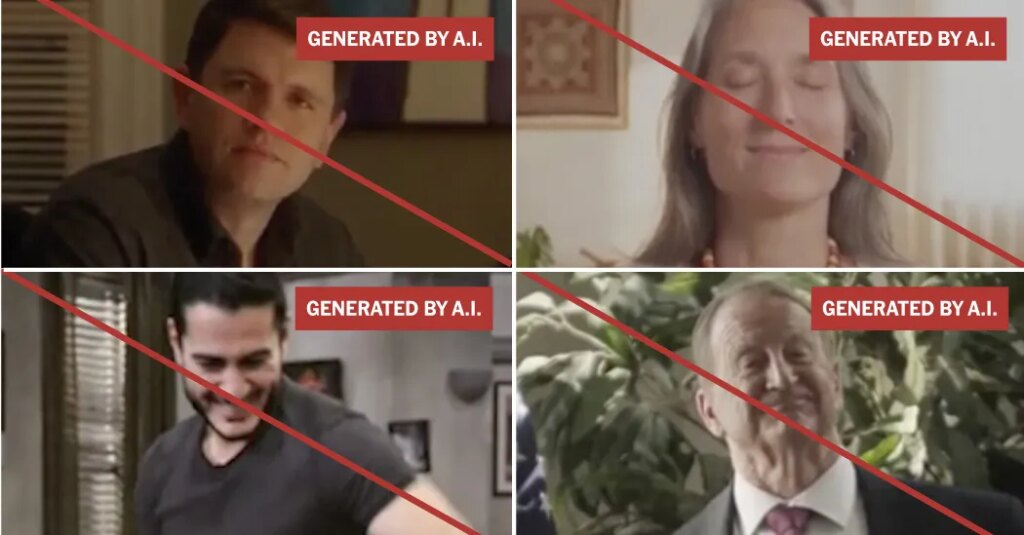
The ad, which included no disclaimer that it was A.I.-made, was one of more than 220 videos identified by the Wesleyan Media Project, a research group based at Wesleyan University, that used A.I.-generated fakery in ways large and small this midterm season — part of a wave of videos powered by artificial intelligence that have flooded the internet and television screens.
Candidates and political action groups, mostly tied to Republicans, have rushed to adopt the technology, spending more than $137 million to promote such ads this year, the researchers found.
“I think what we’re seeing with A.I. has surprised even us,” said Erika Franklin Fowler, a professor at Wesleyan University and the co-director of the Wesleyan Media Project. “A.I. can be used in so many different ways that it creates new opportunities for advertising. Some of the ways in which A.I. is used, honestly, if there wasn’t a disclaimer on the ad, it would be hard to know that A.I. was there.”
Overall, among 220 ads reviewed, researchers found that …
More than 80 percent of the ads were produced by Republican campaigns or Republican-aligned political action committees. Using A.I. has allowed them to make their opponents appear alongside polarizing figures in the Democratic Party, such as Hillary Clinton or Alexandria Ocasio-Cortez.
In one ad from Make Oklahoma Great Again, the Democratic candidate for governor was shown embracing Mrs. Clinton, cheek-to-cheek and hand-in-hand. “Clinton Lover. Trump Hater,” the on-screen text read as President Trump sulked to the side. There was no disclosure that it was A.I.-made. The group spent more than $200,000 promoting the ad on television programming in Oklahoma, according to the media tracker AdImpact.
Yet some ads have gone much further. One ad showed an A.I.-generated version of Dr. Abdul El-Sayed, the Democratic candidate for Senate in Michigan, laughing at cards that read “Death to America” and “Celebrate 9/11.” Another showed James Fishback, a Republican primary candidate for Florida governor, hosting a party with Representative Ilhan Omar and Iranian leaders who used scimitars to attack the Star of David.
Researchers at the Wesleyan Media Project suggested that Democrats may be warier of deploying A.I. than Republicans because their supporters are more critical of the technology and eager to see regulation. “Democratic candidates and groups face more reputational risk when using a tool that they are arguing should be regulated,” said Travis N. Ridout, a co-director of the Wesleyan Media Project and a professor at Washington State University.
One ad from James Talarico, the Democratic candidate for Senate in Texas, seemed to reflect that dynamic with a title that appeared onscreen reading: “Made by humans, not A.I.”
Ms. Franklin Fowler said there were likely many more A.I. ads than what researchers had found, since some videos were identifiable only because they appeared in one of the 30 states that require some kind of disclosure when deepfakes or other A.I. content is used in political ads. Only 31 percent of the ads the group reviewed disclosed that they used A.I.
“It’s the year of the A.I. election,” said Fred N. Davis III, the founder of Strategic Perception, an advertising firm based in Hollywood, and a 50-year veteran of campaign advertising. “It’s top of mind for everybody in my business and pretty much everybody in the political business.”
Mr. Davis was recently planning to produce a political ad that would have cost nearly $2 million before A.I., requiring hundreds of actors, a wardrobe department, catered meals, and a daylong shoot with tradespeople, cameras, lighting — the works.
Instead, he is planning to use A.I. to create the scene, bringing the ad’s total cost down to about $200,000.
A.I.-generated videos have quickly become an alternative to stock footage that once dominated campaign ads — video, for example, of families furrowing their brows over a stack of bills at a dining table. A.I. can create such scenes instantly and for a fraction of the cost, without viewers even noticing that anything was fabricated.
The campaign for Chip Keaton, a Republican candidate for Oklahoma governor, used A.I. in a similar way. A brief shot at the start of one campaign ad showed a still photograph of Mr. Keaton from his time as an Oklahoma state trooper — but brought to life with his head tilting upward, revealing a broad smile. Mr. Keaton’s campaign did not respond to a request for comment.
“If somebody had a tough childhood growing up, they may not have had any pictures of it, but you can recreate what being alone in a room at Christmastime was like with A.I., and that’s helpful,” Mr. Davis said. “It’s not being deceitful. It really happened.”
Some political operatives have pushed back on requirements to disclose A.I. in such cases because the labels can make the ad seem untrustworthy. “It may just be that it is an editing tool that doesn’t change the nature of the content and is not deceptive,” said Julie Sweet, the director of advocacy and industry relations at the American Association of Political Consultants, a trade group.
“Once you put the disclaimer on, it doesn’t help people distinguish between what is the ‘real stuff’ and which is the A.I.-generated stuff,” she said.
Ms. Sweet’s organization is pushing for federal regulations that would override the patchwork of state laws that require various disclosures, with the goal of labeling A.I.-generated content that is “deceptive” while offering broad protections for political speech.
Bruce Schneier, a security technologist who teaches at Harvard and the University of Toronto, said requiring labeling is just part of the solution. “The problem isn’t A.I.,” he said. “The problem is deception. And it turns out that deception is, you know, a pretty good strategy.”
Mr. Blakeman, the Republican candidate for governor in New York, has been one of the most prolific adopters of A.I.-made media, publishing a flurry of A.I.-generated attack ads this year to his social media feed — at least 22 of them since April. Only a few included a disclosure that A.I. was used or that the video was “manipulated.”
The New York State Democratic Party filed a complaint with the state’s Board of Elections in August against Mr. Blakeman’s use of A.I. in advertising, claiming that he had violated a state law requiring political communications that are “materially deceptive” to be labeled A.I.-generated. Mr. Blakeman’s campaign did not respond to requests for comment but told an ABC affiliate in September that the ad was satirical and no disclosure was required.
Misinformation watchdogs had feared that A.I.-generated impersonations of candidates, called deepfakes, and other highly misleading A.I. content would flood the midterms. Instead, researchers at the Wesleyan Media Project found, many ads used A.I. either to make simply innocuous alterations to photographs or videos or to create images too absurd to be believed.
Campaign strategists said voters may object to ads they see as fake or manipulative. Negative attack ads are already unpopular, so adding A.I. on top could create more anger among voters than support.
But Mr. Davis, the ad executive, said that voters are likely to appreciate A.I. ads if they are funny or emotional without being deceptive. He pointed to Spencer Pratt, a former Republican candidate for mayor of Los Angeles, who published reams of A.I.-generated attack ads against opponents, earning plaudits from supporters like Mr. Davis who thought the ads were funny and eye-catching.
Despite the attention, Mr. Pratt failed to build a coalition of supporters and placed third in the primary behind two Democratic candidates.
“You use the entertainment value to get attention, make them listen,” Mr. Davis said. “But then once they’re listening, you better tell them something that makes them vote for you.”
The post $137 Million in A.I.-Generated Ads Flood the Midterms appeared first on New York Times.