The sign affixed to a sandwich board outside a wine shop in tiny Boonville, Calif., was straight to the point: “Puppies inside.” Joshua Korbel, a 43-year-old sound engineer liked wine and puppies both. “And so I put the brakes on and pulled over and parked, and then walked into that tasting room,” he said.
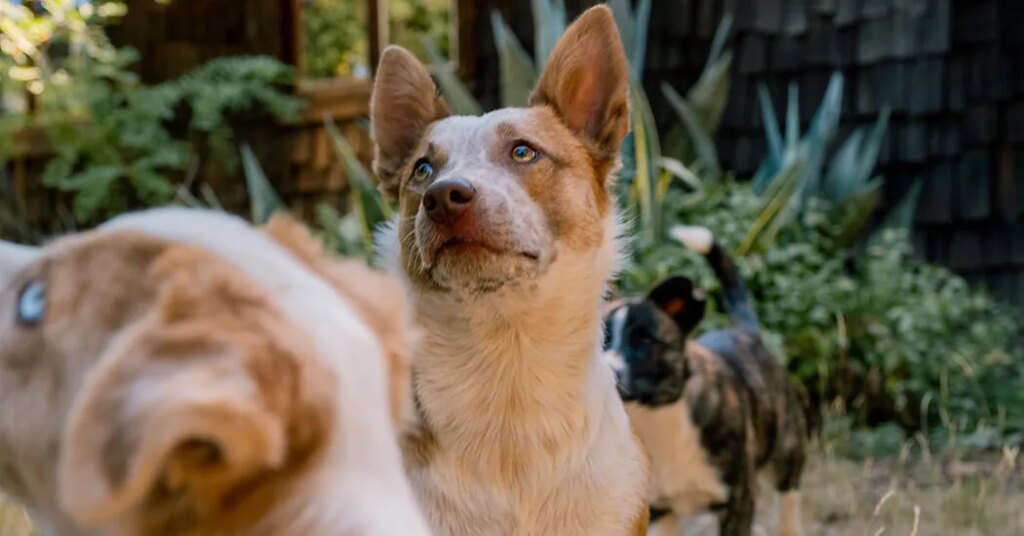
The sign hadn’t lied. More than a dozen puppies raced about the wooden floor and sprawled out on the L-shaped leather couch adjacent to the bar. They resembled short-haired Border collies, with pointed noses and floppy ears, but ranged in color from black and white to brown to an almost heather gray. They were some of the cutest dogs Korbel had ever seen.
They were fox collies, explained Andy DuVigneaud, a winemaker and the shop’s owner, as Korbel took a seat at the bar. Not a known breed — not yet, anyway, or not anymore — but DuVigneaud is out to change that. Because in this dog that arrived in California in 1885, he sees the perfect antidote for all that ails us in 2026. “Us” as in humans, that is, lonely and flailing as we are, and also our dogs, bred for work they no longer do.
The fox collie was a descendant of the McNab shepherd, a popular ranch dog with roots in the Scottish Highlands that had all but gone extinct by the middle of the 20th century. This rare pup was, under no uncertain terms, “the best dog in the world,” DuVigneaud told Korbel. The fox collie can work a ranch and run all day but can also play fetch, hang out in the passenger seat of a car for long drives and relax next to you in bed. Unlike Border collies, say, whose breeding seems to prohibit them from sitting still, fox collies are pros at the art of chill.
With his modest operation, DuVigneaud was working on repopulating the Earth with this perfect creature by breeding it back into being, and doing so, some 150 miles north of Silicon Valley, in perhaps the least technological and most old-school way possible: simply finding the dogs he likes most and mating them for more.
The Fabled McNab
DuVigneaud grew up in the Anderson Valley, a gilded, painterly region of Northern California known for its grapes, orchards and livestock ranches.
He still lives on the remote hillside where he was born in the house his father built, with his partner, nearly two dozen dogs and a few cats. DuVigneaud, 49, resembles something between a hippie and a mad scientist.
As a kid, he said, he knew lots of McNab dogs — a shepherd-collie mix popular among the area’s ranchers. This breed was created by a Scottish immigrant, Alexander McNab, who arrived in California in 1866 and found the region’s shepherd dogs so lacking, according to the Continental Kennel Club, that he later imported a pair of so-called Scotch collies from Scotland.
“Briefly worded, he is the ideal shepherd,” Lulu McNab, Alexander’s daughter, wrote of the Scotch collie in The Overland Review in 1898. The dog is prized, she added, “both in the Old World and the New, as one of the best aids money can procure.”
But not all McNabs were the same, DuVigneaud remembers. As a boy, he heard his neighbors talk about a particular strain of the McNab: dogs that tended to be smaller and shorter haired, often reddish in hue. These were not only the hardest workers but also had the most loyal and calm temperament.
DuVigneaud never forgot this lore. He had always wanted to find one of the fabled McNabs, but, having spent his 30s and 40s running a tasting room and starting a cannabis company, he spent too much time out of town. Covid isolation put a stop to that, and he, like approximately 23 million other Americans who got pets during the early pandemic years, bought a McNab named JJ. She had all the qualities of the mythic strain he had been looking for.
Smitten with JJ, DuVigneaud began to do research on the McNab.
He learned that Andrew McNab journeyed back to Scotland several more times over the years to fetch more Scotch collies, which he began breeding with Australian shepherds and Border collies. He called the mixes McNab shepherds and sold them to ranchers throughout California — back when humans and dogs both had clear-cut jobs to do.
Roughly a hundred years after McNab found his way to Northern California, the McNab was a popular breed recognized by the Continental Kennel Club. It assigns the McNab the highest scores possible for its loyalty, temperament and intelligence. (Top kennel clubs do not recognize the McNab as an official breed.) DuVigneaud is now trying to bring back the original Scotch collie, which he has rebranded the fox collie.
JJ was the key. DuVigneaud decided that JJ was the closest living analogue to the original Scotch collie that Alexander McNab first hauled over from Scotland. DuVigneaud found a neighbor with similar McNab strain and bred the two together. The fox collie was born.
Since first mating JJ in spring 2020, he has bred 16 litters of fox collie puppies, which he figured out how to do via a combination of intuition and online research (he works under the guidance and license of a breeder friend), doing extensive DNA testing to avoid debilitating genetic traits that plague many purebred dogs.
He selects which dogs to breed based on “size and temperament,” he said. Over time, word of the fox collie seems to have spread: DuVigneaud said he had received more than 400 serious inquiries about the dogs.
Korbel, who was living in the Bay Area when he first saw DuVigneaud’s sign, remained enchanted with the fox collie puppies, and made a point to visit them each time he passed through town. DuVigneaud added Korbel to his “hope list,” different from a wait list in that it’s not organized in order of appearance, and is not really a list at all. Rather, it is a collection of pastel index cards with contact information and whatever details the applicants feel pertinent about what they are looking for in a dog (Natalia, age 10: “I want a fluffy puppy. I want a dog who wants to sleep in my room”) or about their lives (Sebastian and Rowan: “We have an apartment in SF, 2 blocks from golden gate park. We’re hikers, love the outdoors, and adore our pets”).
Like the Michelin system, DuVigneaud awards particularly compelling cards one or two stars. He then divides the cards into several zip-top bags based on rank.
DuVigneaud liked Korbel: two stars. He offered him a dog just weeks after they met — almost unheard-of. The dog was the only brown one in the litter, so Korbel named her Morena — Spanish for brunette.
Korbel has no regrets. “She has been, like, the best dog ever,” he said. “Like, I cannot believe how good this puppy is.” When we spoke, she was 4 months old and he had had her for only a few weeks, but she was already fully potty-trained and could stroll with him around San Francisco almost entirely off leash. She even taught herself to do tricks on the bike track at a nearby skate park after an afternoon of people-watching.
I visited DuVigneaud’s home in August, greeted by a raucous chorus of barking — and a skitter of freaked-out cats on the roof. DuVigneaud opened the gate, and fox collies began dashing around the yard, rolling over one another and jumping into his lap. I asked him how many dogs he had. He wasn’t sure. His partner, Cory Lester, took out a utility bill and began writing down names clustered by littermates. She got to 20 before she realized that she had forgotten Sweet Potato. A few minutes later, DuVigneaud called from inside the house. “Did you get Winn-Dixie?”
“Winnieeee!” she cried. She had not. Twenty-two in all.
A Puppy With a Purpose
By most estimates, dogs as we know them have been domesticated for over 15,000 years. It used to be that humans bred dogs to do specialized tasks, like corral sheep in the meadow at sundown.
Now, explained David Howe, an anthropologist focusing on how dogs have shaped human society, we train dogs to redirect these behaviors (teaching a golden retriever to fetch a ball instead of a dead duck, say). Until very recently, “most dogs had a utilitarian working role,” Howe said. “In the modern world, we don’t need them for those roles anymore.” As a result, the dog is in most cases “a technological pet for emotional support.” In the United States, where in 2023 the surgeon general declared loneliness to be a public health concern of epidemic proportions, dogs can supplant the connections we lack from fellow humans — and give us a daily purpose.
For now, DuVigneaud is the only one breeding fox collies. With so many stray and abandoned animals in need of homes — last year, 2.8 million dogs entered U.S. shelters and rescues, according to Shelter Animals Count — DuVigneaud has his share of detractors. He rejects the criticism. “We have too many people,” he said. “Is it unethical to have kids?”
Though organizations like the American Society for the Prevention of Cruelty to Animals emphatically encourage people to pursue adoption, Jennie Lintz, a senior director for the A.S.P.C.A., acknowledged that “there are people who might want a specific kind of dog for a specific reason” and go to a breeder instead. The group’s position is that those people should find what it calls an ethical breeder — someone who tests for genetic traits, has a list of people who want puppies before the puppies are born and vets the people he sells to. DuVigneaud seems to fit the bill.
DuVigneaud is selling the dogs for $1,000 — though he maintains that he isn’t in it for the money. So why is he doing it, then? His answer has all the high-minded egotism of a would-be Silicon Valley titan. He’s doing it, he says, “to change the world.”
DuVigneaud anticipates that the slim share of the world’s herding and working dogs that are still on the job will soon be replaced by drones or other technologies. With its perfect work-play temperament and devotion to humans, the fox collie, he believes, can save purpose-bred dogs from obsolescence.
To be clear, many breeds originally created to serve have found homes by the millions, where little is expected of them beyond companionship. But unlike the fox collie, those dogs often require enormous amounts of exercise and stimulation to compensate for their lack of work.
He sees his mission as helping people, too. Humans are experiencing our own crisis of purpose with the advent of A.I., and a little unconditional love, like the kind Korbel says he has experienced in the three weeks since taking Morena home, might be just what we need.
When I visited DuVigneaud’s home in August, a forest fire was seething not far away, but was being contained; by the time we got to the tasting room, his truck, as usual, packed full of perfect dogs, we could smell the smoke. The future felt particularly bleak, but at least there were puppies.
The post The Man in Search of the Perfect Dog appeared first on New York Times.