President Trump’s low approval ratings have given Democrats a chance to win Senate races in red states like Alaska, Iowa, Texas and Kansas for the first time in a generation.
But at the same time, Democrats in blue states like Minnesota and Maine and battlegrounds like Michigan remain locked in close races where the party’s nominees could jeopardize a Senate majority if they falter in winnable contests.
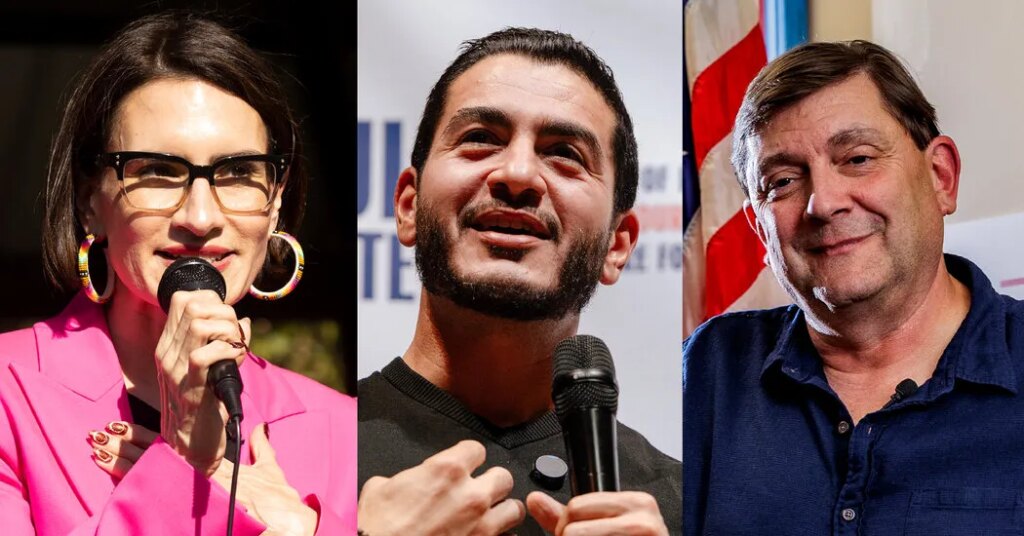
These too-close-for-comfort races for Democrats are each in states where the party, in varying ways, has created its own political headwinds. All three also feature progressive Democrats who won their nominations over the objections of party leaders who backed more moderate rivals.
“I hope they win — we want them to win,” said Matt Bennett, a co-founder of Third Way, a moderate Democratic think tank. “But they are weaker nominees than we had hoped there would be and it means we have to spend money and time, and there are all kinds of things we have to do that we would not if we had stronger nominees.”
In Michigan, Dr. Abdul El-Sayed still faces vocal resistance from some moderate and Jewish voters in his race against former Representative Mike Rogers, a Republican, after one of this year’s most hostile Democratic primaries. In Maine, Troy Jackson, who was subbed in as the Democratic nominee in July after the implosion of Graham Platner’s campaign, trailed Senator Susan Collins in the most recent New York Times/Siena University poll.
And in Minnesota, Lt. Gov. Peggy Flanagan is being dogged by the state’s major fraud scandal in her contest against Michele Tafoya, a Republican former sports broadcaster. Ms. Tafoya is trying to appeal to the political middle by running TV ads that declare herself to be “a pro-choice Republican” and feature a parade of Democrats who say they are voting for her.
“This election is coming down to this reality,” said former Gov. Tim Pawlenty, whose 2006 re-election was the last time a Republican won a statewide election in Minnesota. “Democrats want to make it a referendum on Trump, and Republicans want to make it a referendum on fraud, which happened under Democrats’ watch. It’s the ‘Trump versus fraud’ election.”
A Fraud Scandal Backlash
The Minnesota fraud scandal has dominated state politics for more than a year. It was the reason the Trump administration gave for flooding Minneapolis with immigration enforcement agents in January, which led to the killings of two people protesting their actions.
The scandal also forced Gov. Tim Walz to drop his re-election bid in January. And now, even as Democrats in other states run ads talking about high prices and their opposition to Mr. Trump, the party’s down-ballot candidates in Minnesota are talking about fraud and saying they “stood up to Tim Walz.”
This awkwardness for Democrats was evident in separate interviews this week with Ms. Flanagan and Ms. Tafoya. Ms. Flanagan, who has had a rocky relationship with Mr. Walz since his turn as the Democratic nominee for vice president in 2024, would not say whether the governor’s standing was hurting her campaign.
“People have been used to Walz-Flanagan,” she said in an interview Monday, referring to her role as Mr. Walz’s lieutenant governor. “This campaign has been about Peggy Flanagan and my name on the door. And that’s what I’ve tried to focus on.”
Ms. Tafoya said questions about how she would grade Mr. Trump’s performance in office were unfair and sought to focus back on the fraud scandal.
“You’re sounding a little bit like my opponent,” she said in an interview on Tuesday at the Minnesota State Capitol. “Trump, Trump, Trump, Trump, Trump. There are only two of us running for United States Senate, and only one of us let $9 billion walk out the door.”
Mr. Walz, for his part, said the responsibility for not stopping the fraud belonged to him and not to Ms. Flanagan.
“Look, this stuff happened,” he said in an interview at the governor’s residence in St. Paul. “We were on it early, did what we could do to stop it. It doesn’t excuse it. And that’s why I said I took full responsibility for it. I think most people know that’s not the lieutenant governor’s job.”
Democratic Nervousness
Despite the problems for Minnesota Democrats, Ms. Flanagan is still considered the favorite.
Even in a Republican-friendly year, Vice President Kamala Harris won the state in 2024 by four percentage points. And this year’s Senate race has yet to draw significant investment from either party’s top super PACs — a sign of limited Republican hopes and Democratic worries about the contest.
When asked about her lack of support from national Republicans, Ms. Tafoya laughed and said, “We will work with what we’ve got.”
Like other Republicans in electoral battlegrounds, Ms. Tafoya faces the challenge of carefully distancing herself from Mr. Trump. As Mr. Rogers in Michigan and Ms. Collins in Maine have done, she has expressed disagreements with him without criticizing him by name.
On Tuesday she called the immigration raids on Minneapolis “abysmal” and said “no president should have a blank check to wage war without the consent of Congress or the buy-in of the American people.”
Ms. Tafoya’s name recognition and moderate politics, along with the effects of the fraud scandal, have some of Ms. Flanagan’s Democratic allies nervous.
Gary Wertish, the president of the Minnesota Farmers Union, said the race was “a little closer than I would hope,” pointing to the fraud scandal fallout.
Other Democrats — especially more moderate ones — quietly worry about Ms. Flanagan’s progressive politics and lack of experience in competitive general elections. She has not been in such a race since her first contest for the Minneapolis school board in 2004.
In the Senate primary race in August, Ms. Flanagan defeated Representative Angie Craig, a moderate who had the backing of party leaders including Representatives Hakeem Jeffries of New York, the minority leader, and Gwen Walz, the governor’s wife. Senator Chuck Schumer, the minority leader, did not endorse a candidate, but his allies made clear they preferred Ms. Craig.
If she wins, Ms. Flanagan could become the first Native American woman to serve in the Senate (Mary Peltola, who is running in Alaska, could also reach that milestone). She said she hoped to emulate liberal senators like Bernie Sanders of Vermont and Elizabeth Warren and Ed Markey of Massachusetts. She has endorsed an array of progressive policies, including “Medicare for all” and said in the interview that she would seek to expand the Supreme Court to “at least 12 or 13” justices.
The winner of the Senate race will replace Senator Tina Smith, a Democrat who did not seek re-election. Public polling suggests a competitive contest, with a survey this week from The Minnesota Star Tribune showing Ms. Flanagan with a four-point lead.
Democrats must flip at least four Republican-held Senate seats to win a majority in the chamber. Losing in Minnesota would imperil the party’s hopes of doing so.
Tough Races in Maine and Michigan
As in Minnesota, polls show Democrats with comfortable leads in the governor’s races in Maine and Michigan.
But in those state’s Senate contests, where there is far more outside spending, Dr. El-Sayed and Mr. Jackson, like Ms. Flanagan, are only narrowly ahead or are tied. After winning their primaries (or, in Mr. Jackson’s case, a last-minute convention) by embracing their left-wing politics, they are now vying to win over voters in the middle.
It has not always gone well.
In Michigan, a faction of Democrats has refused to come around to Dr. El-Sayed. A group of rabbis who described themselves as loyal Democrats urged him last month to change his tone and position on Israel, of which he is a fierce critic.
Dr. El-Sayed has sought to build a new type of coalition. He has campaigned in rural, more conservative counties and is planning a bus tour this week of the state’s Upper Peninsula with Representative Alexandria Ocasio-Cortez of New York.
Yet he faces some Democratic resistance. Representative Hillary Scholten, a Michigan Democrat, has withheld an endorsement, and Representative Haley Stevens, who lost the Senate primary to Dr. El-Sayed in August, said in an interview on Wednesday that many of her constituents remained unhappy with him.
“I have a constituency group that has always supported me that is horrified,” Ms. Stevens said. “My goal here is to back the car into the garage. It’s a tossup election. It’s just straight-up a tossup election and it is going to come down to Election Day.”
The concerns about Dr. El-Sayed from fellow Democrats come after the party’s primary voters largely rejected concerns about his electability.
At the same time, Mr. Jackson emerged in Maine after a fellow progressive candidate, Mr. Platner, won the Democratic primary, only to withdraw in the wake of a rape allegation that he denied. Mr. Platner, upon leaving the race, made a public call for a like-minded candidate to replace him on the ballot.
Mr. Jackson, a former logger and longtime state legislator, had a short runway to get up to speed, is a rougher political messenger and has not been as active on the campaign trail as Mr. Platner was. And Ms. Collins has sought to use her experience and seniority in the Senate to argue that she can do more for the state than Mr. Jackson would if he replaces her in January.
Ms. Flanagan, Dr. El-Sayed and Mr. Jackson have all said they would not support Mr. Schumer for majority leader. Mr. Schumer said in an interview with The New York Times last week that he remained confident they would all prevail.
The post As Democrats Plow Into Red States, They Worry About Tight Races in Bluer Ones appeared first on New York Times.