After nearly 35 years of false starts, the Île Seguin is revving up again.
Located about 3.5 miles southwest of the Eiffel Tower in the Paris suburb of Boulogne-Billancourt, the island has had many lives. It lay on the king’s road to Versailles under Louis XIV; later it hosted leather tanneries and clay-pigeon shooting.
But for most of the 20th century, all 28 acres were home to Renault’s flagship factory.
Inspired by Ford, the factory represented a bright new future when it opened in 1929. Nationalized in 1945, the automaker produced the 4CV, nicknamed “the lump of butter” for its yellow paint, the Dauphine and the Renault 4. At its peak, it turned out a car every 90 seconds.
The Billancourt site, which included a neighboring tract known as Le Trapèze, employed 40,000 people in the ’50s and ’60s. It became a Communist-led labor bastion, a barometer of the national mood and, in May 1968, a flashpoint for worker and student protests. A famous saying went, “When Billancourt sneezes, France catches a cold.”
After floundering through the 1980s, the factory turned out its last Supercinq in 1992 and, amid bitter controversy, closed for good.
On Saturday, the site will enter a new era when Large, a center for French contemporary art, opens to the public with a huge art exhibition, “Moteur Imaginaire” (“Imaginary Engine”), featuring works from the Renault collection and that of Laurent Dumas, president of Large (through March 7).
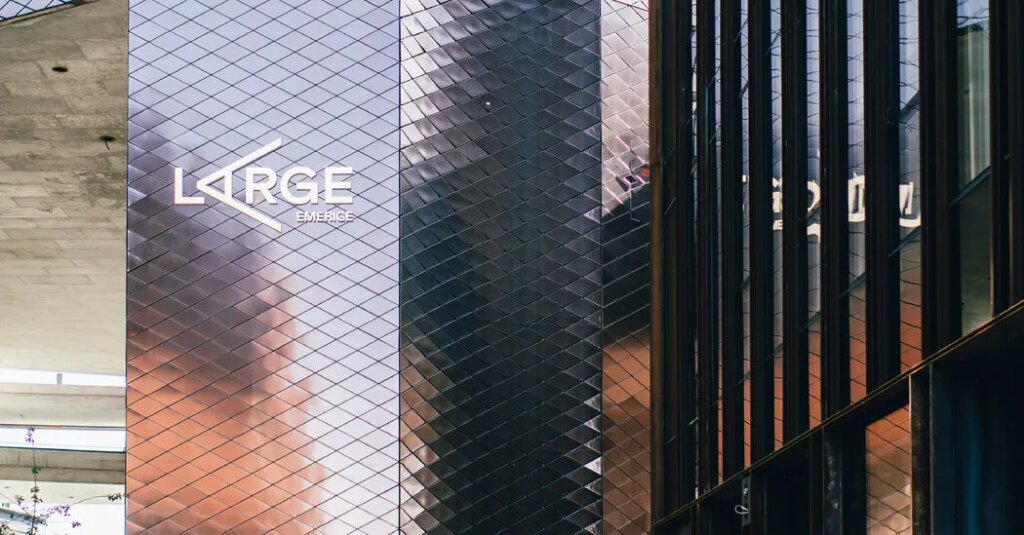
Designed by RCR Arquitectes, whose founders won the 2017 Pritzker Prize, the building has a rolling, almost organic structure, clad in a coppery, anodized aluminum finish that reflects the sky and the Seine. Inside, it was conceived to bring the outdoors in, with sweeping views of the surrounding suburbs — the densely built Boulogne-Billancourt on the right bank and leafy Meudon on the left.
For Dumas, who is also the founder and majority owner of the real estate developer Emerige, it is the culmination of an idea born three decades ago, when, he said, a curator at the Musée National d’Art Moderne told him that France lacked about 50 collectors to support the national contemporary art scene. (Most were buying internationally, rather than spending in France.) Dumas, who said he had bought his first artwork at 18, took note.
In 2016, after many years of political intrigue, administrative red tape and a high-profile effort by the luxury titan François Pinault to establish a foundation, designed by Tadao Ando, for his art collection, Dumas secured official permission to build with a plan centered on contemporary creation.
“A project like this one, on such an emblematic site, is riddled with administrative hurdles,” Dumas said in an interview at his office in the 16th Arrondissement. “We in France are something of specialists in that. But nothing is insurmountable.”
Eventually, “all the stars aligned,” he said. The cultural aspect proved key: “There will be art everywhere.”
The island had fallen derelict since the factory closed. It had even earned a reputation for being cursed. So, Dumas said, he brought in shamans, voodoo practitioners, Native American chiefs and other spiritual guides to help clear the way.
“I believe in forces of the spirit,” he said. “All of them sensed a great deal of historical suffering. But they all said, ‘You have to keep going.’”
A Return to Leisure
Large stands on the island’s eastern tip, where it anchors the Pointe des Arts, an ambitious, privately funded 450 million euro ($504 million) development built by Emerige in partnership with the investment firms Ardian Real Estate and AOG.
Along with the art center, there is an eight-screen Pathé multiplex that opened in July and includes a huge IMAX theater, and a four-star hotel and restaurant planned to open in 2027.
A decade in the making but built entirely in the past four years, Large joins La Seine Musicale, a live performance venue that opened on the island’s western point in 2017 and drew more than 500,000 visitors last year. Between the two sits a public park where more than 30 sculptures are being installed.
For Dumas, the project picks up on the island’s more distant history. “Perhaps it was time to give the place back to leisure,” he said.
Now, Île Seguin is set to become what Pierre-Christophe Baguet, the mayor of Boulogne-Billancourt, has described as the crown jewel in the “Vallée de la Culture,” a string of sites in the Hauts-de-Seine department west of the French capital. The valley includes the Manufacture de Sèvres and National Ceramics Museum, Rodin’s former home and atelier in Meudon and the Albert-Kahn museum in Boulogne-Billancourt.
Dumas, whose art collection includes some 2,000 works, said he wanted Large to feel open and unintimidating.
“In some galleries you’re almost ashamed to ask an artist’s name, because you know they’ll take you for an idiot,” he said. “There’s something elitist about it that I hate.”
About 40 percent of the center, including the lobby, mezzanine and a cafe and terrace designed by Constance Guisset, is open to the public for free. Some art is on view there, too: On the mezzanine hangs a rainbow frieze by Julio Le Parc, commissioned in the late ’60s for Renault’s cafeteria.
Paula Aisemberg, the director of Large and of artistic projects at Emerige, said she hoped the center could grow into the Paris equivalent of MoMA in New York. “Paris needed a place where it could showcase art by artists who live and work here, whether they are established or emerging,” she said.
‘My Obsession’
Almost nothing of the Renault factory survives, save three rusted doors painted by the street artist Jérôme Mesnager, currently in storage, and the 10-foot-high steel letters from its facade, set to be reinstated on the bridge that workers once crossed in the next few months.
What the automaker does have is art. But while the company began inviting artists into the factory in 1967, most of what they produced has been sleeping in warehouses for decades, said Catherine Gros, director of the Renault Foundation and president of the Renault Fund for Art and Culture. Created in 2024, the fund was established because, she said, then-chief executive Luca de Meo “didn’t want his successors to throw out the collection.”
“Putting Renault’s art collection back out into the world has been my obsession,” Gros added.
While Renault puts the finishing touches on its own museum, set to open next year in Flins-sur-Seine, about an hour from Paris, the fund’s first public showing brings 50 pieces to Large’s inaugural exhibition in the main gallery. Among the treasures — all of which have some literal or symbolic relationship to cars — are works by Victor Vasarely (who revamped the company logo in 1972), Arman and Jean Tinguely.
Curated by Cecilia Alemani, the force behind the 2022 Venice Biennale, “Moteur Imaginaire” presents 124 works from the 1930s to the present, including rarely seen loans from private collections and 17 newly commissioned artworks.
Though the automaker’s presence looms large, Alemani said she did not consider the show as necessarily being about cars.
“It’s about the idea that artists project on the object,” she said. “It’s more about what happens around it. In America, car culture is Route 66, a road trip.” As an Italian who grew up with Fiat woven into the culture around her, she said while walking through the airy exhibition space as the pieces were being set up, “cars weren’t necessarily a way of taking me to other places.” Instead, they evoked “the struggles, the factory.”
“What artists do is actually poke a finger and try to make a mess out of it,” Alemani said. “A lot of artists want to create a fracture, a friction in the perfect engine that is the car. They’re interrogating both the legacy of the mechanical tradition and asking themselves what comes next.”
The exhibition unfolds on the fourth floor, in a 10,800-square-foot space with soaring 46-foot ceilings, with a first section called “Factory of My Thoughts,” dedicated to the Renault collection.
It opens with photographs taken here nearly a century ago by a then-unknown photographer, Robert Doisneau, years before he became a household name with “The Kiss” (1950). Doisneau was hired by the automaker at the age of 22, as the factory’s roving photographer. Five years later, he was fired for showing up late. (Doisneau returned after World War II to shoot Renault ad campaigns.)
Monumental works include Jean Dubuffet’s “The Blue Wall” (1967), now shown publicly for the first time in France, as well as Tinguely’s huge kinetic sculpture “Requiem for a Dead Leaf” (1967). Other sections feature works that address themes of man, machine, identity, desire and obsolescence with humor and poignancy.
For the young women of Tehran in Shirin Aliabadi’s “Girls in Car” series, the car becomes “a sanctuary, a place of freedom,” Alemani said. A lime green Renault 12, parked on the gallery floor and packed tight and piled high with luggage — by Mohamed El Khatib, an artist, director and playwright who lives and works in Paris — tells a story of immigration.
Other pieces include a Formula 1 car that the artist Bertrand Lavier repainted for the exhibition, and a 1969 Chevrolet Impala fender set with cherry quartz, agate, citrine, malachite and other semiprecious stones to look like a rotting melon rind, by Kathleen Ryan. A Renault chassis corroded by salt, encrusted with shells and overgrown with moss is a new commission by Bianca Bondi, a finalist for the 2025 Marcel Duchamp Prize.
Though this inaugural show will occupy all the galleries, Dumas said that future exhibitions would pair thematic shows in the main gallery with more contained exhibitions in the smaller ones. Curators also will have full access to draw from Dumas’s personal collection however they like.
“I won’t have enough time to show everything I’d like to show,” he said.
Pinault, a friend of Dumas, also is represented symbolically via personal loan: “Man in a Hurry,” (2010-11) a monumental bronze and steel sculpture by the British artist Thomas Houseago, stands at the tip of the Pointe des Arts, looking toward the French capital.
The post For Contemporary Art, the Large Center Is a Big Deal appeared first on New York Times.