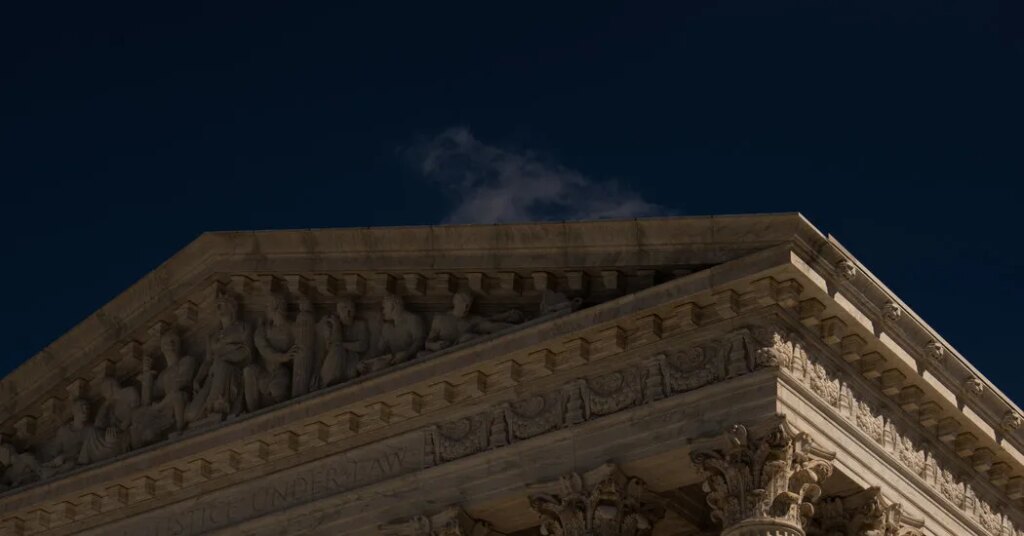
The Supreme Court on Wednesday sided with the Trump administration in a monthslong fight over who is entitled to low rates for political ads.
The emergency order, which was unsigned and did not give a vote count, marked the latest time that the justices have weighed in on an obscure but critical part of the rules surrounding political advertising and whether political parties should be able to take advantage of the same low rates as candidates.
The court’s decision was a win for Republicans ahead of the midterm elections. Democrats have typically been thought to benefit from the old rules, which limited access to lower rates for ads to political candidates. That’s because Democratic candidates have tended to raise more money than their party’s committees. The opposite is true for Republicans.
The order was likely to be only a modest boost for the G.O.P., however, given that the court had made its position clear in two previous rulings in recent months.
The court’s majority found that a lower appeals court had erred when it ordered the Federal Communications Commission to finalize its rules outlining who can benefit from low rates for political advertising. If the rule were finalized before the midterms, it would open up the possibility that Democratic candidates could potentially bring a court challenge to call the issue into question yet again.
The majority wrote that the lower court’s decision was “inappropriate under the circumstances,” adding that federal law “does not obligate the commission to act within a particular time frame.”
The justices added that “our system of separation of powers does not allow the judiciary to meddle” in the workings of another branch of government “in this manner.”
Two of the court’s liberals, Justices Sonia Sotomayor and Ketanji Brown Jackson, noted their dissent.
Last month, the justices sided with Republicans in a similar dispute, finding that, at least for now, political parties and joint fund-raising committees could benefit from the same low-cost TV ad rates as candidates have long received.
That ruling meant that both candidates and committees would benefit from the lower ad rates for the midterms.
But then a lower court sided with the Democratic candidates, ordering the F.C.C. to wrap up its formal adoption of the new rules. The appeals court had accused the F.C.C. of dragging its feet to avoid additional legal challenges ahead of the midterms.
At that point, the Trump administration filed an emergency request with the court asking the justices to once again step in.
In a court filing, Solicitor General D. John Sauer called the lower-court ruling “a flagrant abuse” of the judiciary’s power to order a federal agency to take action and “a baseless effort to circumvent a prior” decision by the justices.
Chief Justice John G. Roberts Jr., who handles emergency applications from that appeals court, quickly issued a temporary block, called an administrative stay, that stopped the lower-court ruling while the justices considered the case.
In response to the administration’s emergency application, lawyers for the Democratic candidates had accused the F.C.C. of deliberately stalling ahead of the election.
David R. Fox, a lawyer for the Democrats, framed the issue as whether a federal agency engaging in “blatant procedural trench warfare” could block courts from reviewing an “unlawful agency directive until it is too late to matter.”
The post Supreme Court Again Sides With Republicans in Political TV Ad Fight appeared first on New York Times.