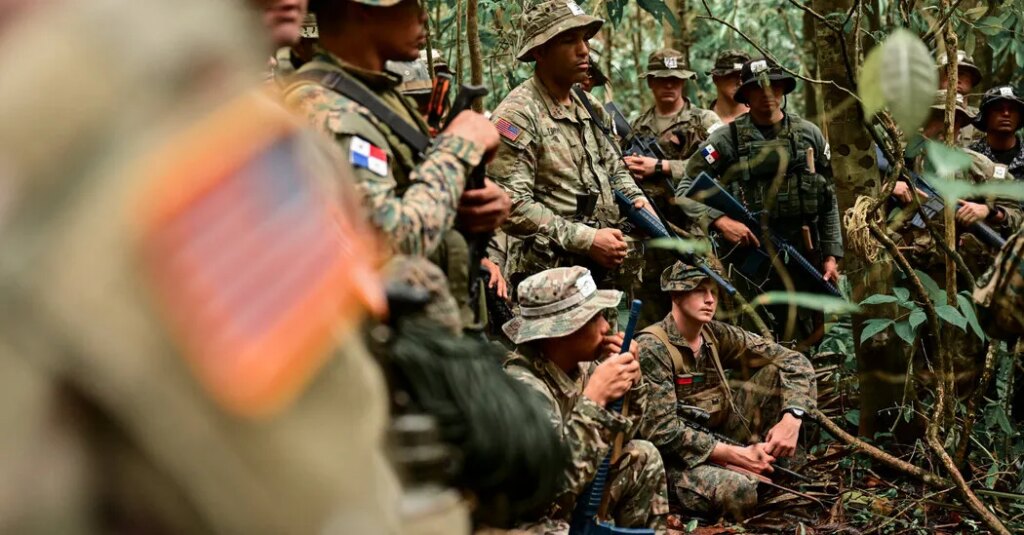
The United States is sending several hundred Army soldiers to train and conduct exercises with local forces in Latin America as the Pentagon expands its campaign to combat drug trafficking in the region, according to U.S. military officials.
The first elements of a 600-soldier battalion from the 10th Mountain Division at Fort Drum, N.Y., has begun deploying to a new jungle training facility in Panama, the officials said, speaking on the condition of anonymity to discuss operational matters.
The troops will eventually train with local forces in Colombia and Honduras, and could also support U.S. Special Operations troops advising militaries conducting raids against accused drug traffickers, the officials said.
In addition to the deployments to Central and South America, officials said that several hundred soldiers from the 10th Mountain were scheduled to help staff a new command for Western Hemisphere operations based in Miami.
Defense Secretary Pete Hegseth recently created a Pentagon office to help oversee the military’s counter-cartel activities.
The deployments and growing headquarters, which have not been previously reported, along with the Pentagon’s recent movement of several MQ-9 Reaper drones from Africa to Colombia and Ecuador, mark the latest widening of the Defense Department’s fight against drug traffickers in the region.
Adam Isacson, the director for Defense Oversight at the Washington Office on Latin America, a research group, said he could not recall any deployment of U.S. troops to the region “that ever came close to 600, except for contingencies like invasions or natural disasters.”
The moves also come as the Trump administration is urging leaders across the region to up their military offensives against trafficking groups, and to permit joint operations with the United States. The top U.S. military commander for most of Latin America, Gen. Francis L. Donovan, has said the United States plans to expand operations from strikes on boats to strikes on land.
Across Latin America, voters have recently elected leaders who have put tackling criminal groups and restoring safety at the top of their agendas. But the prospect of U.S. operations on Latin American soil has raised concerns about sovereignty, and has recalled a long and bloody history of U.S. intervention in the region.
While many Latin American countries have entered into a new U.S.-led political and military alliance to combat criminal groups, only a handful of them have officially agreed to allow joint operations inside their borders, including Colombia and Honduras. Both countries are run by newly elected presidents who were endorsed by President Trump.
Officials in Panama, Colombia and Honduras did not immediately respond to requests for comment on the U.S. plans.
Human rights groups are concerned that the growing U.S.-led military campaign could endanger civilians. And experts say that killing members of trafficking groups — even top leaders — does little to stem the flow of drugs, since those killed can be replaced.
The deployments also come at a time when the U.S. war against Iran has strained the entire military force, from fighter jets and aircraft carriers to surveillance drones and refueling aircraft. The war has also depleted the Pentagon’s global stockpile of critical munitions.
The military’s Southern Command referred questions about the new deployments to the Pentagon, which in a statement declined to comment on the moves, except to say that the department was committed to an “approach of working with capable allies and partners to deepen collaboration and maintain persistent pressure against hemispheric threat networks.”
The Trump administration has made exerting greater influence in Latin America a priority. It has built a military coalition of 19 regional partners, including the United States, that has vowed to help dismantle cartels. The group’s official slogan is: “We do bad things to bad people.”
Earlier this week, Gen. Joseph A. Ryan, who heads the Army’s Western Hemisphere Command, described the stark challenges the U.S. military faces as it returns to a region that for decades has not been its main focus. It is a part of the world where China has growing economic leverage, and where drug cartels have built sophisticated global networks to sell their illicit products, he said.
“We have ceded economic dominance in the region to an adversary, and that is a fact,” General Ryan said in remarks on Monday at the Association of the U.S. Army’s annual conference in Washington. “We are fighting now to retake terrain — maritime and land, human terrain, cognitive terrain — in many cases that we’ve given up previously.”
U.S. Southern Command has bolstered training and exercises with militaries in the region to address the most pressing threats from the cartels, General Ryan said.
The deployment of the 10th Mountain soldiers is in line with the Trump administration’s new focus, officials said. The soldiers will move first into Panama, where they will take part in jungle training exercises, officials said.
From there they will head to Colombia, where they will participate in what officials have called Southern Vanguard, an exercise scheduled to begin later this month. Other rotations will move into Honduras for training with local partners.
Some of the troops could be used to provide additional security for U.S. helicopters in the region, which have been providing support for U.S. Special Operations forces. The 10th Mountain troops could also be used to respond if the Special Operations forces, who are advising local partner militaries, get into trouble, officials said.
The rotations are temporary, but could become a more permanent feature of the U.S. military’s presence in the region.
As Mr. Hegseth has pushed for U.S. Southern Command to take a more aggressive posture in the region, some senior U.S. officials have expressed concern that he and other Trump administration leaders have not articulated a clear goal for the operation.
If armed groups strike U.S. troops, the Trump administration may feel compelled to escalate. U.S. forces, already strained by the Iran war and commitments in Europe and Asia, could be drawn more deeply into a fight in yet another part of the world without a clear plan to get out, one official said.
In August, the military’s Southern Command announced Joint Task Force Western Hemisphere, setting up the infrastructure for an expansion of its war against drugs in cooperation with regional allies.
The task force, led by Maj. Gen. Kevin J. Jarrard of the Marine Corps, builds on a yearlong Pentagon campaign in the Caribbean and Eastern Pacific, where the military has conducted 71 boat strikes that have killed at least 239 people it says, without presenting evidence, were trafficking drugs.
Experts say the strikes have had little effect on the availability of cocaine in the United States.
Legal experts have warned that the strikes are illegal, because the military cannot deliberately target civilians who are not directly participating in hostilities, even if they are breaking the law. Trafficking drugs, they say, does not rise to the standard of hostilities.
Moving the strikes inland also raises concerns about civilian casualties. The current boat strikes happen far from any coast, in mostly international waters. Strikes on land raise the possibility of accidentally hitting civilian infrastructure such as schools or roads, risking many more lives.
A Sept. 11 memo authorized an initial $20 million to pay for hiring dozens of staffers and setting up the civilian-led office that Mr. Hegseth created last month. One leading candidate to be director of the new office is Edward M. Reeder Jr., a retired two-star Army Special Forces officer, according to a person familiar with the assignment.
In the memo, Mr. Hegseth said the counter-cartel coalition would “maneuver with ruthless efficiency and speed to destroy narco-terrorists.”
Michael Crowley and Maria Abi-Habib contributed reporting.
The post U.S. Is Sending Hundreds of Troops to Latin America appeared first on New York Times.