BULLHEAD CITY, Ariz. — This city on the banks of the Colorado River had been part of Sue Berilla’s retirement dream for years. She and her husband picked out a lot, built a house and prepared to move. But before they could begin that next chapter together, he became ill and died.
Berilla moved on her own, believing she could still afford the life they had planned.
Eight years later, as President Donald Trump prepares to visit Bullhead City and make his case to voters, Berilla, 73, is no longer so sure this is the affordable retirement haven she once imagined.
She has watched the number of needy children’s names on the local Kiwanis Christmas tree grow; this year, for the first time, it will top 200. She has seen more hungry people at the senior nutrition center where she volunteers. The shelves of an adjoining food pantry empty almost as quickly as they are stocked. Even the half-loaf of rye bread she treats herself to once a week has more than doubled in price, from $2.49 two years ago to more than $5.
“Yes, it’s more affordable than other parts of the country, but you know, eventually, it’s not going to be affordable here either,” Berilla said. “Not if everything keeps going up.”
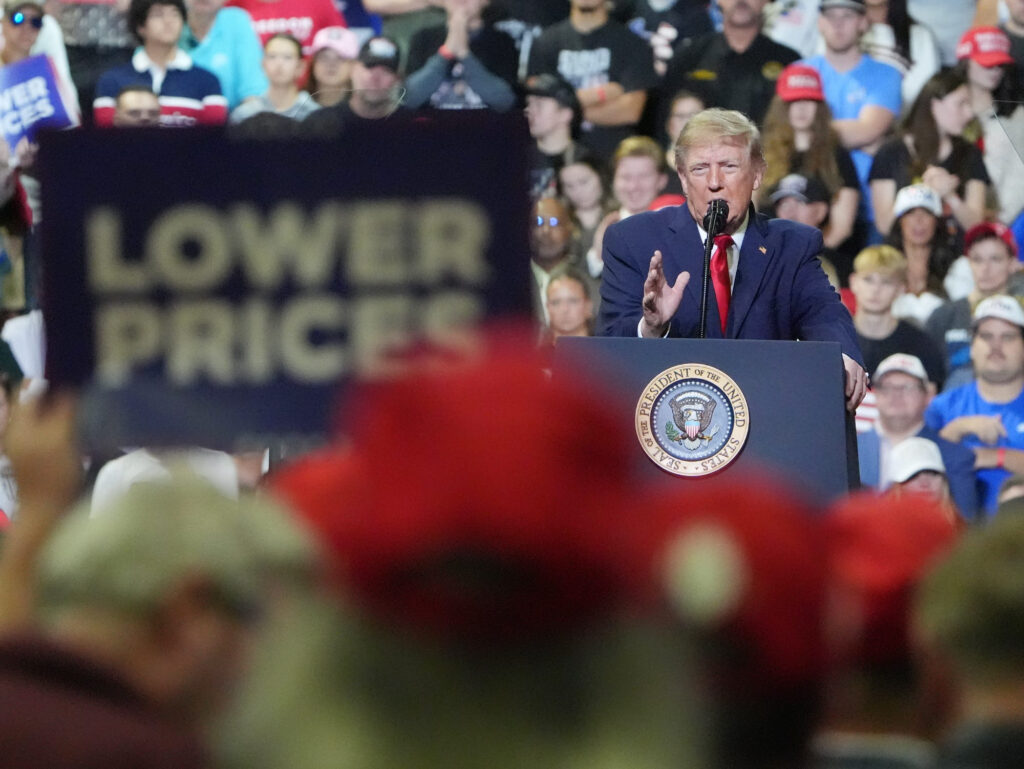
Trump arrives in this city south of Las Vegas hoping to rally voters — many of them older and conservative-leaning — behind Republicans’ effort to maintain control of Washington. In Arizona, he is backing the Republican gubernatorial nominee, Rep. Andy Biggs, a longtime ally trying to unseat Democratic Gov. Katie Hobbs.
But rising costs are testing his economic promises in this reliably Republican place, where many retirees moved hoping to stretch their savings. Hours before Trump was scheduled to touch down in Arizona, the Labor Department reported that inflation rose to a 3.7 percent annual rate in September. The increase — the final report before the midterm elections — continued a months-long upward trend.
Trump campaigned in 2024 on a promise voters could measure at the grocery store, the gas pump and in their utility bills: Prices would come down. He promised to cut energy bills in half within a year and repeatedly pledged to attack inflation beginning on his first day back in office.
But with less than a month to go before the midterm elections, many voters say their economic reality looks different. In a Reuters/Ipsos poll last week, 78 percent of Americans said Trump’s policies bore at least some responsibility for higher costs, while 57 percent of Republicans said their expenses were rising faster than their paychecks. Economists and Federal Reserve officials have pointed to the administration’s tariffs and higher energy costs stemming from the Iran war as factors putting renewed upward pressure on prices.
In Bullhead City, where roughly 1 in 3 people is 65 or older and many live on fixed incomes, those pressures show up in residents’ water bills. Last year, city officials seeking approval for higher water and sewer rates warned that tariffs were among the forces driving up the cost of maintaining Bullhead City’s aging utility system.
They specifically cited Trump’s doubling of tariffs on imported steel and aluminum and said the city was confronting higher prices for meters, construction materials and other equipment. Rates rose in January.
“We’re sensitive to the needs of low-income customers, those who served, and anyone who might find themselves in a financially challenging situation,” Assistant Bullhead City Manager Edigar Kajirwa said in a statement. “At the same time, we have faced rising inflation, high market volatility, rising project costs, materials, labor, and aging infrastructure.”
As he campaigns across the country, Trump has insisted in recent days that prices are coming down under his watch, predicting that energy costs will fall “rapidly” and blaming much of the country’s affordability problem on the inflation he inherited. He has also dismissed “affordability” as a “fake word by Democrats,” even as his administration has taken emergency steps to reduce high fuel costs. Trump has defended some increases stemming from the Iran war as a temporary price worth paying for national security.
Trump has also turned increasingly to direct financial relief as the midterms approach, sending $500 refunds to nearly 1 million Affordable Care Act enrollees and $90 payments to more than 20 million Medicare beneficiaries, the vast majority of whom are seniors. He promised an even larger payout, contingent on the election’s outcome: $5,000 for every American adult if Republicans maintain control of the House and Senate.
For the president, Bullhead City is friendly terrain to mount his economic defense. It sits in deeply Republican Mohave County, where Trump won more than 77 percent of the vote in 2024, up from nearly 75 percent four years earlier. The city itself is older than most of the country, and nearly 7 in 10 people are non-Hispanic White.
Louis Oliverio, 72, who voted for Trump all three times he ran said that he’s seen prices go up, particularly for some of the simple pleasures he enjoys, like grilling steak on a Saturday night. “It’s been a while since I bought a fillet,” he said. “People like myself, middle class, lower middle class — they just want to see prices go down.”
He said he feels Trump has “taken on too much,” particularly in foreign policy, but he said critics of the economy shouldn’t ignore Trump’s progress on other promises, such as stanching illegal border crossings.
“It’s not about MAGA. It’s about what’s best for our country, our freedom, our Constitution, our First and Second amendment,” he said.
Rising costs have sent the city’s senior services staff scrambling for donations and grants, said Kim Cool, the program manager.
A meal that used to cost $1 to provide now costs about $3, she said. And the Senior Enrichment Center has worked hard not to pass on those costs, even as the number of people who come in seeking meals has doubled in the last two years.
Berilla, who volunteers there most days, spent the day before Trump arrived serving cereal, fruit and coffee to her neighbors, who chatted about the president’s impending visit. Almost all are on fixed incomes; for some, the center provides the bulk of their daily food. She said she is worried that the president will give false hope to her most vulnerable neighbors.
“Every time it would be announced that oh, Trump is going to put $2,000 or $5,000 in everybody’s account, I got these friends that are checking their account every day, asking, ‘Where’s that money?’” Berilla said. “And I’m like, don’t count on it.”
The post In this deep-red city, rising costs test Trump’s affordability message appeared first on Washington Post.