EDWARD HOPPER: A Life, by Louis Shadwick
One of the greats of American art, Edward Hopper painted empty rooms better than anyone. He recorded a now-vanished realm of middle-class life set in Automats and all-night diners, in anonymous offices and hotels. He came of age at a time when technology promised globe-spanning miracles of human connection. But the advent of telephones and airplanes did not improve life for the people in Hopper’s paintings, who tend to stay up too late and drink too much coffee and dwell on invariably doomy thoughts.
To what do we owe his lonely-guy vision of modern America? A new biography, by Louis Shadwick, promises to provide the answer. Shadwick, an art historian who wrote his dissertation on Hopper at the Courtauld Institute of Art in London, adopts a broad social approach, arguing that the artist’s work was an expression less of idiosyncratic genius than of “the collective nationalist cultural politics” of his era, in particular of the patriotic and isolationist sentiments embraced by Americans following World War I.
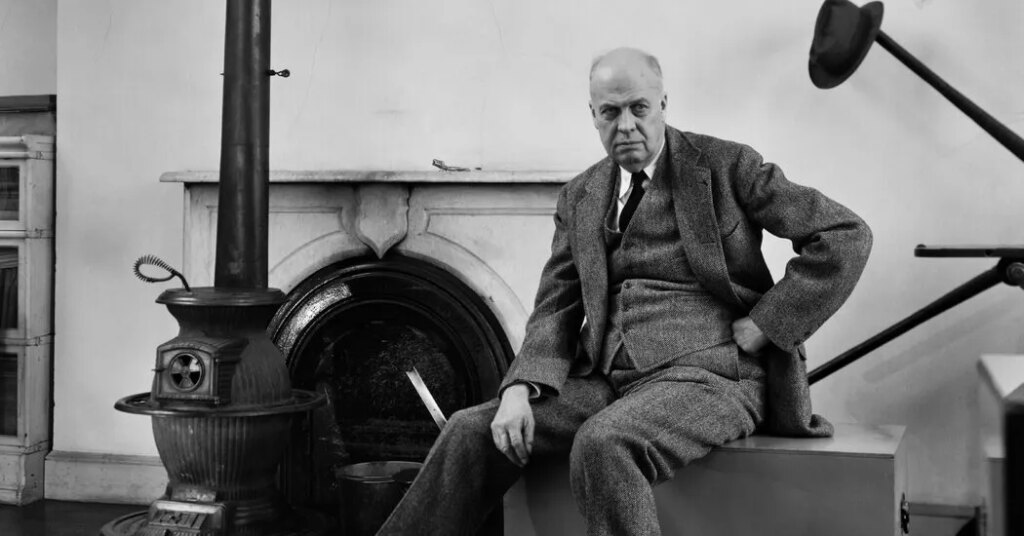
Hopper, a crotchety, well-read man who stood 6-foot-4 and, according to his wife, was “as silent as a tomb,” insisted that his work had no social or political meaning. But Shadwick brands the artist a “deeply unreliable narrator” and sets out to show how he strove to create a classically American art.
For instance, when Hopper acquired his first car — a green Dodge — in 1927, and drove with his wife from their home in Greenwich Village to a town on the Maine coast, where he painted a landscape entitled “Lighthouse Hill,” he wasn’t just taking a random trip; he was embarking on a calculated quest to link his reputation to America’s Puritan heritage. “By rooting his artistic identity in New England,” Shadwick writes, “Hopper substituted his original past for a sense of pastness that was nationally meaningful.”
The book is well researched and includes engaging asides, such as a brief history of the automat. Shadwick’s prose, however, could benefit from editing. Some of his sentences are clunkers: “Hopper’s robust lighthouses subliminally inferred the artist’s credentials via a gendered and racialized anthropomorphism: whiteness, virility and the locus of region that represented the cradle of a historic American Puritan and Anglo-Saxon identity.”
Still, Shadwick is correct to say that Hopper’s work was steeped in the iconography of the American Scene. Born in Nyack, N.Y., in 1882, the son of a dry-goods grocer, he began his career when the Ashcan School was at its apex and young artists were turning out socially enlightened, mud-toned scenes of tenements and rooftops and working-class life. Hopper studied at the New York School of Art under Robert Henri, who exhorted his students to “paint what is real to you” and spurn the idealized figures and unctuous surfaces of academic art.
Over the years, Hopper remained loyal to recognizably American subjects. Although he sojourned to France on three occasions, the people in his paintings pass the time in Manhattan diners, not Parisian cafes; they sip on nickel cups of coffee, not on cafés au lait.
The signage in his painting is also a tip-off. The Ex-Lax ad legible in a pharmacy window, or the Mobil gas sign rising above a filling station, suggests a proto-Pop preoccupation with American culture and commerce. But Hopper’s style owes an enormous debt to European masters, especially to Édouard Manet, who purged his work of detail in favor of flattened planes of color.
Alternately, you could say that Hopper’s work is inseparable from a pronounced morbidness in his temperament. The light in his paintings — whether the squinty-bright sun on Cape Cod, or the yellow electric glow in a city window — tends to be rimmed by encroaching shadows, by a sense that “nothing gold can stay,” to borrow a line from Robert Frost. Once, when I was standing in front of Hopper’s masterly interior, “Hotel Window” (1955), which depicts a dignified elderly woman with a red hat alone in a room, I gasped when I realized that a rectangular rug in the lower right looked more like a deep, steep-walled opening cut into the carpeted floor — in essence, a grave.
Shadwick’s book is the first full-dress biography of Hopper since 1995, when the scholar Gail Levin published her eye-opening “Edward Hopper: An Intimate Biography.” Since then, a trove of Hopper correspondence known as the Sanborn Hopper Archive has been acquired by the Whitney Museum, and Shadwick’s book, he writes in the introduction, “is the first to divulge the collection’s secrets.” Yet he never specifies what those secrets are, or mentions that Levin had access to at least some of the papers before they belonged to the Whitney. Moreover, his account of Hopper’s marriage to Jo Nivison, an artist herself and obsessive diarist, offers little that is new.
Nivison, a year younger than her husband, was 41 when they wed, and she expected little in the way of material comforts. For the remainder of their lives, the couple lived frugally in Greenwich Village, in a top-floor walk-up on Washington Square whose only bathroom was in an outside hall. They had no children, just a cat named Arthur. Nivison devoted herself to her husband’s career. She served as his secretary, business manager and ever-willing model, posing in guises that ranged from a slender ingénue to a burlesque stripper and a melancholy movie usherette in a blue uniform.
Even so, she saw herself as a chained creature, and their marriage fell into a pattern of mutual abuse. She described her husband as a grump and a bully unwilling to acknowledge her artistic talents. In a diary entry from 1941, she confided that she would be delighted to have him “choked or smothered or roasted until he had been forced to make some slight gesture of concern for my concerns.”
At a time when the Metropolitan Museum’s joint exhibition of Lee Krasner and Jackson Pollock is focusing attention on the plight of artists’ wives, it makes sense to think about Nivison. Are we likely to see a major exhibition called “Nivison and Hopper”? Probably not. Unlike Krasner, Nivison poured so much energy into her husband’s career that she did not have much left for her own artwork, which can feel tepid and halfhearted. But it would be nice if someone published her diaries and pointed out that she was a brilliant and witty writer.
EDWARD HOPPER: A Life | By Louis Shadwick | Yale University Press | 504 pp. | $40
The post When Edward Hopper Painted Lonely People, He Was Channeling America appeared first on New York Times.