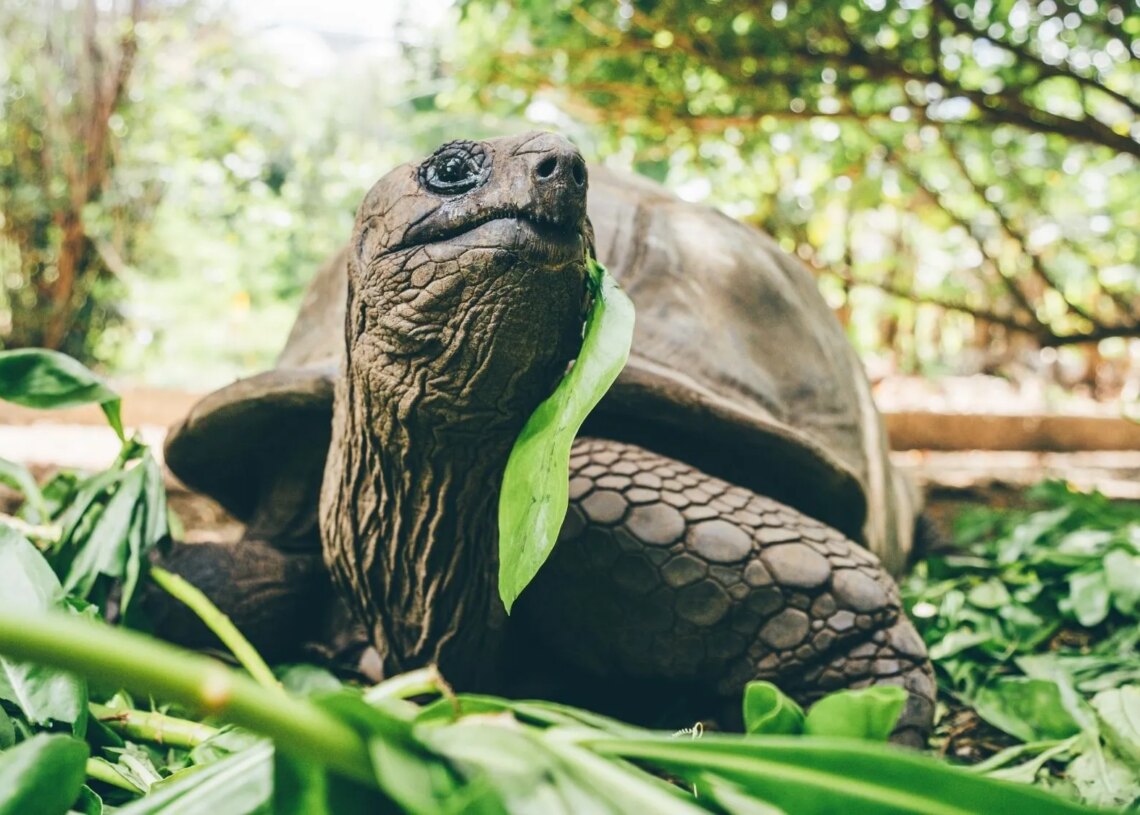
The giant tortoises of the Seychelles once dominated the landscape. And then, we came along. 15th-century human explorers hunted them for food, reducing the population to fewer than a thousand by the 19th century. Proving once again that conservation efforts work, a study published in Ecology and Evolution found that giant tortoises in the Seychelles now outnumber humans for the first time in centuries.
Who would’ve thunk decades of strict environmental protections on the Aldabra Atoll would make a difference by turning the island into a full-blown giant tortoise metropolis? Other than, of course, conservationists who logically figure that if you protect the species and let it thrive, it will. Statistical modeling estimates that the current population sits at somewhere around 180,000 free-roaming giant tortoises, blowing past the island nation’s roughly 100,000 human residents.
The giant tortoises spend their days lounging in open grasslands known as “tortoise turf,” knocking down trees to eat their leaves and spreading seeds in their poop, seeds that will probably grow into a tree one day, which their ancestors, or maybe even they themselves, will get to knock down.
Seychelles Giant Tortoises Now Outnumber Humans After Centuries of Decline
In related news, you might remember that a deeply unfunny person thought it would be funny to announce that Jonathan, the 194-year-old Aldabra giant tortoise living on St. Helena, had died. That was a hoax, thankfully, because in a study published in Science Advances, researchers recently announced that they were able to analyze cheek swabs from the living legend known as Jonathan and found that perhaps some of the keys to his extraordinarily long life are 287 gene variants linked to DNA repair and anti-inflammation that contributed to his overall cellular resilience.
Unlike us humans, whose cellular machinery breaks down and starts causing all sorts of age-related diseases, Jonathan somehow maintains the genetic control switches of a much younger animal. By studying how these living ancient creatures dodge cancer and tissue degradation, researchers hope to develop a new drug that could help humans slow cellular decline.
In other words, it’s in our best interest not just to keep giant tortoises of the Seychelles alive and well, but to keep them thriving so we can study what makes them live so long, in the hope that we can one day apply some of that knowledge to ourselves.
The post An Island Nation’s Giant Tortoises Now Outnumber Its People. Here’s Why That’s a Good Thing. appeared first on VICE.