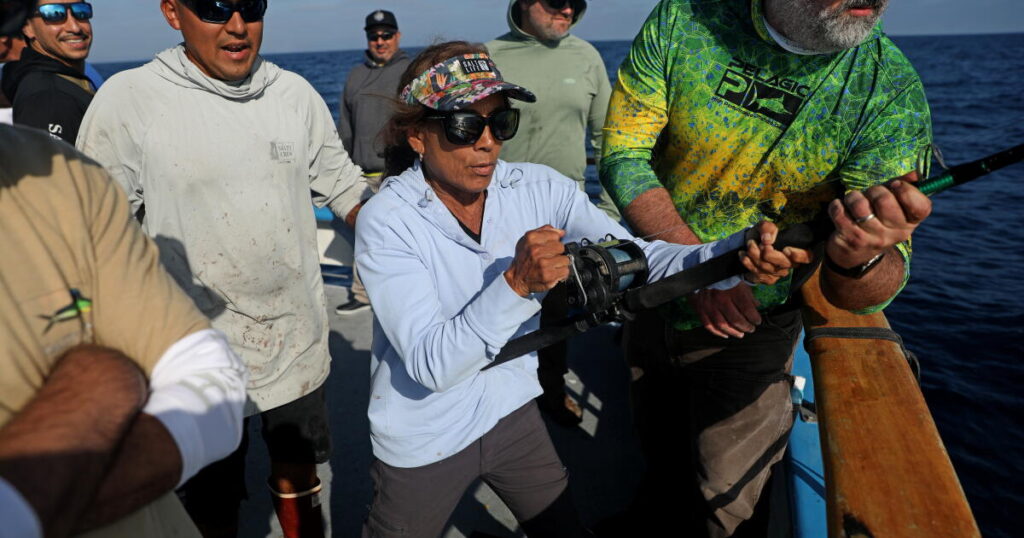
Captain Brandon Erdo steered the 95-foot Dana Pride up to a patch of water that looked promising miles off the Orange County coast on a Wednesday morning.
The boat was near capacity — 37 of 40 available angler spots were taken. And, after hearing on social media about the great fishing to be had with the super El Niño, they wanted in on the action.
“Get a little bait going here, Eric,” Erdo said over the loudspeaker, as a deckhand hopped onto a tank of anchovies, scooped them and hurled them overboard, raining tiny translucent scales onto the deck and anglers’ backs.
“First fish!” shouted veteran angler Chuck Freeman, reeling in an approximately 2-foot-long shimmering bullet tuna — his first time catching one in 47 years of fishing the Pacific.
Minutes later, he pulled in another and tossed it with the others, their tails thwapping the deck, painting it red with blood.
According to scientists, the super El Niño conditions that currently exist in the Pacific have boosted a warm blob of water that began to appear off California’s coast earlier this year.
Combined, the conditions are welcoming fish that are typically rare to these waters, like the bullet tuna, which typically swims in the Indian and Atlantic oceans or around Hawaii and the central Pacific.
In the last few months, sea creatures such as whale and hammerhead sharks, devil rays, wahoos and other fish species have been seen by beachgoers and amateur anglers from Orange County to Malibu.
“We’re seeing fish that should be in Cabo San Lucas right now,” National Oceanic and Atmospheric Administration fish biologist Owyn Snodgrass said. “The entire ecosystem has shifted.”
For recreational fish companies, the super El Niño is supercharging their business. Tuna and other sought-after species are being caught in U.S. waters by the thousands, some for the first time in two years. It has also been a historic year for marlin fishing, data show, with more of the large fish caught this year than any year since 1990.
“This is the future’s ‘Good old days,’” said Mike Conroy, president of the Sportfishing Assn. of California. “The ‘Remember when’ days.”
But the reality out at sea is much more complicated. While there is widespread agreement that there are fish off California’s coast that haven’t been seen here since the last major El Niño and marine heat wave a decade ago, for reasons scientists can’t fully explain, there’s just not as many of them being caught as last time.
The initial frenzy aboard the Dana Pride after Freeman’s success subsided quickly.
“Who wants a bullet tuna?” shouted a deckhand, dropping it in the sack of a willing angler. As it turns out, anglers said, bullet tuna don’t keep well so are not a popular catch even in their regular turf.
Erdo ordered everyone to reel their lines in so he could move on to another spot.
An uneasy quiet took over the boat as customers waited for another catch.
With his blood-spattered feet resting below a panel of monitors in the wheelhouse, the captain used binoculars to scan the water around him, looking for any sign of life that could mean fish were near.
That could be kelp, which attract small fish seeking safety, in turn attracting larger fish looking for a meal. It could also mean birds diving into the water, or simply disturbed water indicating fish at the surface.
The sonar pinged about once a second, scanning the water 500 feet in every direction for signs of life, while another machine scanned the water immediately below the boat. Early in the trip, Erdo followed a large pod of dolphins that took turns blasting out of the water, appearing to put on a performance for the boat.
“So far so good,” said Jacob Rubio, who had snagged some bullet tuna on his hook but lost them before he could reel them in. “It’s still early.”
Last year, Dana Wharf Sportfishing and Whale Watching boats, including the Dana Pride, caught only two yellowfin tuna, said owner Donna Kalez, citing data from sportfishingreport.com, a website that publishes sportfishing companies’ catches. This year, they’ve already netted more than 5,800, along with more than 150 mahi-mahi that also prefer more tropical waters.
The last time the company was catching yellowfin anywhere like this was in 2014 and 2015, when the water was again unusually warm and they caught nearly 10,000.
“Thus far, fishing for mahi-mahi, yellowfin tuna, skipjack, yellowtail and bonito has been good,” fisheries scientist Lyall Bellquist said in an email after reviewing the state’s commercial passenger fishing vessel catch data for The Times. “But we’re not yet seeing the huge spike in catch that we expected to see in association with the El Niño.”
One possible explanation could lie in the differences between the marine heat waves this year versus back then, NOAA research oceanographer Andrew Leising said.
From the fall of 2014 into the summer of 2015, a marine heat wave set itself up off the coast of California, which scientists nicknamed “the blob.” The phenomenon disrupted the food chain, sending ripples through the commercial and recreational fishing industries. El Niño conditions also sprang up in 2015 but did not produce significant rainfall.
By the end of September 2014, anglers on commercial passengers boats like the Dana Pride had caught 101,610 yellowfin tuna and 9,200 skipjack tuna off the California coast. By that point in 2015, they’d caught 88,590 yellowfin and 17,950 skipjack tuna.
This year, they had caught 10,980 yellowfin and 2,440 skipjack tuna through September. To underscore how unusual this year still is, California Department of Fish and Wildlife data show that no yellowfin tuna or skipjack tuna were caught off the California coast at all in the last two years. (The state excludes fish catch data if fewer than three boats reported catching a species.)
Bellquist said the lower catch numbers compared with the last major warm water year could be “due to a combination of reduced offshore fishing effort this year for economic reasons, and reduced yellowfin tuna availability relative to 2015 for oceanographic reasons.”
A preliminary analysis Bellquist performed on fish catch data indicates there have been 25% fewer anglers making trips on boats like the Dana Pride than in 2015. And there are “significant, fundamental oceanographic differences” between the 2014 and 2015 “blob” and the marine heat wave that’s been occurring for months this year, he said.
Erdo, the Dana Pride captain, said the talk about the El Niño hasn’t quite lived up to the reality.
“It was hyped up so much,” he said.
Even the California Department of Fish and Wildlife has noticed the gap between the hype about the fishing on social media and the reality, senior environmental scientist Elizabeth Hellmers said.
“Exaggeration is just part of being a fisherman,” Hellmers said.
By around 12:40 p.m., Erdo had found a couple of boats near a patch of floating kelp and joined them, when finally the bite was on.
Multiple anglers reeled in yellowfin tuna, which were visible through the clear water flitting back and forth near the boat. They were about 40 to 50 feet deep, the captain said, and he suggested that people drop their lures to around that depth to entice the fish to bite.
But the fish soon stopped biting, likely because they had been gorging on tuna crabs, Erdo said, a species drawn into Southern California by the warm water.
By the end of the day, the Dana Pride’s haul consisted of 120 bullet tuna, 17 yellowfin tuna, three skipjack tuna and one mahi-mahi. Freeman and his son each landed a yellowfin, while Rubio and his son came away with a handful of bullet tuna but no yellowfin.
“Not an epic day by any means,” Erdo said over the loudspeaker as the anglers got ready to get off the boat. “Keep an eye on the fish counts. I don’t think this fish is going anywhere.”
The post El Niño shifts exotic sea creatures to Southern California’s coast. Here’s what anglers are seeing appeared first on Los Angeles Times.